EEK!


EEK!

by Sharon Stevens

In memory of Ray and Pat Miller

Don’t get me wrong.

I know spiders have their rightful place in the overall balance of the universe. There’s Halloween for example, and the great outdoors, and in stories (think “Charlotte’s Web). And then there’s…well I can’t think of any other place they belong. They are one of God’s creatures, right? How did it come to pass again that they survived the rising waters to make it on board the Ark two by two? Who made that Executive decision? Or was it that they just snuck aboard under the cover of darkness to find a black place hiding in the shadows among the coveted animals.

As I said before, I know spiders have their place. But nowhere in MY book of life does it say they can inhabit my bathroom sink, especially when I have just risen sleepy eyed from a warm bed and peaceful dreams. Turning on the light and seeing thousands of legs and hundreds of pairs of eyes do not start my day off right. Okay, so there was only one, and it sported the requisite number of appendages and whatever else they sport, but in that instant it was hard to tell. I didn’t think this sight was necessarily evil, but in that split second I didn’t think sunflowers and rainbows either.

After the initial eyeball to eyeball, and the flailing that followed to get away from the monster in the bathroom, I returned with the biggest and closest weapon at hand, which happened to be my husband’s boot. But lo and behold when I returned I found she or he had disappeared in some dark recess I didn’t want to know existed. I am sure my shrieks had got their heart to pumping, and they probably ran as fast as their spindly legs could carry them away to what- ever hidey hole they could find.

As I said I know they have their place. Another example-We were spending the weekend out at Camp Kiwanis with the Girl Scout troop. Our daughter, Andrea Keller, was a member. We had the standard hobo supper cooked in the campfire followed by the requisite “S’mores”. Then we visited the latrines, and with the stars lighting our way we made our way back to our cabins. While we were gone a spider had formed an intricate web in the corner of the porch railing, and the light we had left on sparkled through the lines of its creation.

About that time Ray Miller, the camp ranger came by to check on us. Some of the girls were shrieking, and I’m sure he must have heard the commotion clear across the camp. He stood for a moment underneath and looked at our troop leader, Nancy Huntington and asked what he wanted her to do. He said he could either take the spider away to another campsite or leave her be. (How the heck do you know whether its a he or a she anyway?) The decision was up to our troop. By this time, the girls had calmed down somewhat. They knew a brave man was among their midst that would protect them against the marauders. No harm could befall them this night. Our leader said that to keep the peace he probably needed to remove the offending ugly, evil one. As he reached up to capture the arachnid, one of the girls who had screamed the loudest said to wait. The more she looked at the detail in the design of the web she could see how it shimmered in the light. Then she became intrigued, or maybe she just didn’t want to be the one responsible for having one of God’s creatures destroyed. She said that maybe it would be all right for this one spider to stay a little longer or at least until they went to bed, as long as she didn’t leave that corner. To this day I wonder, just how did she think a creature of this sort would observe boundaries?

Nonetheless, Ray went his merry way and the next morning the web was hanging in tatters and the spider was gone.

As writers, we have a true gift. We can weave a tale and follow whatever direction it leads. Halloween can be about evil and witches, or about sweet memories of trick or treating as a child. I am sure there are countless kids that remember my grandmother’s homemade popcorn balls back in the day when she could share these treats with neighborhood families.

Any time of the year, we can take a simple thought and connect it further. We can celebrate and elaborate. There are no boundaries that limit our creation or imagination. This is one of the reasons I love writing. Whatever hits your brain can become a story if you just take the time and make the effort to make it tangible from your thoughts to print or social media.

As I am completing this blog, the wind is howling outside. They predict a hard freeze and maybe even snow. But in remembering spiders my thoughts go back to a moment in summer and a memory of sunflowers.

I was photographing the brightness of these colorful summertime beauties when I witnessed a yellow spider camouflaged among the petals. I zoomed my camera, and it promptly scurried to the other side of the flower. When I moved to the other side to get a better view, it moved back around. We played this game together countless times before I tired and left this spider in peace. But I will never forget the contrast in colors, or how blue the sky, or the scent of the summer earth, or the sweet breeze causing the stalks to gently sway.

At that precise moment this spider was where he belonged and all was write with the world.

But in getting back to my original conclusion…I’m sorry. I draw the line at finding creatures in my bathroom sink. After all, a snake by any other name….

*****************************************************************************

Don’t forget two very wonderful events this coming weekend. The Friends of the Amarillo Public Library are hosting the second annual “Open Book Festival and Breakfast with the Authors” on Saturday from 9:30 a.m.-12:20. The festival is a celebration of books and reading that raises funds for Friends support of Education Services such as Adult Reading Skills tutoring and ESL Classes offered by the Amarillo Public Library. Meet local and regional authors—with more than 30 participating authors along with stories, games and activities for kids!

$15.00 per person-children 10 and under free with paying adult and going to a good cause.

At 11 a.m. New York Times Bestselling Author JODI THOMAS will be speaking-“A Funny Thing Happened on the Way to the Book Signing. Breakfast catered by the Ambassador Inn. Call 378-4245 to reserve tickets.

Also Canyon High School Choir is presenting “Sound of Music” on stage at Canyon High School.

Neither of these events have any connection to spiders unless you count Nazi’s as evil, or to count your “favorite things” that don’t make you feel so bad.
Resurrection


Outtakes 65

Resurrection

by Cait Collins

It’s almost time to take on the final edits for HOW DO YOU LIKE ME NOW? That means it is time to think about the next project. I have a short story entitled Borrowed Uncles in the works. I’m still working on my contemporary western Wildfire. But my next novel will be a resurrection of one of my under-the-bed works, MACON GEORGIA.

MACON GEORGIA is a person, not a place. Macon is part of a covert ops recon team assigned to scout an event for women in Afghanistan. I was well in to the story when the events of 9/11 derailed the piece. I shoved it in a box thinking it was beyond salvation. I opened that box before I moved and reread some of the chapters. I truly believe it is some of my best writing. The question became how do I fix it?

The thought of resurrecting an earlier work is intimidating. I want to keep the tone and suspense of the original, but bring it up to date. Technology has changed. Governments have toppled. Leaders have been assassinated. The whole make-up of the Middle East has changed. Still, I know I can make it work. In many of the countries, women have no status or freedom. I can work with that.  My characters are solid and the premise is valid. I look forward to the challenge.

While there will be bumps along the way, but I’m glad I did not toss the draft into the shredder. No story should be dismissed out of hand. I believe in maintaining a file either electronically or on paper of unfinished works. Why? There are several reasons. 1) What if you are meeting with an agent or editor and he asks, “Okay what else do you have?”  You can pitch your hidden-in-the-box novel. 2) Parts of a discarded work might be applicable for a new story. 3) Even stories that have problems can be reworked into updated and modern novels. Another reason to hang on to an old work is the writer has gained experience. The story that failed earlier may have new life because a more seasoned author has a different perspective than he had years earlier. He can envision alternatives to the original outline. He’s able to give CPR to the story. In the end, the piece rescued from the box will be better because the author has become a better writer.

My advice is to hang on to your unfinished projects. If you don’t have room to store the paper copies, scan the hand-written and printed notes into your computer. Back them up on flash drives or an external hard drive. Revisit them occasionally to ascertain if there are lines, settings, or characters that might fit into a current work. You just might find a treasure among the trash.

Comma, Comma, Comma, Comma, Comma Chameleon


Comma, Comma, Comma, Comma, Comma Chameleon

By Rory C. Keel

For me the correct place for using a comma seems as elusive as a chameleon. Hidden somewhere between subordinate clauses, independent clauses and coordinating conjunctions, the comma hangs out waiting for a slight pause.

Here are five basic rules to help in using a comma.

  1. Never place a comma between a subject and its verb or between a verb and its object.
  2. When a subordinate clause introduces an independent clause, separate the two with a comma.
  3. Don’t use a comma to separate the clauses when a subordinate clause follows an independent clause.
  4. Use a comma before the appropriate coordinating conjunction to join two related sentences.
  5. When in doubt, leave it out.

Remembering these basic rules will help you put them where they belong and leave them out where they don’t.


Steven James Keynote on Characters


Middle grade Monday 

Steven James Keynote on Characters

OWFI Session, 5 May 2012

by Natalie Bright

The keynote speaker for the Oklahoma Writers Federation Inc 2012 meeting was Steven James.  Following is a list on his observations regarding character development:

*  Your main character is a putty person. They change shape as a result of the struggle of the story, and as the story transforms, the character emerges always different

* One moment can pivot your entire book; heroes don’t back down

* Every verb you choose shows status for your character

* Raising the stakes of the antagonist also raises status of MC

* Develop characterization using internal dialogue, show sarcasm by thoughts, not words, posture, body language.

*Main Characters always have self control.

*Give your main character what he wants the most, then snatch it away.  Or,

dangle what they want the most in front of them and never let them have it.

* Main characters must interact with every sub-character; don’t waste characters. For every minor character in your book, the MC has attitude, history, intention

* Your #1 Goal as a writer:  always give the reader what he wants or something better!

Pantsin’ It


POST CARDS FROM THE MUSE

Pantsin’ It

By Nandy Ekle

I have a cast of characters. I have a situation. I have a setting. I drop my characters with their situations into their setting and say, “Okay, go.” They begin to act and speak to each other and to me and the story appears.

I am a pantser, one who writes “by the seat of my pants.” Some of my best tales are those where I put my hands on the keyboard, or pick up a pen and paper, and just start to write. I usually have an opening sentence in mind, or at least an opening situation, and a vague idea of an ending. I try not to be too attached to an ending because I know that anything can happen.

And what usually does happen is magic. The zone comes down and blots out the rest of the world and I focus one hundred percent on the character. I see her face, her home, her clothes. I hear her voice and the way she speaks her words. I see through her eyes and feel everything she feels and hears. A lot of times I am as thrilled and surprised by the story as I hope my readers are.

The advantages to this are limitless. This brings an intimacy between me and my characters and I trust them when they want to go in a different direction from my plans. Also the story is more genuine than if I planned every single detail (intricate planning feels very clinical to me). My favorite aspect of “pantsing it” is the spontaneous fun and adventure I have when I write.

I had the story planned just the way it should have gone. I knew the theme of my story and I had the events in place to bring the characters to the ending I had planned. Everything was going like clockwork. As I type I watch the characters act and speak as I knew they would. Then, suddenly, one of them—the one I thought was neutral—turns to look at me with a glint in his eye. That’s when the true ending springs to life in my head. My skin prickles with goosebumps and my eyes tear up. I cry and giggle at the same time all day long.

That is why I write as a pantser.

Congratulations. You have just received a post card from the muse.


STOP


STOP 

By Sharon Stevens

This last weekend my husband and I decided to take off for a long weekend. Even though we needed to get away, with the price of gas we knew we couldn’t go too far. So yet again we chose the same old journey that has provided refuge for our family over the years. Even though we didn’t think we would be doing much fishing we packed the tackle box and fishing gear just the same. Monument Lake Colorado here we come.

Our excitement continued to build as we got closer to our destination. The colors began to change the farther we traveled. The air was lighter, and so was our hearts. The road wound through the familiar countryside. Oh, if only our children, our families, and our friends had been with us. So many times they had come along to keep us company in years past, and filled our soul with the kind of memories that kept us warm however cold a winter’s night. Actually my husband and I were sort of lonely, with just the two of us along for the ride. How would we keep each other company over the next three days?

But after we got to the lake, and once my husband threw his line into the water it didn’t take long for us to go our separate ways. Forget any kind of relationship bonding. We both knew we needed to refresh ourselves. To each his own.

As usual while he fished, I wandered. I wondered and marveled and rejoiced to see all the beautiful creation that welcomed me. I smelled leaves, and grass. I heard birds twittering and elk calling. I felt the breeze brush my face. The last of the wildflowers and the ever green pines filled my head with the scents of autumn, the last before blizzards buried the smell till the coming spring.

And the colors! How could anyone describe the colors? There were no words for every shade of red, orange, green, yellow and every hue in between. I turned my camera this way and that and took pictures from every angle, with every light and shadow I could fathom.

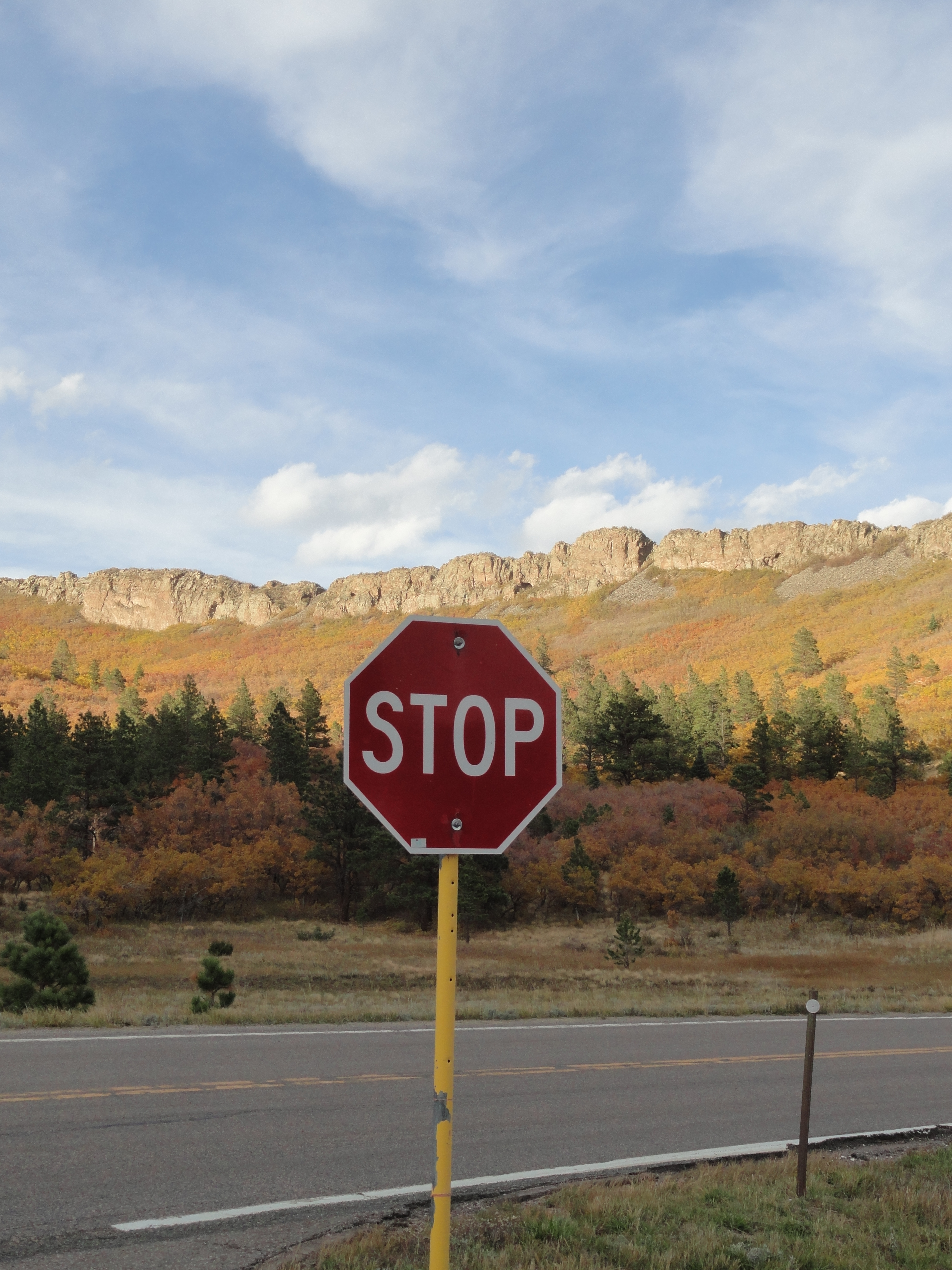
And this brings me to my thoughts as a writer. Everywhere I go I take a picture of a sign. This may be a STOP sign, or a yield sign, or a directional sign, or one advising of speed limits, or a twist or a turn. These metal fixtures are there in my camera as a constant reminder…a reminder of what?

Once they are downloaded they are in my computer forever. Later when I come across them as a slide show I can relive them again and again, in my heart and in my soul, and with every fiber of my being. I never know when these may help me to STOP for just a moment, and reflect on what I am really trying to say. Or maybe it’s my character’s way of saying not to go down that path, but to choose another. Or it could be my psyche’s way of reminding me I need to take a break for myself or my story, to stave off getting too bogged down with the nitty-gritty. Or it could be God’s way of saying to take a minute and remember HIS Creation. Every sign may have the same word, but the message may carry a different meaning.

And as a final thought, when this symbol comes across, it could be a sign that I need to get up from my laptop, go find my husband, and tell him how much I love him. If I follow the direction printed on the sign, I can remind him how much he is appreciated. With love I can thank him for taking me for a weekend getaway, driving hundreds of miles, burning expensive fuel, spending his (our) hard earned money for a night’s stay in a hotel, and blowing our food budget by eating out again and again. Even though I did let him fish, how wonderful it was that he would drive all that way just so I could STOP for the briefest of moments, and capture countless pictures of every STOP sign at every intersection.

After all, he ever so gently reminds me, each one says the same thing.

The Business Card


Outtakes 64


The Business Card

By Cait Collins

Let’s face it, business cards are a must. Can you imagine a salesman going to meet a new client and forgetting to bring his business cards? Talk about a major mistake. That little card is your signature. It represents you and your work. But what if you had a more visible signature piece?

My writer friend, Dee, received the best gift from her kids. It’s a royal blue cloth purse depicting the classic monsters: The Wolfman, The Mummy, Dracula, and Frankenstein’s monster. Strangers walk up to her and ask “Were did you get that purse?” “Why monsters?” Then she introduces herself and says, “I write horror.” The purse opened the door to promoting Dee’s work. She can go on to engage the potential reader as to his likes and dislikes, what frightens him, his go-to authors. She’s hooked a fan. If it works with fans, just think the impact that bag will have when meeting agents and editors.

Every writer has some item that sets them apart from the crowd. I have a collection of antique and contemporary lizard broaches. I wear them when shopping my novels.  The creature glittering on my shoulder creates interest and might lead to an invitation to submit the work. I began collecting the lizards after hearing the legend of the well-loved lizard becoming a dragon to protect its owner. I still wear one of the pins in situations where I feel I might need an edge. They are a conversation starter.

No matter how well written or unique the story, marketing and promotion are necessary. A prop might help a more timid author to open up and enthusiastically promote the project. I’m not suggesting a cheesy prop or outlandish get-up. Use something simple and in keeping with the setting. Accessories such as jewelry, Dee’s purse, or a rodeo belt buckle just might give you an edge. I’m certain Dee doesn’t mind folks associating her purse with her writing. And I really don’t mind an agent referring to me as the lizard lady as long as he remembers the title of my book.

I Admit It; I’m an Outliner.


I Admit It; I’m an Outliner.

By Rory C. Keel

It is generally accepted among writers that there are two categories of writers: outliners and non-outliners, otherwise known as “plotters and pantsers.”

While non-outliners, or pantsers, fly by the “seat of their pants” when writing, the plotter or outliner does just what the name implies, we make an outline.

Make an outline.

When your writing begins, make a brief outline of the story you want to create. It doesn’t need to be a formal outline with roman numerals and such, but a basic list of plot points. It can be very general or elaborately detailed, either way you know the direction you want to take your story.

Benefits of Outlining

There are several benefits in outlining.

  1. It allows you to know where you’re going.
  2. It allows you to see the balance of a story at a glance.
  3. Keeps you from chasing dead ends.
  4. Helps in determining the POV of your story.

If you are struggling with writer’s block, try outlining the rest of your story to move you forward.

Why do You Write? – Keeping the Big Picture in Sight


Middle Grade Monday

Why do You Write?

Keeping the Big Picture in Sight

By Natalie Bright

So, why do you write?

I don’t mean the reasons that we hear most people repeat: they want an agent to get a big publisher for a big book deal and a big movie deal so they’ll make major bucks and then retire to their massive beach front property. I honestly don’t believe that’s motivation enough to put oneself through the endless torture of trying to write. It’s the hardest work I’ve ever done in my life.

What about the gutt-wrenching, down in your soul reason you’ve never told anyone, ever. If everything suddenly went to ePublishing and all books were free and there was no way whatsoever that you could ever make money writing, would you still write? I’d like to think that most of you would, because you haven’t lost sight of the big picture.

The Big Picture: Story, Story, Story

Story is the reason. It’s the oldest form of human entertainment. Down through the ages, “tell me a story” has brought countless generations together. From the time we were youngsters, we remember stories that spoke to us and left their imprint in our brains or hearts. Agents, editors, publishers, book packagers, book stores, book buyers  and now the ePublishing world all gravitate around a need for quality work. It’s all about story.

Who Holds the Key

Writers are the key to this process. The successful writers I know are continuously learning and improving upon the craft, and they have a zillion ideas in their head, just not enough hours in the day.

Falling in Love with Your Work

It saddens me to meet writers who have lost sight of the big picture. They have talent, amazing ideas that I’d be thrilled to see as a book, and they are very capable, yet they’ve very much attached to their work and remain steadfast to argue and justify instead of moving forward.

I understand that you may not agree with others opinions. That’s okay. In the end, remember that it’s your work and you can write it however you want. I’ve discovered that most writers and editors and agents tend to be very generous people. They enjoy helping others reach their dreams.

When someone says “I have this story”, my first instinct is elation. I want to grab it up, I want to read your story, I want to love your work, and I want to help you make it better. People who work in publishing have never lost sight of the big picture and know that there’s always a better word or phrase. There’s always a better way to tell the tale.

So Why Be Snarky?

Here’s a thought; don’t submit your story to a critique group, editors or agents if you don’t want to know what’s wrong. Don’t waste other people’s time by asking for advice that you never have any intention of following. It’s okay to be completely and absolutely in love with your work. Treasure it, keep it safe in a beautifully padded box, but don’t make copies and don’t ask me to read it.

Honest opinions are golden in this business, so why do writers waste their creative energy fuming and fussing over opinions when they’ve solicited said opinions? Let me repeat, in the end, it’s your work and you can write it however you want.

Listen, Learn, Find the Magic

For me, once I was able to really hear the feedback without argument and move past the fear of chopping off the fish head or rewriting parts that didn’t fit, then I understood even more about the writing process.

The story will take over and empower you and you’ll know why you write.

My hope is that you’ll realize you write because you want your story to be the best that it can be, and it will entertain, teach, touch a heart, or make a life-long impression on a reader. And you’ll know when it’s ready.

In short, the big picture of this maddening process:  you write because there’s a story burning deep in the core of your being, and no one can tell it like you.

www.nataliebright.com

Clean Your Plate


POST CARDS FROM THE MUSE

Clean Your Plate

By Nandy Ekle

You sit at the table and the food server brings you a plate with several wonderful looking foods. You like the chicken, the squash, the potatoes, the salad. Your entire plate is full of food and you pick up your fork and start to eat. Then someone next to you finishes their food and their dessert is served to them. That’s when you realize you have too much food. What was a great dinner has now become a drag. So you start to stuff the food in your mouth just to get your plate clean enough for the dessert.

Writing is a little like that. You are involved in several projects that you enjoy doing.  When out of the blue, the muse comes back with a great story line. She’s got a clever beginning, an air-tight plot, and a punch-in-the-gut ending and she’s giving it all to you on a silver platter. But the tasks you normally savor have now become drudgery.

Time for concentration. You want your work to be quality, but you want it to be quick. So, the only choice you have is to buckle down and get it done. Getting all the other projects out of the way will make your actual writing experience all the more exciting.

Congratulations. You have just received a post card from the muse.