Authors Reviewing Authors


Middle Grade Mondays

Authors Reviewing Authors

by Natalie Bright

Writers write and writers read. And most successful writers I know read a lot, which brings me to the question of book reviews.

Should authors be reviewing other authors? The messages are mixed.

Some say no because if you’re going to do a book review, you need to be honest. If you have to give a bad review, why would you want to jeopardize relationships with other authors?  There are professional reviewers who can give honest, unbiased reviews of books. That is their job. The point being, do you want to write novels or post reviews?

The other side argues why wouldn’t you want to help a local author or friend? The gesture will be returned in kind, and everyone wins with the additional promotion. One author told me she only gives blurbs or reviews if she is absolutely blown away by the story and by the writing talent. Most authors post reviews for their friends and the question remains if they’ve taken the time to even read it.

Goodreads

I am beginning to rely on Goodreads more and more. It’s like a humongous book club where everyone loves stories and books, and those that don’t like a book aren’t afraid to say so. I read a lot, and I usually post reviews for stories that I absolutely love. For every book I love there are probably two or three that I couldn’t get past the first chapter, which makes me sad. Does that give me license to trash that author’s work? I don’t think so.

Now that eBooks have become an impulse buy and in my opinion, GoodReads offers varied and honest opinions to guide me in my purchases. My eReader is running over and that’s a good thing. It’s a wonderful time to be a book junky.

Subjective Opinions

The shocking realization that publishing is such a highly subjective business and people are so varied in their personal tastes came to light for me through a contest. One of my very first middle grade manuscripts was submitted to two different contests with varying results.

The first had a $50 contest fee, and came back with scathing comments. This judge did not like my characters, the setting, with the added notation that this should NEVER be in print even as a manuscript. Seriously, one entire page, single-spaced, of why and how much he detested this story. My investment to learn about story craft came back as hate mail.

How about a notation to subscribe to a market listing for magazines?  Your goal will be to actively study submission opportunities and submit X number of freelance articles during 2013.

What about your goals in social media and promotion? These are difficult to measure because the connections you make this year may not reap benefits for months, even years from now. I’ve had invitations to speak come from a contacts I made years before at a chance meeting.

You can define specific activities, for example, actively participating on twitter during the next year, setting up a Facebook fan page, or uploading your inspiration to a Pinterest page. Authors are utilizing Pinterest in unique ways and it’s loads of fun.

Dreaming Big

Add to your worksheet one “dream big” goal. List something you hope to achieve that seems totally impossible. Go ahead and put the “NYT Bestselling list” here if that’s what you want more than anything.

I’m excited to announce that my dream big goal from way back in 2010 was realized this past year in 2012: I signed with a literary agent. Don’t be shy or doubt your abilities. Dream away.

Thanks for Following our Blog

Good luck and Happy New Years, and thanks to all of you who have followed this blog, Wordsmithsix, during the past year. We really appreciate you. Sending out our best wishes that you achieve your writing goals in 2013!

www.nataliebright.com

Humorous-Holly, CO. 1980


A Pinch of Rodeo

Short stories from a rodeo cowboy, 100% true-98% funny

By Joe R. Nichols

Humorous-Holly, CO. 1980

A warped sense of humor is hilarious to some, not understood at all by most. A rodeo cowboy is considered to be odd for laughing at his buddies when their life is threatened.

Moss was an old bull. Six to eight years old would be toward the end of a bucking bull’s career (which is longer than a ranch herd sire). But this little black muley (no horns) was maybe old enough to vote. I understand, in his younger days, he was seriously mean, never missing an opportunity to mall a fallen cowboy. Apparently, seeing my buddy on his back directly in front of him revived his desire to try and kill somebody. He attacked.

My friend, Spike, bucked off at about the seven-second mark and would have won the rodeo had he lasted one more tick of the clock. Now most bull riders will tell you, if they are going to die in the arena in front of a crowd of people, they would prefer the deed done by a ferocious two thousand pound tiger striped bull with horns as long as your arms. A small pig-eyed Angus just isn’t material for ballads, folk songs, or legends. This added to Spike’s humiliation.

The two rodeo clowns (bullfighters) wore trench coats. One wore a Jed Clampett style hat and carried an umbrella, the other wore a cap with an eighteen-inch bill and had an oversized pink plastic baseball bat. They would usually end up throwing everything they had at the bulls, either trying to get the bull to spin, or distract them from the rider on the ground. This included the trench coats. There was so much debris in the arena after a bull ride, it looked like a tornado went through a trailer park. They had to hurry and gather up all their belongings before they turned the next bull out.

Moss ignored all of their props hurled at him. He had his man down and he wasn’t giving him up for no umbrella, I promise you.

Now, I’ve seen plenty of hookin’s in my time, but this went on forever. The clowns became desperate, pulling on the bull’s ears, pulling on his tail, screaming insults at him, but nothing worked. When you think about it, why would a bull trade a man on his back for one standing up that can run? Makes no sense.

Anyway, the whole time the ancient, cute, curly headed little bull mashed and scooted ole Spike around on the ground, he wasn’t really hurting him. And we all knew this. Naw, hell, Spike’s all right. He just can’t get away from him.

Well, I don’t know how many of you are familiar with the ways of a mature bull, but one thing they do a lot of is snort and beller. This is to show dominance, which they are. Just ask Spike. But the thing is, when they snort and beller, they generally excrete large amounts of snot and slobber. Moss had been snorting and bellering during the entire happening, and Spike seemed to be really absorbent. The incident was funny to me from the beginning, but I lost all composure when Spike finally crawled out from under his captor and made his way out of the arena. What was left of his shirt was completely soaked in slime from the bull’s mouth and nose. His hat, not only destroyed, seeped with the same mucus. His glasses were broke and sat crooked on the tip of his nose. He had so much white foam on his head it dripped off his ear lobes. It looked like someone rubbed a jar of mayonnaise in his hair.

I don’t know why he got so mad at me for laughing at him. He got even madder on the way home when I periodically recalled the sight of him doused in white slobber and mostly clear snot.

I reckon he ain’t got no sense of humor.

Atrayou and the Child Like Empress


POST CARDS FROM THE MUSE

Atrayou and the Child Like Empress

By Nandy Ekle

“You must contact an earthling child,” the child-like empress says.

“An earthling child? Where do I find one?” Atrayou asks.

“You can only find an earthling child beyond the boundaries of Fantasia.”

This is one of the themes of the movie, The Neverending Story, one of my favorite children’s storiess. The theme simply means that your character must reach out to the reader. And so, how do we do that? How does a character reach beyond the boundaries of the page?

One of the first things to consider is who is the earthling child you are trying to reach? If you write romance, your audience is probably female. So your main character should be female. If you write for children, your character should be a child. Your character should be identifiable with your readers. They should have a lot of things in common.

When you connect with your reader, they will follow your character through the whole story. This is the object of your writing, to get the earthling child to go on the adventure with the character.

Congratulations. You have just received a post card from the muse.

MIRACULOUS


MIRACULOUS

By Sharon Stevens
DSC02922

MIRACLE

I had heard on the news about the anniversary of E.B. White’s, “Charlotte’s Web” and read the interview in Vice Magazine centered on Bryan Garner. In the article by Jesse Pearson, Garner mentioned how much he loved this book, but also touched on another book by White which is considered a bible for writers as “Strunk & White’s, Elements of Style.”

I dropped by the Canyon Public Library to pick up a copy of this beloved book, and visited with one of the librarians. She had several copies there of the “web” and asked me to choose which one. I chose the Collector’s Edition in larger print. The illustrations by Garth Williams were vivid and striking. After I got home I opened the book, and touched each of the pages in turn, reading every word and treasuring each picture. I came across the story of when Mrs. Arable went to visit Dr. Dorian on behalf of Fern. She was so worried about her daughter spending all her time in the cellar barn with Wilbur, the pig. The mother asked if the doctor understood how there could be any writing in a spider’s web.

“Oh, no,” said Dr. Dorian. “I don’t understand it. But for that matter I don’t understand how a spider learned to spin a web in the first place. When the words appeared, everyone said they were a miracle. But nobody pointed out that the web itself is a miracle.”

Charlotte’s Web” brought up the most wonderful memories for me, and my husband, and our trip to Chicago in 2011 to the Follett Corporation. We needed to update the software for our business, the Buffalo Bookstore. We encountered so many wonderful treasures along our journey there, with each person and the life they shared. Southwest Airlines was our chariot there and back, but, every life held an open book of their family and home and community. To me THIS was truly the MIRACLE!

My blog today takes the words that Charlotte wove into her web to try to save Wilbur’s life, and connect them to everything wondrous we encountered.

HUMBLE

Bill Long, our Follett book salesman, picked us up at the airport and then took us to Maggiano’s for lunch. What a tremendous experience! Our server noticed the logo on Bill’s shirt, and mentioned she had gone to college, and bought the major bulk of her textbooks from a Follett bookstore. I explained that we were from Canyon Texas, and represented the off-campus, small local home-town business for our community, and that of our college, WTAMU.

I asked her what her degree was in and she told me that it was in business marketing, but that she had a family to support with small children, and this job worked better for her. I assured her she was using her degree every moment she served the public, and also for the business she represented. Her kindness and efficient attention to her customer’s needs meant so much to those of us she served, whether refilling our glasses or taking away our empty plates. We were travelers from miles away, petrified visiting the big city, on an adventure that would impact how WE would do future business. It only took a few moments for her to make us feel comfortable, to put us at ease. We found the same community we cherished at home, right then and there in Chicago! What a MIRACLE!

Bill then dropped us at our home for the week, the Hilton Garden Inn at Oakbrook Terrace at Drury Lane, next to the Drury Lane Theatre. Inside our room, I found in the drawer, a copy of the Bible placed there by the Gideon’s, but also of Conrad Hilton’s book, “Be My Guest” of his life building the Hilton hotel empire.

The whole time we were there I found an extension of all that community represented. Everyone worked hard to see our needs were met, but more than that, they greeted us with smiles, and truly cared that we stayed at their hotel and in their city. What a MIRACLE!

SOME PIG

Follett took us on a tour of their facilities and we got a behind-the-scene view of how our books came from the warehouse to our store and the process to make it all possible. We even got to meet the people (so many wonderful people dedicated to their passion and vision) The whole week my husband attended the training along with people from several other small colleges across the country. Carolyn Recker was one of the instructors and to this day will answer questions and help us with any concerns. We even witnessed the way trashed boxes were being recycled with turning them into packing materials to protect our books until we opened our boxes here at home in our store.

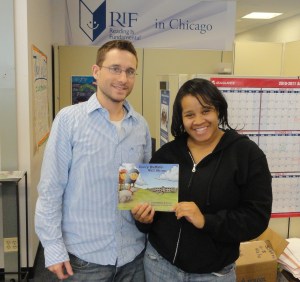
On that day while my husband was attending his final course I scouted out “RIF, Reading is Fundamental” which is housed in the same building. My daughters participated in RIF when they were in grade school and we have always cherished READING. What a true MIRACLE!!

I met the most amazing kids involved with this endeavor, as Follett is where it all began. They shared with me where their program reaches, and showed me the posters and thank you board they received from all over the country. RIF goes to ALL the schools, but also impacts the prisons, and juvenile centers. They gave me books printed down through the years that had been compiled by the students themselves filled with poetry and stories from the heart. This reminded me of Mark Williams and his North Heights students right here in Amarillo, and the books they have written and published, and the apps they did for tourism for the Amarillo Chamber of Commerce. The student-produced books “Voices of the Heights” and “Paintings on the Wall” are available for download on iBooks, iPhone, iPad and iPod Touch.

The photo above is of the two kids who were so kind in sharing their passion and that of the Follett Corporation and Higher Education. I wished I remembered where I put their names. They gave me so much more than books, so much more than from the past of the kids they represented. They centered my heart and reminded me of the MIRACLES that will always be books.

They presented me with a pocket-sized copy of Dr. Suess and I gave them a Buffalo Bookstore bag filled with Amarillo magazines, Canyon News, Jodi Thomas books, and pamphlets from around the panhandle area. But the true treasure I gave to them was a copy of “Every Buffalo Will Shine” written by Dr. Marty Kuhlman representing the 100 year history and heritage of our college, WTAMU.  I could think of no better gift to give them.

TERRIFIC

One of the most terrific experiences I treasured from this trip happened to connect closer to home. When we checked into our room I noticed the big sign advertising the performances for the Drury Theatre next to hotel. “Aida” was in the evenings, and ‘Charlotte’s Web” for the school kids. one morning after my husband left for his daily course I looked over at the theatre across the way. School buses had pulled up to the entrance and the kids were unloading. I knew what this meant! This was just like here at home when the school kids were going on a field trip to a show at the Varsity Theatre down the block, or over at the Panhandle Plains Historical Museum for a tour, or in the Sybil B. Harrington Fine Arts Theatre on campus at WTAMU for a student performance of a children’s play, or at Mary Moody Hall for a musical extravaganza. This was meant for me!

I walked right next door and asked if I could purchase a ticket for the live theatre performance. They looked at me quizzically, but didn’t question. Oh, to be in such a wondrous theatre!! Instantly I was immersed within. I listened to the kids and the parents surrounding me. After being involved in musicals and plays at Canyon schools for so many years and also our area being the home of the musical drama “TEXAS” I knew what it was to bring a performance to life. I witnessed the costumes, the sets, the music, the lights, the seats, the colors…I saw it all. I even heard the outbursts of a group of kids at the back of the theatre that must have been the special kids that had come to see the show. Since our daughter, Andrea Keller, teaches special kids I recognized what a wonderful treat this was. (She had also attended Follett’s Higher Education ISTE this past year. What an experience that was for her!)

I settled into my seat in this wonderful theatre and immersed myself from the first notes of the overture to the last bow of the cast and crew. My tears were near to the surface throughout it all but were spilled when I saw the image of the windmill projected on the backdrop of the farm. Oh, this so reminded me of home.

My blog probably sounds more like a travel log and a review for the hotels, and restaurants etc., but nothing could be any further from the truth. Think of how many books have been placed in our hands as well as our hearts that have come alive within our soul. Our imaginations have become tangible with inspiration and encouragement from books. I have no idea of the future of college textbooks or even books for that matter, but I know I will treasure the written word in any form until they are gone or I am transformed from this earth. You can’t tell me that God doesn’t have some sort of library in the Heavens above.

My 1890 Webster’s Dictionary gives the definition of a MIRACLE as, “to wonder, to marvel, to hold.” I consider each and every precious word as a true MIRACLE in itself. No one can convince me that it will ever be anything else.

“Wilbur never forgot Charlotte. Although he loved her children and grandchildren dearly, none of the new spiders ever quite took her place in his heart. She was in a class by herself. It is not often that someone comes along who is a true friend and a good writer. Charlotte was both.”

THE END

Nip/Tuck


Outtakes 76

Nip/Tuck

By Cait Collins

Editing and proofreading are not among my favorite writing tasks. First of all it’s time consuming. And there’s always that sneaky little error that escapes my computer checks and my eyes. Still the cosmetic surgery must be done in order to produce the best possible product. Each writer has his own method of editing and proofreading, but there are some basics that may help us.

1.  Develop a two-step approach. There is a difference in editing and in proofreading. Editing focuses on the style, flow, accuracy and completeness of the story, poem or novel. Proofreading emphasizes the mechanics such as grammar, spelling, and punctuation. Editing first and then proofreading could save time and duplication of effort.

2.  Check the following when editing a project.

  • Accuracy.  Are all names correct? Is the time line consistent? Does the character with blue eyes in chapter one have blue eyes in chapter 16?
  • Completeness.  Is the story finished? Have all the questions been answered? Has each character’s story line come to a satisfying conclusion?
  • Structure.  Does each chapter have an introduction? Are the paragraphs logically arranged? Does each chapter have a hook that makes the reader want to know what will happen next?
  • Clarity.  Is the story easy to follow? Is the plot complex enough to hold interest yet simple enough to be reader friendly? Are there sufficient tag lines to tell who is speaking, or are dialogue sequences cluttered with too much he said/she said? 
  • Conciseness.  Are the sentences to the point, or are they wordy and run on? Is the dialogue sharp and clean or do the characters stumble through the scene? Are descriptions sufficient to anchor the scene, or are they overdone?
  • Tone.  Is the tone appropriate to the scene? Are the characters speech patterns appropriate for age, occupation, background, and social status? Are dialects salted throughout the work, or are they over used?

3.  Distance emotions from the editing process. While writers have a relationship with their characters and story, not every scene or line of dialogue moves the plot. Be open to putting even the most favorite scenes on the chopping block if they are not needed. The goal is to create an exciting story, not justify each word.

4.  Whenever possible, take a break before starting the editing process. Trying to edit the minute after typing “The End” is not always productive. A few hours or even a couple of days may provide better prospective.

5.  Once the initial editing is complete, reread the work to make sure the edits have not created issues with the story. Correct any inconsistencies before moving forward.

6.  When the edits are complete, it’s time to proofread the project. Take a break. Proofreading is the subject of the next Outtake.

Frontiers in Writing Contest


Announcing

2013 Frontiers in Writing Contest

Now open for entries 

 For one low entry fee you can now enter multiple categories

Cash prizes for 1st, 2nd and 3rd places in EVERY category.

Go to:

www.Panhandleprowriters.org

Entry rules, procedures and format regulations are listed on the FiW Writing Contest page

Download FiW entry Application and mail along with your entry.

Entry fees can be check or Money order, or pay online using “Payments” on the PPW website.

Sponsored by the Panhandle Professional Writers

Basics to Entering a Writing Contest

 Writing contests can offer great benefits to a writer, however they can also be intimidating. To help you wade through the process, let’s look at some of the basics of entering a Writing Contest.

1. Choose the right contest – Do the research to find the best contest for your writing. Contest entry fees can vary greatly from free to extremely high. The rewards can be just as varied from a simple recognition and critique of your writing, to rewards of money prizes and publication. Beware of contests that require you to purchase the published work of your “Winning” writing. More information can be found in my article Writing Contest Benefits.

2. Choose the correct Genre – To avoid poor critiques or placement, choose the correct genre for your work. While some pieces may cross over into another classification, you will have better results if you focus your writing to one specific genre.

3. Follow Submission Guidelines – When entering a contest pay close attention to the submission guidelines. These rules may vary greatly with different organizations and contests. Be diligent to have the correct word count while using the proper page format, font, and cover page identification requirements. Don’t expect contest officials to overlook the rules just for you, it’s their contest and it’s their rules.

4. Pay attention to Postage – If you are sending an entry by mail it will require the correct postage, so does the return of your entry. Read carefully any instructions regarding postage and the return mailing requirements of your entry or prizes. If you are using metered mail, postage from a meter or computer, understand that it expires on the date stamped. If you stamp the return envelope with the current date, and the contest results are not given for several months, postage may be expired and could result in your entry not being returned.

By following these few steps, entering a writing contest can be fun and successful!

Rory C. Keel

Zombies are Among us Still?


Zombies are Among us Still?

by Natalie Bright


This is a topic that I should defer to the horror writer of our group, Nandy Ekle, but I read a zombie novel, TRUE NATURE, and it blew me away. I was surprised how much I enjoyed reading about gory, flesh-eaters.

Which got me to wondering, why is everyone so fascinated with zombies?  It seems like they’ve been around forever.

A Classic Flesh Eater

The classic Night of the Living Dead started it all in 1968, so yes, they have been around for a while. The director, George A. Romero, and co-writer John A. Russo, redefined modern horror at the cinema. This classic can be found on YouTube.  Romero went on to expand this classic into a trilogy, and returned in 2000s with three more flicks (Land of the Dead, Diary of the Dead, and Survival of the Dead).

The famous deathlike stupor, typically after death, has roots in various cultures throughout the world. Africa and Haiti repeat tales of wakening the dead, past relatives coming back, or witches that can inhabit bodies. Even as recently as 1982, a Harvard ethno botanist claimed his research in Haiti resulted in the discovery of two special powders with the ability to turn a living person into a walking-dead zombie-like state.

The zombie remains undead to legions of fans through movies and books.

eBook Debut

The author of TRUE NATURE, Jere Ellison, met with our writers critique group several years ago and I knew this novel in its infancy. I was intrigued then by the characters and writing style, and I couldn’t wait to see how it would develop into a full story. I wasn’t disappointed.

Jere kept writing and kept polishing, and thank goodness, shared this story with the world as an eBook. It’s available now on Amazon.com.

Writers who Stretch and Grow

For the New Year, I’ve decided to stretch out and consider reading genres that I normally would never spend time on; horror is one of those categories.

Writers write, and in order to have a greater appreciation for the flow and order of words, I think that it’s imperative that writers read too. Even zombies can teach us a thing or two.

The Name Game


POST CARDS FROM THE MUSE

The Name Game

By Nandy Ekle

A face materializes before your eyes. It belongs to a new character who has come to tell you their story. You see the hair and the color of their eyes; you hear their voice as you learn what they have to say. Then the time comes to name them.

Some characters come to us already named. A lot of times naming a character is easy because they have specific traits or a specific role. I like to choose names that have something to do with the story. I keep a baby name book handy and a bookmark to baby name sites that can tell me meanings of names. It just makes sense to have a depressed female character named Mara, or a very passive male character named Bob. Or a serial killer whose last name is Carver.

But sometimes a character comes to us with no particular name. This is a little more challenging. When this happens there are a few rules to help us name give our characters realistic names. To make them believable, we should take into account the story setting. Different names might indicate different regions or ethnic backgrounds. Time also makes a difference as to name trends. Clara might be an older woman and Brittney might be a younger one. Elizabeth is an older name while Sierra is a younger name.

Another thing to take into consideration is the type of character you have. A passive male character might be Bob, while a romantic male could be Collin or Mark. A cowboy could be Cody or Don and a bully might be Bruce or Oscar.

One thing to keep in mind is the rule of twist. How fun would it be to have a young child named Bertha, or an old man named Brylan. Or think of a gloomy woman named Susie and a bubbly woman named Morticia. But make sure there’s a reason for the twist or it becomes unbelievable.

And don’t forget the originality nicknames bring to a story.

Congratulations. You have just received a post card from the muse.

THE BUS


THE BUS

by Sharon Stevens

Years ago my daughter traveled with the Girl Scouts to the birthplace of Juliet Low in Savannah Georgia. Their bus was involved in an accident in Memphis Tennessee. They reported that their bus driver saw a light pole at the intersection ahead moving back and forth. In his experience he knew a wreck was occurring and reacted accordingly. He slowed and swerved till he could safely stop the bus. With his actions he was able to avoid a horrific and deadly tragedy. There were a few minor bumps and bruises among the girls and their leaders, but nothing that prevented them from continuing their journey. It could have been so much worse!

Dad used to drive the bus for the WTSU band kids and the football kids, spiriting whoever needed a ride to a school rivalry or athletic function.

My father-in-law and my husband both drove a school bus not only to get the kids safely to and from school, but they also drove the band bus, the spirit bus, the football bus, the fan bus to away games.

I remember the story my mom would tell about my grandfather. He would come home from working all day and see how tired grandmother was so he would send her downtown on the bus to window shop while he watched the kids just to let her get out of the house.

Servicemen stationed at the Amarillo Air Force Base rode the bus to get to town, to go to dances, to go to the movies, or just to see the sights.

I rode the school bus, my sister and brother rode the school bus, our daughters rode the school bus, and our neighbors rode the school bus until such time as we could afford a car to make the journey. Precious cargo!

I wonder how many college students make ends meet by driving a school bus every week, back and forth, to and from, day in and day out?

Our Canyon High School drama group traveled to Dallas one year to see Our Town performed by the Dallas Theater. A sweet memory I will carry with me forever. The Randall and Canyon High School choirs rode a charter bus to Dallas to take a flight to New York City to see the sights and perform at St. Patricks Cathedral and several other venues. One of the highlights was to sing the “Star Spangled Banner” at Shea Stadium for a Met’s game. What a journey that was.

My mom rides the bus at the Craig Retirement Center to go to the doctor, to get groceries, to eat out with other residents. The bus driver is always gracious and helpful as they get on the bus as well as when they exit.

Jodi Thomas, our local best selling author and Writer-in-Residence at WTAMU told me her dad used to drive a city bus in Amarillo.

Countless times I have watched across the street as school buses from around the panhandle as well as those from the charter bus companies unload passengers to tour the Panhandle Plains Historical Museum.

Rosa Parks and also The Freedom Riders will forever be linked. Their memories of riding a bus differ from mine.

I was reminded of all these stories when I heard that members of the TEXAS Musical Drama were traveling to The Gaylord in Dallas Texas to perform for the opening ceremonies for the American Bus Company.

What an opportunity! What an experience!

TEXAS has been named for several years as one of the top ten destinations for the bus companies. Here in the panhandle this means they visit our restaurants, our museum, our shops and our TEXAS.

But more importantly when they get back on the bus they take a little bit of our heritage and hospitality home with them.

Can you imagine the stories that are shared between the passengers after each stop? Many have some tie or connection with either our community, WTAMU or the history of our area.

I will never forget standing in line at Luby’s in Amarillo several years ago. Ahead of me in line was a group from Kentucky traveling by charter bus. One of the men stepped out of line and made his way back asking if anyone knew about the area. Always the tour guide I spoke up. He shared with me that he was working on a book and was wondering where he could do research in the area. He was scoping out places he could return to later on.

The bus had visited the museum, but this man didn’t know about the archives and their rich storehouse of information for every aspect of pioneer life from architects, ranchers, cowboys, business and writing. I told him about the Cornette Library and their special collections, and I racked my brain for all the out-of-the-way spots where he could find information.

I also pointed out that we were home to the Panhandle Professional Writers, one of the oldest continuous writing groups in the nation and that every year we sponsored the Frontier in Writing conference in conjunction with Amarillo College. He was excited to say the least! In one moment he had scored a hit just by getting off the bus.

This last year a tour bus from England stopped at the museum. Several tired of walking the halls and wandered across the street and came into our Buffalo Bookstore. One of the women visited quite a while with me and shared her story. Later I encountered this same group when I went by United and Hastings here in Canyon to run an errand. They had just been to Feldman’s for lunch and wandered over to visit the shops next door. The same lady who had talked with me for so long was excited to see me again. With a twinkle in her eye she smiled and said, “Isn’t it ever so nice to have a chat.”

And this brings me to the crux of my blog. A bus driver drives the bus. They may travel hundreds of miles from their home on their journey. They have a life, a family, a story. Who knows when they might recognize an adventure at hand or a tragedy about to unfold.

I have a great deal of respect for bus drivers. When passengers get on the bus they are putting their life in the hands of an experienced man or woman, trained to deliver them safely to their destination.

Who knows who they will bring to visit our community and what memories they will take back with them.

So many times as writers we are so focused on the story itself we can’t see all aspects surrounding the tale. We want to make our writing fit the page, the paper, our visions, our ideas and can’t bear the thought that we might have to go in an entirely different direction than what we anticipated.

If only we could gaze out the window at the scenery passing before us, by us, behind us and let the bus driver drive the bus.

He knows the way.

Sharon Stevens

Through the Looking Glass


Outtakes 75

Through the Looking Glass

By Cait Collins

How do you perceive yourself as a writer? More importantly, how do others view you? Do you come off as knowledgeable and confident, or uninformed and unsure? Are you a leader or the flip, unconcerned good-off? Do other writers look to you for advice and value your views? Or do they avoid and ignore you? How does the way you dress affect your image? Are you careless in you appearance or are you neat, properly groomed, and appropriately dressed? Do you really care? If you don’t care, you should.

The image we project as writers has great bearing on acceptance from fellow writers. You attend a workshop. The brochure indicates the dress is “business casual”, but you walk in wearing wrinkled cargo shorts, a tee-shirt sporting a cartoon or political statement, and flip-flops. The other registrants are attired in pressed slacks, skirts, shirts, blazers and polished shoes. You might stand out in the crowd, but not in a positive way. A professional workshop is not an opportunity to express your individuality. If you want to be accepted as a professional, dress the part.

Attitude is another image check. One of my pet peeves is the person who continually interrupts a speaker to insert personal viewpoints or experiences. While an exchange of ideas is valuable, the speaker is the star of the session and should be given an opportunity to present the program. A know-it-all could potentially disrupt the presentation to the point the attendees get nothing out of the session. Both the speaker and the students are frustrated. And sadly, the person who keeps talking comes off as rude and unprofessional.

It’s okay to be shy, but don’t be a wallflower. Take a deep breath, step out, and introduce yourself to others. Seek out the conference planners and offer your assistance. Remember when (never think if) you become successful, you will be required to speak or maybe do book signings. It’s better to take baby steps to becoming more confident than be unprepared later.

What about your speech? Dirty jokes, cursing, political speeches, religious orations, put downs of other attendees or speakers are inappropriate. While I believe in free speech, there are times when it’s best to check your politics and religion at the door. You do not want to lose the good will and support of the writing community due to an over-active mouth.

Writers might be viewed as eccentrics working out of attics or dingy rooms. Few may truly realize the work that goes into creating a poem or short story or novel. That’s okay as long as writers realize they are professionals. We produce an important and viable product. Writers provide a means to enlighten the world on an untold number of subjects. We should be proud of our craft and project that pride and professionalism to our community and our readers.