Hamartia


Hamartia

by Adam Huddleston


This week’s literary term is: hamartia. It is also referred to as a “tragic flaw.” A hamartia is an aspect of the protagonist which can hinder their progress or possibly bring about their downfall. This “tragic flaw” can be external, but more often than not, it is an internal characteristic. For example, hubris (ego or pride) is one of the more commonly seen problems with characters. This inflated sense of oneself may lead to unwise decisions.

One of the positive results of utilizing a character’s hamartia, is that they are more relatable. Readers like to see a hero that suffers from the same issues that they do. This can increase suspense for the reader because they may realize that the protagonist could ultimately fail due to their flaws.

Hopefully, the use of hamartia in your writing will help flesh out your characters and make the story more enjoyable. Happy writing!
Hamartia


Hamartia

by Adam Huddleston


This week’s literary term is: hamartia. It is also referred to as a “tragic flaw.” A hamartia is an aspect of the protagonist which can hinder their progress or possibly bring about their downfall. This “tragic flaw” can be external, but more often than not, it is an internal characteristic. For example, hubris (ego or pride) is one of the more commonly seen problems with characters. This inflated sense of oneself may lead to unwise decisions.

One of the positive results of utilizing a character’s hamartia, is that they are more relatable. Readers like to see a hero that suffers from the same issues that they do. This can increase suspense for the reader because they may realize that the protagonist could ultimately fail due to their flaws.

Hopefully, the use of hamartia in your writing will help flesh out your characters and make the story more enjoyable. Happy writing!
Static Character


Static Character

by Adam Huddleston

This week’s literary device is the static character. A static character is one that experiences no arc throughout the story. Their motivations and personalities remain the same from beginning to end. This is not to say that a static character is also a “flat” character. Flat characters are one dimensional. A static character can be fleshed out as much as the author wishes.

Some examples of static characters are: Scar in “The Lion King”, Draco Malfoy in the “Harry Potter” series, and Atticus Finch in “To Kill a Mockingbird”. They remain constant throughout their tales and often are employed to aid the protagonist or antagonist in their pursuits.

Hopefully, the use of static characters will help you in your craft. Happy writing!

Dialect


Dialect

by Adam Huddleston


The literary term this week is: dialect. This word is simply defined as the pronunciation, grammar, and spelling of a particular people. Dialect is one facet that separates groups of people from one another. Using dialect effectively increases the level of characterization and leads to more enjoyment by the reader.

Many authors have used regional dialects well. The first author that comes to my mind is Mark Twain. If you’ve ever read Tom Sawyer or Huckleberry Finn, you can almost feel Southern speech dripping off the page. My favorite author, Stephen King, uses speech patterns and phrases often heard in the northern New England states.

One word of advice: if you give a character a specific dialect, be cautious that it is one generally understood by your audience and not what you think it sounds like. For example, some may believe that all Southerners use the term “ain’t” or drop the “g” off of the ending of words. Many do, but don’t fall into the trap of stereotyping.

Hopefully, the proper use of dialect will flesh out your characters. Happy writing!

More Funny Pics About Writing


More Funny Pics About Writing

by Adam Huddleston

     Here are more humorous pics about writing:

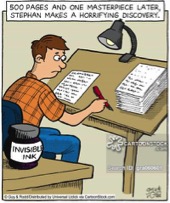
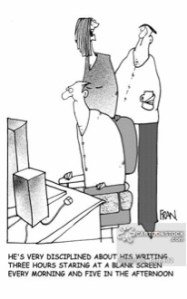
untitled untitled1 untitled3 untitled4 untitled5 untitled6

Author Intrusion


Author Intrusion

by Adam Huddleston


This week’s literary term is: author intrusion. Another similar phrase you may have heard is: breaking the fourth wall. It is a device where the author/narrator speaks directly to the reader/audience. This can be used to give the reader extra information that might be difficult or time-consuming to acquire. For example, in a stage-play, a character may step aside and speak to the viewers about what other characters in the story are thinking or doing.

Malapropism


Malapropism

by Adam Huddleston


Here’s another quick literary term to add to your repertoire: malapropism. It is defined as the use of an incorrect word (with a similar sound) for a correct one.

Why would you do this?

It can be used to show that the speaker is confused, upset, or otherwise impaired. It is important to understand that in order to be effective, the two words must be similar in sound or structure.

For example, in “Much Ado About Nothing” a character states: “Our watch, sir, have indeed comprehended two auspicious persons.” In this case, the speaker substituted comprehended for apprehended.

I hope this helps in your writing!

Alliteration


Alliteration

by Adam Huddleston


This week’s literary term concerns a device often used by poets, but not as much by novelists. Alliteration is defined as the repetitive use of words with similar sounds in quick succession. For example: George the Giant jumped over the garage. It can be very effective in children’s literature (where the reader often enjoys the sounds) or lyrical writing. Most novelists try to avoid alliteration however in that it can distract the more mature reader from the overall story.

Happy writing!

Author Intrusion


Author Intrusion

by Adam Huddleston


The literary device we will be discussing this week is: author intrusion. It is not commonly seen nowadays as it has fallen out of favor. It is defined as the practice of having the author cease telling the story and directing the prose towards the reader. This changes the perspective from first or third-person to second-person.

This technique may be used to reveal specific plot points to the reader that may otherwise be unknown to the protagonist. I personally have never used this device, but its inclusion in your writing may help change things up a bit.

Happy writing!

Malapropism


Malapropism

by Adam Huddleston


Here’s another quick literary term to add to your repertoire: malapropism. It is defined as the use of an incorrect word (with a similar sound) for a correct one.

Why would you do this?

It can be used to show that the speaker is confused, upset, or otherwise impaired. It is important to understand that in order to be effective, the two words must be similar in sound or structure.

For example, in “Much Ado About Nothing” a character states: “Our watch, sir, have indeed comprehended two auspicious persons.” In this case, the speaker substituted comprehended for apprehended.

I hope this helps in your writing!