Monday Writing Quote
“I think you will find that, if you continue to write fiction, every character you create is partly you.”
― Stephen King

Monday Writing Quote
“I think you will find that, if you continue to write fiction, every character you create is partly you.”
― Stephen King
Monday Writing Quote
“In the final exam in the Chaucer course we were asked why he used certain verbal devices, certain adjectives, why he had certain characters behave in certain ways. And I wrote, ‘I don’t think Chaucer had any idea why he did any of these things. That isn’t the way people write.’
I believe this as strongly now as I did then. Most of what is best in writing isn’t done deliberately.”
― Madeleine L’Engle, A Circle of Quiet
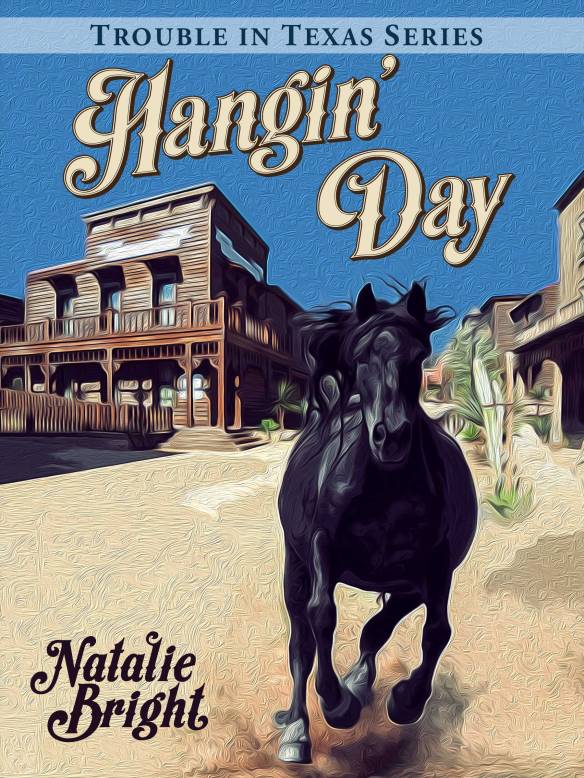
NOW IN PRINT!
HANGIN’ DAY & A Publishing Journey
As writers, you understand that when someone says, “Tell me about your book.”, it’s a complex question. Not only do our books have inexplainable parts such as themes, plots twists, and glorious characters, the finished manuscript can go on a long and complicated journey on its own.
This is true about my book HANGIN’ DAY (title number four). This story has evolved into book #1 of my new middle grade mystery-adventure series, TROUBLE IN TEXAS. This manuscript has a long history. If publishing journeys bore you, I understand that your time is precious. For you, I’ll say keep writing and keep moving forward. Don’t ask why, just write it.
If you’re interested in the story behind the story…
The main character came to me in a dream, in part because of a question from my then elementary aged son. I saw a tough, skinny young girl with dark curly hair staring at a hangman’s platform. My son was studying westward expansion at the time and had asked about lawmen and hanging criminals in the Wild West. (Dinner conversation with our boys has proved to be an invaluable source for filling up my idea journal. Need inspiration? Take a kid to dinner and put the cell phones away.)
The lawless frontier has fascinated countless generations, and sentencing outlaws to hang is a real and horrible part of U.S. history. Law abiding citizens didn’t want to wait weeks, or sometimes even months, for the lawman to pass through town, so they administered justice themselves most especially to horse thieves.
As a life-long fan of historical novels, I wanted to write a humorous tale set in frontier Texas, that would be heavy with details of the time period to address my son’s questions and with enough action to hold a kids attention. The book was written during lunch breaks over a year’s time, and after edits from my awesome WS6 group, I felt it was ready to submit to contests. The story won 2nd in a contest, and then it won a face-to-face meeting with an agent at an SCBWI Oklahoma conference. The 15 minute ‘prize’ meeting with that literary agent was invaluable. He totally got the premise and characters of my story. I worked on his suggested revisions.
The next year I approached the same agent at a conference. He didn’t remember my name, but when I mentioned the characters, he remembered my book. He asked to see the revisions I’d made. We corresponded over several months and together worked to polish it even more. One day he emailed me with a question: “what other stories are you working on?”. Within 30 minutes I had an offer for representation, and just like that I had a literary agent who was shopping my books with publishers in New York City! Working on edits with someone who has read hundreds more kid lit books than I and who knows more about story structure than I’ll ever learn in my lifetime was an unforgettable experience. His suggestions were spot on. The book was finally the best it could be and I had a new found confidence in my writing abilities.
Silver Belle was on her way! That was 2013, four years after the spark. I waited AND I kept writing Book 2 and Book 3 of this series, plus freelance and wrote a coming-of-age novel for young adults. Except my middle grade series set in the Texas frontier never found a home in traditional publishing, nor did any of my other novels that he shopped during that time. My entire body of work was sinking into a deep, dark hole.
Rejection.
In an effort to keep it real for you, I’ll share a portion of the feedback I got over the years relating to the TROUBLE IN TEXAS series.
1) An editor told me at a conference that country kids don’t read that much and that I’m wasting time writing stories about farms and ranches and the frontier. Nobody wants to read those kinds of stories any more. (Unfortunately, the historical market continues to be a hard sell in kid lit these days.)
2) The marketing department will never be able to sell this book because it has no wide appeal.
3) Would I consider making the town sheriff a werewolf?
4) An agent stated that this story is unbelievable. It would be impossible for a twelve-year-old girl to accomplish the things my character does. Obviously, this from someone unaware of the abilities and chores required of farm and ranch kids. Taking a moment to shed light on the rural lifestyle, I grew up in a small-town but spent summers on my grandparent’s farm. I drove my Pappy’s tractor in Junior High, and my kids were doctoring cows, mowing the lawn, and driving the backhoe by about the same age.
I respected and greatly appreciated those who took the time to provide critiques. I carefully considered their suggestions. One horrible day I realized that my style of story telling had no place in the mainstream world of children’s literature. I write frontier Texas, horse and buggy, and Wild West adventures. I’ve read those kinds of stories my whole life. The reality of popular culture boils down to this: how can a feisty group of mystery-solving frontier kids ever compete against world apocalypse? My target market of readers is not on a world wide scale, but selective and unique.
Even at this point, I didn’t stop writing. Would you? There are too many ideas in my head to quit now. Here I am, back to square one it seems, to sink or swim as an Indie Author. I’m tackling the publishing business in different ways, and seeking new opportunities to find readers.
It is my belief that stories choose the writer.
Stories grow wings and fly because of us and the words we write. The characters we create really do exist to breathe, laugh, cry, and have adventures. We can’t ignore them. I hope readers love this black horse named Sweet Fury and these rowdy frontier kids as much as I do. The commotion in my head will not quite down…their adventures continue, just waiting on the writer to supply the wings.
TROUBLE IN TEXAS Series ~ Historical Middle Grade Adventures
Hangin’ Day Book 1
The Great Train Caper Book 2
Murder in the Morning Book 3
Natalie Cline Bright is a blogger and author of the fun, historical western TROUBLE IN TEXAS series for middle grades, the nonfiction RESCUE ANIMAL series, and is currently working on an action-packed novel for young adults, WOLF’S WAR. Read about Natalie’s grandmother and her cherry salad recipe, recently selected for “THE WESTERN WRITERS OF AMERICA COOKBOOK: Favorite Recipes, Cooking Tips, and Writing Wisdom” (TwoDot Publishing, June 2017). Go to her website nataliebright.com for buy links.
Monday Writing Quote
“Anyone moderately familiar with the rigours of composition will not need to be told the story in detail; how he wrote and it seemed good; read and it seemed vile; corrected and tore up; cut out; put in; was in ecstasy; in despair; had his good nights and bad mornings; snatched at ideas and lost them; saw his book plain before him and it vanished; acted people’s parts as he ate; mouthed them as he walked; now cried; now laughed; vacillated between this style and that; now preferred the heroic and pompous; next the plain and simple; now the vales of Tempe; then the fields of Kent or Cornwall; and could not decide whether he was the divinest genius or the greatest fool in the world.”
― Virginia Woolf, Orlando
Monday Writing Quote
Write.
Write more.
Write even more.
Write even more than that.
Write when you don’t want to.
Write when you do.
Write when you have something to say.
Write when you don’t.
Write every day.
Keep writing.”
― Brian Clark
Monday writing Quote
“I think there are two types of writers, the architects and the gardeners.
The architects plan everything ahead of time, like an architect building a
house. They know how many rooms are going to be in the house, what kind of
roof they’re going to have, where the wires are going to run, what kind of
plumbing there’s going to be. They have the whole thing designed and
blueprinted out before they even nail the first board up. The gardeners dig
a hole, drop in a seed and water it. They kind of know what seed it is, they
know if planted a fantasy seed or mystery seed or whatever. But as the plant
comes up and they water it, they don’t know how many branches it’s going to
have, they find out as it grows. And I’m much more a gardener than an
architect.”
― George R.R. Martin
Writing Quote
Natalie Bright
“A scrupulous writer, in every sentence that he writes, will ask himself at least four questions, thus:
And he will probably ask himself two more:
—George Orwell
A Scene Defined
Natalie Bright
The scene is the unit of story, and in a book usually starts with a character arriving and ends when something has changed. A scene propels the story forward.
Does your scene play like a movie in your head?
Agents of Evil
Natalie Bright
Every great story has a villain. A character who drives your main character crazy and prevents him/her from reaching their goal.
A great novel has tension on every page, and the antagonists’ strengths are stronger than the protagonist. There’s no fun in reading a story with a stupid criminal. Ramp up the conflict, create tension in every scene.
Below is a thought-provoking list of the types of antagonists, based on my notes from a writing workshop I attended at the WTAMU Writers Academy several years ago:
Accidental Villian–fatal flaw, does not set out to be bad, bitterly regrets the act of villainy, the evil acts keep snowballing.
Examined Villian–intends to sin, plans crime carefully and meticulously, criminals always have a good reason, criminals rationalize their behavior because what they do makes perfect sense to them.
Surprise Villian– introduced sympathetically and later it is revealed that this person is evil.
Over the Top Villian — untextured bad guy, not realistic as found in the form of comic book characters, their sole purpose is to make things difficult for the good guys, quircky, different, extreme.
Mundane Criminal — not larger than life, but wrong for their own advantage.
Now go write a character profile about a very bad person for your next story.
Cardboard Characters
Natalie Bright
One of the most difficult tasks for a writer is to create fictional characters that seem real and believable to the reader. I love books in which characters seem to jump off the page and ones that remains in my head long after the book is closed.
Much Like Cardboard
Are your characters more like cardboard; stiff, emotionless, without personality? They have names and faces, but they are just on the surface of your story and nothing more. The solution: dig deeper into your character’s motivation.
As an author, you must torture your characters. It is impossible to reveal deep character feelings and personalities without applying deep, intense pressure. The ways in which they react to that pressue reveals their temperament and psyche.
Using Character Profiles
Complete character profiles on both your protagonist and your antagonist. There are many great example forms available online.
Don’t stop at the name. Create a birthdate, a history of where they were born, family description, dominate characteristics, weaknesses, and physical limitations. Create historical events for your character that might have happened in their life such as school’s name, college, children’s names, etc.
Write A Letter
Many of my author friends write a letter in first person POV from their character. Don’t think; just free write. Let them reveal their secrets, desires, fears, self-image.
This trick worked great for me on the story I am working on now. My main characters are a young mule-skinner and a Comanche brave. I am alternating chapters between their points of view. I want to show the contrast between how very different their worlds are, yet they are both sixteen-year-old boys. They each wrote me a letter about their different worlds. One holds a great hatred for his father, and the other resents the physical limitations he has to live with. Now I have something to build upon and add the conflict. At this point, writing is more fun than work.
Keep moving forward and thanks for following WordsmithSix!
 Wordsmith Six