Writing Exercise


Writing Exercise

Rory C. Keel

Our Wordsmith Critique group participated in a writing exercise in which we wrote a letter to a student. In the letter we selected a word and wrote about all aspects of that word and our surrounding community.

When you’re stuck in your writing, use this type of exercise to move your writing along.


Balloon

1. An airtight bag that rises and floats above the earth when filled with hot air or gas lighter than air, such as hydrogen or helium.

2. A bag of this sort with an attached car or gondola for carrying passengers or instruments.

3. A small rubber bag inflated for use chiefly as a toy or decoration.

4.  The outline enclosing the words or thoughts of a character in a cartoon, as in a comic strip.

WEBSTER’ NEW WORLD COLLEGE DICTIONARY, Fourth Edition, Page 110

Dear Brian,

Balloons are the most amazing things. They are made from many different materials such as nylon and rubber. They can be any color of the rainbow like blue, red, yellow and green. Some balloons are even Silver or Black.

When I watch a balloon rise into the air, it lifts the corners of my mouth creating a smile without even being tied to it.

A balloon can fly like a rocket when you let it go untied, zigzagging around the room before running out of air.  Clowns use them at parties to make balloon animals like a giraffe or a wiener dog.

Have you ever used them to play games with your friends? When I was a child, my brothers and I would play with them like volleyballs, hitting them to each other across the room. We would also see who could pop the most by sitting on them one at a time. At the carnival people throw darts at them winning the prizes that are hidden behind them.

One of my favorite things to do is watch the Macy’s Thanksgiving Day Parade on T.V. and see the giant balloons of Mickey Mouse and some of my other favorite heroes. Wow, It takes a lot of people to hold the ropes so they don’t fly away!

Science also uses balloons. A weather balloon is a balloon that carries an instrument that measures atmospheric pressure, temperature, and humidity. It can obtain wind data by being tracked by radar as it floats along the air stream. These balloons can reach an altitude of 25 miles or more.

Ocean scientists use balloons to lift heavy objects from the ocean floor such as sunken ships. Balloons are attached to the object and inflated with air, which brings it to the surface of the water.

In medical science balloons are used to open arteries to help blood flow easier. An instrument is inserted near a blocked artery and a balloon is inflated, expanding the artery to allow more blood to flow to the heart.

Balloons are sometimes used for transportation. In early years giant balloons that were driven by propellers were called Dirigibles or Zeppelin’s. They carried passengers from place to place. The military used them in early wars to carry equipment and as look out posts. Today we call them blimps, such as the Goodyear blimp we sometimes see at football games.

Hot air balloons are very popular today. A hot air balloon consists of a bag called the envelope that is capable of containing heated air. Suspended beneath is the gondola or wicker basket that carries the passengers and a source of heat, usually an open flame. The heated air inside the envelope makes it float since it has a lower density than the relatively cold air outside the envelope.

Recently, A hot air balloon event was held near my community of Canyon, Texas, in the Palo Duro Canyon, the second largest canyon in the United States.

The hot air balloons were filled at the bottom and lifted out of the 800 ft deep chasm and high into the sky.

The rim of the Palo Duro Canyon in located about 12 miles from my community, the city of Canyon, Texas. It has a population of about 13,000 people, and is the county seat of Randall County. It is located south of the city of Amarillo, Texas, in the Texas Panhandle. The city of Canyon has an average of 19 inches of rainfall annually and ranges in temperature from 74 degrees for the high to 44 degrees for an average low, and an average of 9 inches of Snow each year.

With a University like West Texas A&M University, and many things to see and do such as the play TEXAS in the Palo Duro Canyon, Buffalo Lake National Wildlife Refuge, Panhandle Plains Historical Museum, Canyon Texas is a wonderful community to live in.

roryckeel.com

Cowboy Slang


Cowboy Slang

By Natalie Bright

Southerners have a way of cutting consonants and lengthening vowels to speak our mind. Some people may assume we’re ignorant. I think we’re entertaining and somewhat lazy. For instance, we’ve shortened you all to y’all. Rather than converse in a lengthy explanation of our intentions and plans, we simply say, I’m fixin’ to. The listener has to guess at the intended task.

Lunch or Dinner; Which Is It?

Common day phrases have been altered too. My husband and I have had many a discussion regarding breakfast, lunch, and dinner. He insists the correct names are breakfast, dinner and supper, just like his grandparents used to call it.

Talking Hoss

Same thing goes for the American cowboy. Raising quality beef steak was a real profession, and continues to be so today. Technology has had some influence on the cattleman and ranching industry, but what remains is a simple way of speaking his mind. There are few story tellers equal to a group of cowboys gathered around talking hoss. These types of conversations are gold to a writers ear.  I heard a cowboy mention that his horse was smoked, which means the horse had already been ridden hard and needed a rest so the cowboy had to quit work for the day. One simple word can say a lot. 

Down in the Skillet

In the olden days, the Texas Panhandle was down in the skillet. On the cattle drive, the chuck wagon cook, or dough-wrangler, might whip up a batch of sour-doughs with sop (biscuits and gravy), along with a boggy top for dessert (a pie with only a bottom crust).

After work, the ranch hand would dig around in his war-bag for a clean shirt, which is a carry-all for his personal possessions. I’ve heard the term still used today. A war bag is similar to a sports bag with a cowboy’s rodeo gear for riding broncs or bulls.  Back to the olden days, if he could find clean duds, he’d slick-up for the shin-dig at a neighboring ranch where they’d shake a good hoof until day break.

Cowboy Slang Reference

These witty and colorful catch phrases are interesting to me and I love sprinkling a few throughout my stories. I’ve discovered several helpful reference books, in case you’d like to learn more about the lingo of the great American west. These are a few of my favorites:

COWBOY LINGO by Ramon F. Adams, is a collection of slack-jaw words and whangdoodle ways (Houghton Mifflin Company).

WESTERN WORDS, also by Adams, A dictionary of the Old West (Hippocrene Books, New York).

COWBOY SLANG by Edgar R. Frosty Potter

Happy trails and keep writing! 

www.nataliebright.com


SCUM


SCUM

By Sharon Stevens

“Scum-the refuse, the recrement, that which is vile or worthless”

Webster’s 1890 Dictionary Definition

While getting cookies at the local discount store for our cookie jar at our family business I spied a package of Kool-aid someone had knocked to the floor. (Black Cherry if I remember right.) It took only a second to pick it up and put it back on the shelf. That’s all I did, nothing more and nothing less. There was no fanfare, no flags unfurled, no pageantry anywhere around me. All I remember is looking at the image for just a moment, remembered the brand, then placing the bright colored picture back where it belonged among the others. I then simply walked on down the aisle.

But I came away from that brief encounter with memories that flooded and overwhelmed me deep within my heart all the way down to my toes, so much so that I couldn’t shake it off.

My husband worked with a man who had been in Vietnam and had battled some of the fiercest fighting of the war. He was just nineteen years old and from a small town in Texas surrounded by every horror known to man. He told us that he would never forget a hometown gesture that really kept him sane. He said that friends and neighbors back home would send him packets of Kool-aid. When he came to a steaming creek or river, all he had to do was skim the scum off the top of water, fill his canteen, pull out a packet with the bright colored logo, empty it in, shake it up and voila. In the horrendous heat of the tropical jungle he had a drink that instantly reminded him of cool glasses of lemonade on the front porch, or back porch, at the lake, at the baseball field, at a family picnic, or after a hard days work. His thoughts could return to home even with the drones of every insect, the scavengers in the water, and the bombardment of the deafening fight that surrounded him.

I will always remember Mrs. Gordon-Cummings, our neighbor next door out in the country. She was one of the original pioneers of our area. Until her death she would ask her caretakers to go down into the canyons, to the artesian springs, and bring her back a glass jar filled with cool water. I have been down to those very springs and they are covered in a scum that transcends nasty. But to her, for some reason, this was the nectar of the Gods.

But then again, when I think about it, I have gone down to these ponds and noticed a sweet smell, something that I couldn’t put my finger on. Earth, flowers, water, grass, leaves…all the colors of the rainbow would fill my senses. Years later I could be walking next to a stream in Colorado and be surrounded with these same thoughts.

Scum is such a relative word. When you hear or see this image you can’t help but think evil, ugly, and dark. Or child molesters, wife beaters, drug dealers, the whole gamut of despair. You can’t separate anything out other than the deepest and the worst. Men come to mind more than women, old comes to mind more that youth.

As writers you have to write your characters as you see and feel them. It is so very hard for me to write of the darkness of the soul. I don’t always look for the silver lining in whatever story I am working on, but I usually find a memory that pulls the very dregs of humanity out back up into the light. Makes me weary though. I so want everyone to be happy all the time. My heart tells me that not every story has a happy ending, or a joyous middle, or a sweet beginning. Or maybe its my brain that is forcing me to see reality between the lines.

On the other hand. I never want to get so lost in the black that I can’t ever see the light at the end of the tunnel. I think this is what happened to Heath Ledger in “The Dark Knight”, as he became consumed with the darkness that turned inward.

So the next time you hear or think the word, “scum” take just a moment and place yourself away in a world where a homesick soldier is skimming aside the scum of the earth to get a quick drink of memory so many miles away from the world he grew up in. Imagine a woman that remembered while living in a dugout, raising her family, so far away from the nearest neighbor or friend that a cool glass jar filled with water from the creek could make all the difference in the world.

Maybe then, as a writer, you will see your world in a different light.

I want to take a moment and remember Elsie Batenhorst who passed away this week. PBS televised a special called, “Cathedral on the Plains” about St. Mary’s Catholic Church in Umbarger a few years ago. We had our book signing for Donald Mace Williams with his book, “Interlude in Umbarger” about the Italian Prisoner’s of War who painted this church and were featured in this documentary. Elsie came as well as Gerri Gerber and shared her memories and scrapbooks with those of us gathered. I will always remember her twinkling smile and impish laughter. She shared several stories about Mrs. Gordon-Cummings with me as well. I miss them both.

SCUM


SCUM

By Sharon Stevens

“Scum-the refuse, the recrement, that which is vile or worthless”

Webster’s 1890 Dictionary Definition

While getting cookies at the local discount store for our cookie jar at our family business I spied a package of Kool-aid someone had knocked to the floor. (Black Cherry if I remember right.) It took only a second to pick it up and put it back on the shelf. That’s all I did, nothing more and nothing less. There was no fanfare, no flags unfurled, no pageantry anywhere around me. All I remember is looking at the image for just a moment, remembered the brand, then placing the bright colored picture back where it belonged among the others. I then simply walked on down the aisle.

But I came away from that brief encounter with memories that flooded and overwhelmed me deep within my heart all the way down to my toes, so much so that I couldn’t shake it off.

My husband worked with a man who had been in Vietnam and had battled some of the fiercest fighting of the war. He was just nineteen years old and from a small town in Texas surrounded by every horror known to man. He told us that he would never forget a hometown gesture that really kept him sane. He said that friends and neighbors back home would send him packets of Kool-aid. When he came to a steaming creek or river, all he had to do was skim the scum off the top of water, fill his canteen, pull out a packet with the bright colored logo, empty it in, shake it up and voila. In the horrendous heat of the tropical jungle he had a drink that instantly reminded him of cool glasses of lemonade on the front porch, or back porch, at the lake, at the baseball field, at a family picnic, or after a hard days work. His thoughts could return to home even with the drones of every insect, the scavengers in the water, and the bombardment of the deafening fight that surrounded him.

I will always remember Mrs. Gordon-Cummings, our neighbor next door out in the country. She was one of the original pioneers of our area. Until her death she would ask her caretakers to go down into the canyons, to the artesian springs, and bring her back a glass jar filled with cool water. I have been down to those very springs and they are covered in a scum that transcends nasty. But to her, for some reason, this was the nectar of the Gods.

But then again, when I think about it, I have gone down to these ponds and noticed a sweet smell, something that I couldn’t put my finger on. Earth, flowers, water, grass, leaves…all the colors of the rainbow would fill my senses. Years later I could be walking next to a stream in Colorado and be surrounded with these same thoughts.

Scum is such a relative word. When you hear or see this image you can’t help but think evil, ugly, and dark. Or child molesters, wife beaters, drug dealers, the whole gamut of despair. You can’t separate anything out other than the deepest and the worst. Men come to mind more than women, old comes to mind more that youth.

As writers you have to write your characters as you see and feel them. It is so very hard for me to write of the darkness of the soul. I don’t always look for the silver lining in whatever story I am working on, but I usually find a memory that pulls the very dregs of humanity out back up into the light. Makes me weary though. I so want everyone to be happy all the time. My heart tells me that not every story has a happy ending, or a joyous middle, or a sweet beginning. Or maybe its my brain that is forcing me to see reality between the lines.

On the other hand. I never want to get so lost in the black that I can’t ever see the light at the end of the tunnel. I think this is what happened to Heath Ledger in “The Dark Knight”, as he became consumed with the darkness that turned inward.

So the next time you hear or think the word, “scum” take just a moment and place yourself away in a world where a homesick soldier is skimming aside the scum of the earth to get a quick drink of memory so many miles away from the world he grew up in. Imagine a woman that remembered while living in a dugout, raising her family, so far away from the nearest neighbor or friend that a cool glass jar filled with water from the creek could make all the difference in the world.

Maybe then, as a writer, you will see your world in a different light.

I want to take a moment and remember Elsie Batenhorst who passed away this week. PBS televised a special called, “Cathedral on the Plains” about St. Mary’s Catholic Church in Umbarger a few years ago. We had our book signing for Donald Mace Williams with his book, “Interlude in Umbarger” about the Italian Prisoner’s of War who painted this church and were featured in this documentary. Elsie came as well as Gerri Gerber and shared her memories and scrapbooks with those of us gathered. I will always remember her twinkling smile and impish laughter. She shared several stories about Mrs. Gordon-Cummings with me as well. I miss them both.

Growing Up Friendly


Growing Up Friendly

By N. Bright


“Most people that are too nice are either very naive or have a hidden motive.” This comment posted on a blog was very troubling to me and has been on my mind for several weeks.

Seriously? Do people really believe this about kindness and manners?

Hidden Motives

When the coffee barista hands me my latte and says, “Have a wonderful day” with a friendly smile that shines in her eyes, does she have a secret motive? When the bank teller says that he really appreciates my business, obviously he must be naïve about the world. When a friend buys my lunch for no good reason, what secret agenda is she hiding?  And when the waitress tells us to come back again soon, what is she really plotting?

Living in the Texas Panhandle, I have experienced “nice” my whole life.

Good Manners

Good manners are  important in this part of the country. I think back to my grandparents who treated each other with nothing but kindness and respect, and I remember them showering the same over their kids, grandkids and neighbors.

My mother managed the cosmetic counter at Parsons Rexall Drug in my hometown of Dimmitt. I grew up as “Peggy’s daughter”. From her I learned that people love to talk about their life and the things that matter to them, and sometimes they just need someone who’ll listen. She had a steady stream of loyal customers and sold a lot of perfume and jewelry, but I don’t believe this was her hidden motive. I think my mom really cared about other people and their lives. She was a kindhearted, generous person.

I am continually reminded that nice and friendly are not foreign to the Texas Panhandle. When I walked across the campus of West Texas A&M University on my way to a meeting with writers, several young men held the doors for me usually with a friendly “Hello “ma’am”. These young gentlemen might sport a white Stetson and wrangler jeans, typical West Texas attire, and yet  another had a tattooed arm attached to fly-away locks and body piercings. The kindness expressed by these students makes me proud to know that common courtesy can be found even in today’s youth. After my meeting I made a stop at the local Braum’s for milk and eggs, only to be greeted at the door by a young man of about seven who held the door open for his mother and me.

I’ve traveled to numerous places to speak in Texas, as well as to Oklahoma, New Mexico, and Kansas, and I’ve found nice people in all of those places.  I attended a conference in Bakersfield, California and had a blast with several very nice and fun folks who rolled out the red carpet to welcome us.

Friendly People & Talented Writers

I don’t believe that acts of kindness and good manners are entirely absent from the human race, and I don’t think that nice people are stupid to the ways of the world. My heart goes out to the person who wrote that comment above, and to other people who truly believe it. How very sad to live every day in suspicion, cowering in alarm of random smiles or hellos, and wondering at any kindness that might come their way.

A New York City acquiring editor told me that she loves coming to this area to find authors. “People here have a clarity of emotion that is rare. You are sincere in your thoughts and actions, and writers have the ability to arrive at the heart of the story.”

Isn’t that a better way to live?  Growing up friendly and finding the heart of the story.

Or maybe I’m just naïve.

Why, Oh Why?


Why, Oh Why?

Don’t Be Afraid of the Journey

By Natalie Bright

A feisty eleven-year-old by the name of Silver Belle consumes my thoughts. She lives in 1887 Texas in the fictitious frontier town of Justice, Texas.

She’s the main character in my western middle grade novel, and she’s so demanding. Thoughts of her adventures interrupt me without notice, day and night. Several weeks ago, for example, I realized her grandmother does not like her.

WHY is there conflict between Silver Belle and her grandmother? WHY must Silver Belle explore her Mexican heritage by visiting a sheepherders plazita in the Texas Panhandle? WHY can’t their issues be resolved and does this story end well?

I have no idea as to the answers to any of those questions, but I do know for a fact, just as true and real as this blog I’m writing, that Silver Belle’s grandmother refuses to acknowledge her own granddaughter’s existence.

The journey as a writer is in finding out the WHY.

At this point, I have total sympathy and a better understanding as to WHY Hemingway began drinking every day at noon.

www.nataliebright.com

Natalie Bright

Tourist Tracks


Outtakes 56

Tourist Tracks


We had a new family visit our congregation recently. I was talking with the wife regarding the area, and she asked about the town and things they should know. I told her I worked near the tourist bureau and would pick up the information she needed. I had not been to the Texas Tourist Bureau since they moved into their new facility. I could not believe the information available for Texas travelers. The racks were divided into the seven geographical areas of Texas: Panhandle Plains, Big Bend Country, Hill Country, South Texas Plains, Gulf Coast, Piney Woods, and Prairies and Lakes. No matter where he plans to travel, the visitor can easily find pamphlets on places of interest.

The travel assistant prepared a packet for the new comers and then handed a booklet to me. “You’ll need one of these for yourself,” she stated. I checked the title; Texas Events Calendar Fall 2012. Doesn’t sound like much, but I now have a list of events across the state that might be helpful for researching story locations and historic sites. I know which events are day trips and which will require longer stays. I’ve started marking my calendar with events that interest me as a writer and ones that just sound fun.

I never considered the Tourist Bureau as a source for research, but now I must reconsider the value of these facilities. Getting to know the state’s geography, geology, archeology, and history will add color to my writing.  Contact information provided in the guides might lead to experts in specialized fields who will have answers to my questions.

While state tourist bureaus do not have locations in every city, local Chambers of Commerce will have information on the area. Every state has a Convention and Visitors Bureau that will be able to send information on state events and historic locales. Email them and they will forward brochures and guides to you. In this day of on-line access to information, obtaining brochures and events calendars from state and local agencies may seem unnecessary, but the information might be the very thing a writer needs to add sparkle to his writing.

Cait Collins

Say What?


Outtakes 55 
Say What?

I’m an Air Force brat. My father served 26 years in the Army Air Corps and the Air Force. We did some traveling; mostly south to north and back again. Dad was assigned to a three-year stint in St. John’s, Newfoundland, an island province of Canada, but that’s a separate story. You see the military views things a little differently than civilians. Someone might ask about your hometown, but the service views you as Air Force regardless of age, sex, or state of origin. Imagine how difficult is for Southern-Air Force to be stationed in Northern Air Force.

As Southern Air Force (Texas-born, Louisiana cultured), I was raised to say ‘Ya’ll come’, ‘Thank you kindly, sir.’ ‘ Mom’s cooking up a mess of turnip greens and ham,’ ‘the skillet’s hot and ready to fry up some chicken’, or ‘I sure do love corn bread and sweet milk’. Unfortunately, the good citizens of Bangor, Maine, considered my terminology quite colorful. Of course, I had the same issues with Maine-speak, especially if the speaker was from down-east Maine. My teacher told me I needed red shots for gym. Cas were paked in the paking lot. Shooting stas could be seen in winter. We went to Ba Haba on Saturday. Quick translation: Red shots are red shorts. Cars were parked in the parking lot. Shooting stars can be seen in winter. And we went to Bar Harbor on Saturday. No wonder I nearly failed spelling! It seems strange that a country whose primary language is English is full of dialects and colloquialisms. Then again, the regional differences in our language are a gold mine for writers.

Can you imagine Scarlet O’Hara without her sweet southern belle smile and “Oh, Rhett, I do love you.”  Or “I want everyone to be pea green with envy.” I also enjoyed the Closer’s Brenda Lee Johnson’s syrup-sweet “I’m doing just fine, thank you, but you on the other hand are under arrest.” What about President Kennedy’s cultured Boston accent? Californians have their special vocabulary. Sarah Palin speaks with a wonderful homey twang. Sprinkling these regional dialects and phrases in our stories adds color and enhances the setting. It brings realism to the work.  Just don’t over-do it. There is a balance that should be maintained.

I say all this as I work on my contemporary cowboy story.  In Texas, a filly could be a young female horse or a young lady. Is wushin’ my dirty clothes appropriate? I know we must greeze the axle on the hay-hauler. But if I order a soda, will I get a Dr. Pepper or a Big Red? Will the sky fall if I plan a bar-b-q on Friday night during high school football season? Such an action is sacrilegious and a hanging offense if a town’s team is in the state play-offs. Is referring to the protagonist’s girlfriend as ‘ugly as a mud fence’ too much an insult? When in doubt, I’ll consult Lou Hudson’s SPEAK TEXAN IN 30 MINUTES OR LES. I just have to be sure my good friends up North know that Texans no longer tie their horses to the hitchin’ post in front of the livery stable. We now drive trucks and park them in the parking lot.

Cait Collins

TEXAS


TEXAS

by Sharon Stevens

While going through used paperbacks at our bookstore I came across a copy of Shakespeare’s “Romeo and Juliet” with a bookmark I had tucked between one of the pages long ago. My memories instantly took me back. I remembered watching this version, the production by Franco Zeffirelli’s, at the movies on my fifteen birthday. Something stirred in my tender soul that night and it wasn’t just the scene where a naked Leonard Whiting (Romeo) rises from Juliet’s bed and greets the morning sunlight. I was overwhelmed not only with the words of Shakespeare, but the poetry, the settings, the costumes, and the way the dawn filtered through the sheer curtains of the bedchamber. All of it connecting me from that day to this moment, celebrating cinema and live theatre through the centuries. The story is timeless of two families struggling, torn with their beliefs ripping each other apart while destroying the very heart of the youth until all come together in grief.

The notes in this Scholastic book mentioned that Shakespeare borrowed the plot and characters from a long poem by Arthur Brooke called, “The Tragical Historye of Romeus and Juliet, but the ancient story came from an Italian tale very much older than that.

Jennifer Yirak Ryen directed “Romeo and Juliet” this past year at Shakespeare in the Park at Palo Duro Canyon. I can’t tell you what this meant for me to hear “A curse on both your houses” echo against the canyon walls, and to see the lights glint off the swords as they battled each other to the death. I think this is truly what Shakespeare envisioned as he read the “historye” and set his images to resound through the centuries. He wrote this play to be performed on a bare stage with minimal distractions from the periphery of our vision. In Palo Duro Canyon Jennifer did just that as Paul Green did over fifty years ago with TEXAS and Dave Yirak continues to this day. The play is the thing and the world is our stage.

Shakespeare never wasted a tragedy and as writers neither do we. We collect every thought, every scent, every memory, every pain, and every joy in between. We don’t celebrate misfortune, but we do rejoice in the friends and families that stood beside us as we struggle…those who brought us to the brink as well as those who held us back.

We can never know what someone may glean from something we had written. An image may come to mind that we weren’t anticipating, tugging at our hearts or gnawing at our soul. So many times I burst with excitement over a phrase and burst into tears with the next one. Who are we to judge what stirs a soul or drains a heart?

We can only write and hope that someday our writings will touch either a passion or a nerve and ignite a flame.

The musical drama TEXAS begins their season on June 2, 2012. Much has changed from year to year, but the passions remain the same. Dave Yirak, the artistic director, will again be guiding the cast and crew to perform for millions from around the world. Paul Green’s message as a writer of man against man, man against nature and man against himself has never gotten lost amid the controversies trying to divide the very foundation of our heritage. Even though the names of the actors, hospitality, front of the house and those behind the scenes may be different, Shakespeare will be front and center with the best seats in the house.

Sometime in the past I had tucked a quote in between the pages of “Romeo and Juliet” to hold my place. Where ever that place was I have forgotten long ago.  I wondered why in the world I had marked that certain spot. What did I notice, what caught my eye, what was in my heart? The quote was from “The Lost Colony”, a symphonic drama and the accompanying article written in the July 1960 Reader’s Digest by Alan Rankin about Paul Green.  Margaret Harper was moved by the words and she and her husband Ples visited with Margaret and William Moore about asking Green to come to Palo Duro Canyon to see if he would write a play to be performed with the spirit of our heritage.

Green asked for a packet of material to be sent to him so he could get a feel of the legacy that surrounds us. The Panhandle Plains Historical Museum gathered material from all his sources and sent it on. The museum will be holding their, “Night At The Museum” on June 1 & 2nd from 9:00-10:30pm. All the lights are turned down and everyone brings a flashlight to explore the museum in all its glory.

I treasure TEXAS and all it stands for. I marvel at the majesty of Palo Duro Canyon. I rejoice in the men, women and children that encompass the cast and crew past and future. I know that each time I walk the grounds leading to the entrance to the amphitheater, as God and John Wayne are my witness I know without a doubt that there will be something that will touch my soul and bring back a memory.

Maybe I will use it in a story or maybe I will store it in my heart, and come across it sometime in the future when I open the page of a book and turn to the placed I marked so long ago.

I truly think Shakespeare will be proud.

Sharon Stevens

DESTINATION


DESTINATION

by Sharon Stevens

“Destination-The purpose for which anything is intended or appointed; end or ultimate designs.” 1890 Webster’s Dictionary

I just love pageantry, don’t you? I love everything about it… the colors, the music, the fanfare, the camaraderie, the life stories, what’s not to like? I am amazed how people can pull together thoughts and families and turn them into visions and images for the whole world to view.

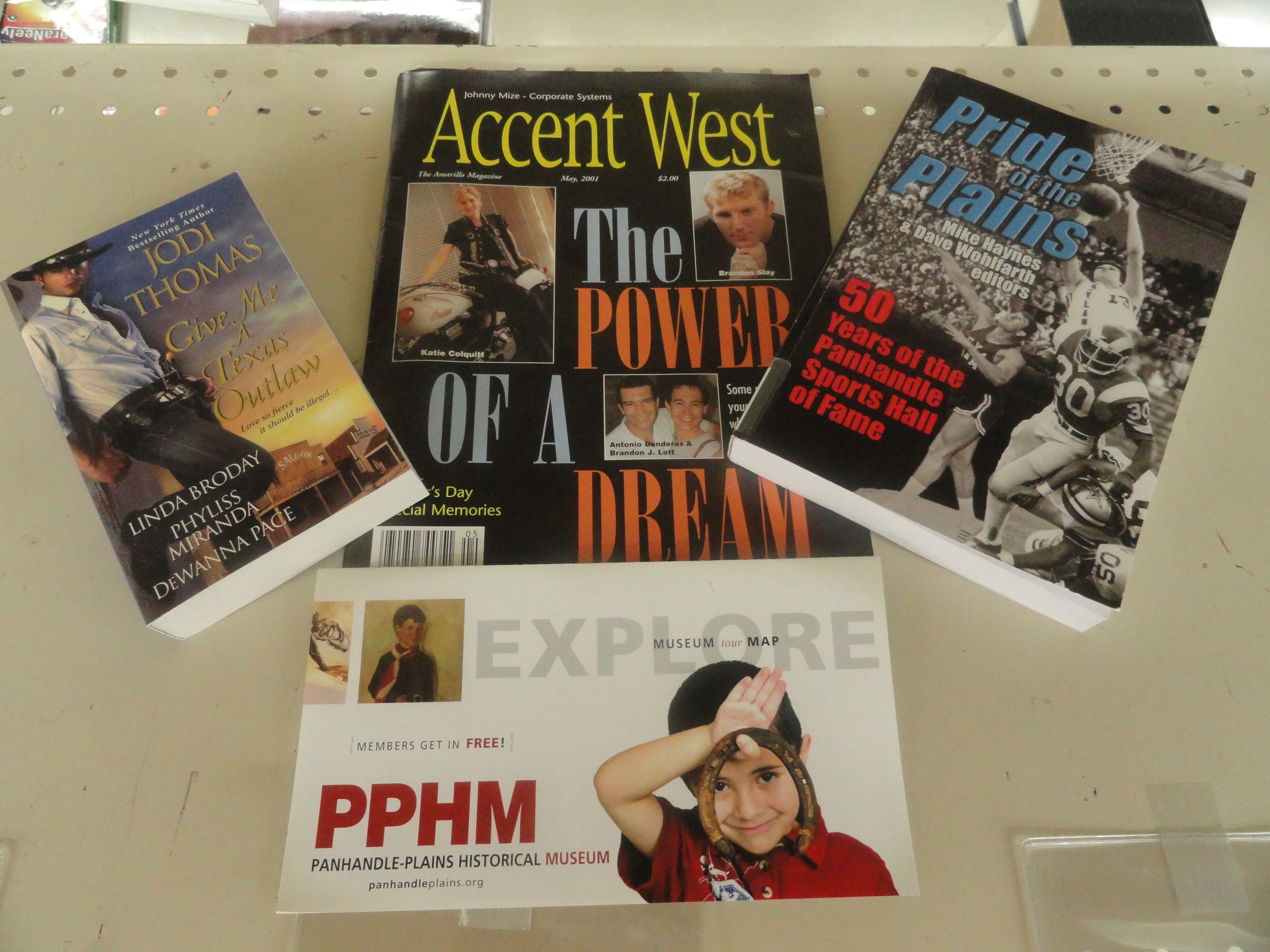
There is so much pageantry going on this weekend. To name just a few, the Olympics begin, the Panhandle Plains Historical Museum in Canyon will be displaying a lock of George Washington’s hair, and last but not by any means least, Linda Broday, Phyliss Miranda and Jodi Thomas are in Anaheim California for the Romance Writers Conference and Awards.

There is enough inspiration in just one moment with any of these events to carry an average observer for an entire year.  I was reminded of this when I was cleaning out the trunk of my car and came across the May 2001 issue of the local magazine ACCENT WEST. In it was the article by Liz Cantrell, “The Power Of A Dream,” about Brandon Slay and the story of his memories with the Olympics.

I had forgotten there was so many connections to our area so I stopped by the Canyon Public Library and picked up a copy of “Pride Of The Plains, 50 Years of the Panhandle Sports Hall of Fame” by Mike Haynes and Dave Wohlfarth. The first story was about Joe Fortenberry, the Olympic basketball player from Happy Texas who attended WTSU. The last story was about Brandon Slay and his commitment to youth and sports all around the country. One of the many stories in the book was written about Merry Byers from Canyon, and her journey in basketball, all written by Jon Mark Beilue.

Every story I read is pageantry. I can’t help it. My heart doesn’t need to hear the “Star Spangled Banner” to explode with pride. It swells with everything I read in every publication with each word printed, and every photo posted no matter what country is represented. I can celebrate every single second all the way from the Opening Ceremonies to the last fireworks bursting in the skies over London. And this leads me to the connection with destination.

Diane Sawyer interviewed Apolo Ohno for the 2010 Olympics. He said something so interesting and deep I have carried this in my writing ever since.

Ohno mentioned that most of the other kids were there to win a Gold Medal, but he said he was living his destination. He had come to enjoy and celebrate the experience of just being among competitors and athletic friends.

So this weekend if you watch the Opening Ceremonies of the Olympics, or travel to the Panhandle Plains Historical Museum to view the lock of George Washington’s hair, or google the awards at the Romance Writers Convention in California of Jodi Thomas, Phyliss Miranda, Linda Broday and DeWanna Pace, embrace the joy and excitement and pageantry each represents. Wish them God Speed as they travel to their destinations, and don’t forget that they cherish these wishes as they return home.

As always I am living my destination. Happy trails as you journey to yours.

Sharon Stevens