OUR TIME ON Route 66 – WAITING


OUR TIME ON ROUTE 66

WAITING

Rory C. Keel

His desire to go home grew stronger every day. He gave every bit of his strength to the mission in front of him and pushed forward through the stress knowing it was the only way he could go home. He endured the constant running, the overbearing heat of the desert, the sand getting in places where grit shouldn’t be, and eating the same bland military rations every day. Every evening he dug a fresh foxhole to cradle him while he slept. And every night when he closed his eyes, he dreamed the same dream. In his nightmare, he would dig his own shallow grave in a foreign land and settle into the cool sand to sleep. And one-by-one, the other men would shovel the sand over his body while he slept and forget where they buried him. And he would be alone forever.


Five authors tell five different stories, through five different time periods, and all crossing the same place—the Tower Station and U-drop Inn.

Coming in June

Critiquing


Critiquing

by Adam Huddleston


Although it’s (regrettably) been some time since I’ve met with them, I’m a part of a writers group that gets together to read and critique each other’s work.  It is extremely beneficial to gain both positive and negative feedback concerning the craft that you’re working so hard on improving.  Recently, one of the members asked me to critique a few pages of her writing and it got me to thinking: What would be considered good etiquette when it comes to this process.

  1. Always be truthful. It may sound like something you would teach a child but it still rings true to the critiquing process.  The writer may be your closest friend and confidant, but you won’t be doing them any good by lying about what you feel could be improved upon.
  2. Try to include positive reinforcement with the negative. Tell the writer what they are doing right, what you enjoyed, and how it makes you feel.This will go a long way toward encouraging them and making their work stronger.
  3. Make sure your advice is clear. Plainly state what you don’t understand and if you are critiquing by hand, make your notes legible. Insertion arrows, punctuation changes, and paragraph signs should be easy to see.

This list is far from exhaustive.  Hopefully it will help you if you find yourself facing the rather enjoyable task of helping another writer with their work.

River Valley Writer’s Workshop, Canadian, Texas


River Valley Writer’s Workshop, Canadian, Texas

Natalie Bright

Sponsored by the Canadian Arts Alliance and Texas High Plains Writers, we had a good mix of brand-new newbie writers to multi-published hybrid authors in April. In addition to local writers, I met people from Lubbock, Shamrock, Abilene, and San Antonio. This was the first ever workshop sponsored by the Canadian Arts Alliance.

One of the most interesting talks that really made an impression on me, was by young adult fantasy author, Kathleen Baldwin. She talked about the differences between two writing methods: pantsers vs. plotters.

Pantsers vs. Plotters

If you’ve been writing for a while, these terms are probably familiar to you. In case these terms are new to you, I will clarify the difference.

Plotters plot.Plotters work in a more controlled creative process than pantsers. Some begin with an outline, scene diagram, timeline, or even a lengthy book bible with character profiles and meticulous setting details. Some have visual storyboards with a guideline for which chapters they will work on that day, or a chapter-by-chapter or scene-by-scene outline posted on a wall. They usually know the ending and take their characters on a journey to that point.

Pantsers Wing It.They are in the zone, writing and creating and following their characters where ever they go.  They might begin with a great character or no more than a seed of an idea for a first sentence, or descriptive imagery for a unique setting, and then they’re off. The story takes over and they don’t stop to research or question why, they just keep going to the end with a complete book.

The Secret Life of Pantsers

The session in Canadian was nothing like I had ever heard before regarding the pantser vs. plotter method. Kathleen introduced us to our creative brain. We took an interesting quiz to determine if we lean more towards being a pantser or a plotter. Our personalities have a lot to do with influencing our creative process.

Pantserslove adventure and not knowing where their characters will take them. If they know the ending, they are bored. A pantser plots on the fly, relies on their subconscious creative mind or even on their dreams.

Plotters are brilliant planners who like working from outlines. They rely on the power of conscious creation, and usually like structure and order in their lives.

Studies have shown that there are just as many bestselling authors who are pantsers as plotters.

The main point of her talk is to know your brain. How can you maintain balance in your life? How do you minimize stress? One way is to write at the same time every day because we are wired to respond to habit/repetitive behaviors. When are you the most creative? Your creative mind blossoms when you reward it for brilliance. Give yourself emotional strokes for your creative accomplishments.

Try these Magic tricks for your brain: aim for ten ideas, state the most obvious and then state the opposite of that. For example, If Buffy the Vampire Slayer is walking through a graveyard at midnight she might see: a vampire jumping out and attacking her. The opposite of that might be; a happy clown pops out of the headstone. The second idea is very different, but too weird and doesn’t work for the story. List five or more opposite ideas, but less obvious. What works best? 1) An old lady sits in a rocker, knitting. 2) Buffy’s dead mother floats up singing a ghostly warning. 3)Buffy finds a baby sleeping. 4) Maybe the baby is a toddler, and it looks like Spike. 5) Little vampire Spike is trapped in a time warp, and is crying, lost, alone, hungry. Does this idea make sense for your story, characters and theme?

I have several friends who are pantsers and their stories are amazing. I felt very frustrated when trying to understand their writing method and put it to practice. My day job involves numbers and deadlines, and now I understand that my brain likes that sort of structure. I like having an outline for my story and realized that I don’t feel ready to write until the story has come together in my brain. I usually know the ending. It’s at that point that inspiration strikes and I am able to put words on a page, which is the exact opposite from the pantser method. After taking Kathleen’s quiz I discovered that I exhibit qualities of both processes, which might explain my hyper, squirrel-chasing work habits. I can never settle on one project. There are too many things going on in my head at once.

What about you? What process makes you feel the most creative?

It was a great weekend of inspiration to learn story craft, eat some great food, and meet some awesome creatives. If you ever have the chance to visit the beautiful town of Canadian in the Texas Panhandle, stop in at the Stumbling Goat Saloon for a burger and a beer, or The Cattle Exchange for a steak. So many other great places to dine along with unique boutiques for shopping. A must is The Citadelle Foundation which houses an amazing art collection.

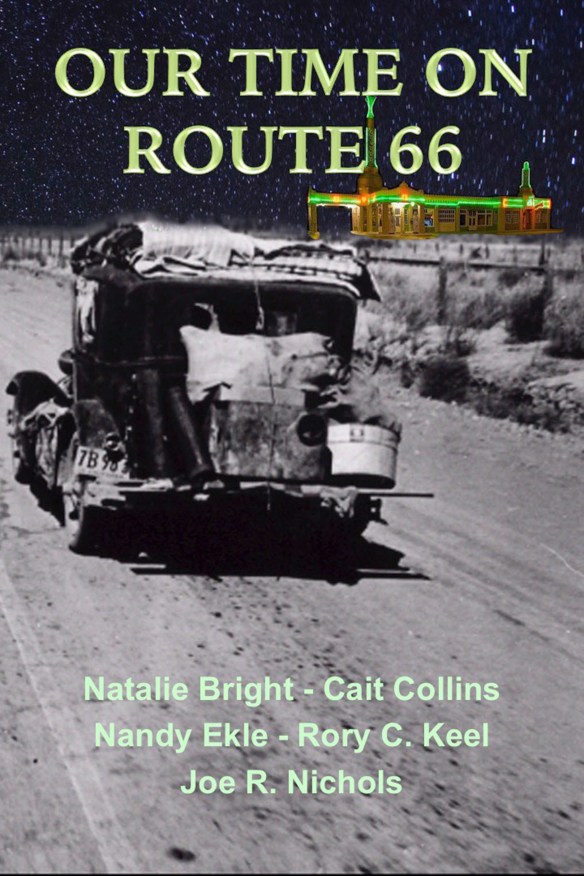
 

OUR TIME ON ROUTE 66 – FEAR OF HEIGHTS


FEAR OF HEIGHTS

Nandy Ekle


Raylene was in a hurry to get in the house. She thought she had seen her ex-husband’s truck in the neighborhood when she left for work that morning and she didn’t want to take a chance on him spotting her.

She dropped her purse and keys in the chair by the door. Her six-and-a-half-year-old daughter, Pearl, and her just-turned-five-year-old son, Jam, came bounding up the steps into the mobile home behind her, trying to tear each other apart.

“No, I get the first snack,” Pearl yelled.

“No, I do,” Jam yelled back.

“Ow! You pulled my hair! I’m telling. Mom, Jam pulled my hair and it really hurt!” She rubbed the offended part of her scalp, then she stomped on his foot.

 Jam let out an amazing shriek. “Mom! Pearl stepped on my foot!”

 Raylene took a deep breath and shut the door. “Stop it right now! Both of you. No snacks for anyone. Both of you get to your rooms while I figure out supper. Now.”

            “But, Mom,” they both whined in unison.


Find this story and more in OUR TIME ON ROUTE 66.

Coming in JUNE.

Five authors tell five different stories, through five different time periods, and all crossing the same place—the Tower Station and U-drop Inn.

IDK


Outtakes 346

IDK

By Cait Collins


I don’t know what to write next. Do I work on my next Route 66 story or do I work on the edits for my memoir?

I don’t know when I’ll finish the edits on the last draft of my novel How Do You Like Me Now?.

I don’t know the best way to inspire my students to write about their dreams and fantasies.

I don’t know who my best mentor is.  My life has been blessed with many inspiring people.

I don’t know where I’ll find the perfect place to write my next story. There are many choices.

I do know I will finish both the Route 66 story and the memoir.  I just have to put my mind to it.

I do know How Do You Like Me Now? is my favorite of my novels.

I do know young people need inspiration and as a writer I must help them develop their verbal and written skills.

I do know that I must be willing to mentor others because I have been blessed.

I do know that there are many places where beauty inspires me to write.  Some are close to home and others require travel, but each destination brings peace and the opportunity to create.

I know that I don’t have all the answers, but my job is to seek knowledge.

I know that knowledge requires dedication to study and by studying I learn not only facts but how those facts can impact my life and my surroundings.

I know that it’s often difficult to come up with a topic for my blog, but the fun is in playing with the thoughts and words.

OUR TIME ON Route 66 – WAITING


OUR TIME ON ROUTE 66

WAITING

Rory C. Keel

The fumes from the Yellow Coach Greyhound parked in front of the Tower Station and U-drop Inn cafe swirled around the vehicle. The odor of diesel fuel was familiar to him on the farm but it never lingered very long in the swift West Texas wind. 

Standing on the sidewalk between the cafe and the open door of the bus, Brennon O’Neill held his new bride Patricia as if it would be the last time. Pulling her close, he inhaled deeply, drawing in the sweet aroma of cinnamon, apples, and the hint of rose perfume that always hid in Patricia’s thick auburn hair. He knew the one thing that the stiff breeze could never blow away was the scent of her.

Five authors tell five different stories, through five different time periods, and all crossing the same place—the Tower Station and U-drop Inn.

Coming in June

Route 66 Factoids


Route 66 Factoids

Natalie Bright 

Our group’s Route 66 Anthology is in the final stages of edits and formatting. I hope you enjoy our stories which are set in different time periods, but have one common location: the U-Drop Inn in Shamrock.

Here are a few Route 66 Factoids that might be of interest.

In February 1927, Cyrus Avery from Tulsa, created the US66 Highway Association and in an extensive marketing campaign the Route was tagged, “Main Street of America.”

A goal of the newly formed US66 Highway Association was to make Route 66 the first fully paved highway in the new U.S. highway system.

The First Annual International-Trans-Continental Foot Race was held to promote Route 66. Beginning in Los Angeles on March 4, 1928, runners followed the 2,500 mile route to Chicago, and then continued on to New York.

The winner of the grueling First Annual International-Trans-Continental Foot Race was 19-year-old Andy Payne, a Cherokee from Foyil, Oklahoma. The 2,500 mile race began March 4, 1928, with Payne crossing the finish line May 26, 1928 and claiming the grand prize of $25,000.

In 1939 John Steinbeck portrayed Route 66 as an escape for desperate people, a road of tragedy and sorrow, in his book THE GRAPES OF WRATH, and coined the phrase “mother road.”

Billboards, colorful magazine advertisements, newspaper articles, travel brochures, and picture postcards promoting businesses and landscapes urged people to vacation on America’s Main Street during the 1940s. The notion of traveling on the highway Route 66 became an adventure and quest.


The International Hero


POST CARDS FROM THE MUSE

The International Hero

By Nandy Ekle

I am a very confirmed introvert. And really, I think a lot of writers are. Think about it. Writers spend a lot of time alone, with characters they made up, in a world they made up. And I believe they enjoy it that way. That’s the reason they do it. Dealing with people in your head is much easier than dealing with people in the room next to you.

And that’s the reason that for my day job, I do not answer phones; I write letters. Even though I sign my name to each every letter I write to each and every client I communicate with through my correspondence, I can still be anonymous.

So the day came when I was to send a fax to a client, but this client had the type of fax machine that had to be turned on before it would answer the fax. When means my instruction was to call the client on the telephone and advise him I was about to send him a fax.

Need I say how this affected me.

Sweat popped on the palms of my hands. I saw black dots before my eyes. My heart palpitated. And my lungs refused to pull enough air to feed my body. I was going to have call a complete stranger and speak to him. And since my telephone is not a recorded line, I was not supposed to have a conversation. I was to simply say, “Mr. Client, I am sending you a fax. Good bye.” 

Yes, I was terrified.

Now, when I was a kid in high school, I acted in several plays. And, really and truly, I was not too bad. And, of course, I am a writer, constantly creating characters and situations. And at other intensely nerve wracking times of my life, such as job interviews, I had been known to invent characters to hide behind while I did what I had to do to get through it.

So that’s what I did in order to call this client.

Suddenly I was a svelte secretary for an important global corporation. I had to call this client because he was waiting for my call to keep the global-sized bomb from obliterating the entire earth.

I wiped my hands on the sides of my gorgeous sheath dress and walked across the room in my stiletto heels, not wavering one bit. My perfectly coiffed hair stayed out of my way as I picked up the receiver to the phone.

When the phone call was finished and the fax was sent (fax report stated successful), I sat at my desk and thought about what a close call that was. I had made the call and saved the world.

Congratulations. You have just received a post card from the muse.


History and Kids


Outtakes 345

History and Kids

By Cait Collins

I teach a group of fourth and fifth graders at my church.  They’re great kids and are really starting to figure out that the past often has a bearing on the present.  They know I’ve been working on a story about Route 66 and have expressed an interest in the Mother Road.  So I’m planning to take them to 6thStreet here in Amarillo.  This stretch of the historic highway is a haven for antique collectors, music lovers, and art gallery patrons.  I plan to show my kids how we lived back in the “olden days”.

This section of the Mother Road is a still a business district with antique shops, galleries, and music.  The Old Nat Ballroom still stands.  The history of a kinder gentler time lives on in a few blocks of the older part of Amarillo.  I really want them to see that even though it’s different our lives were still full and happy and we had technology.  Well, sort of.

I think young people are more willing to learn history when they have hands-on or eyes on the artifacts.  But there’s another reality…they keep me young.  I get to see the life I lived through their eyes.  I get a second chance at living the good times and the bad times through their interpretations of the items they see and touch. And I will pick their brains for a historic building to house my antique pottery and china shop in my next Route 66 story.  The location has to be special because the mission is life saving.  I have my eye on a store front.  I wonder what my students will think about my pick.

Writer’s Block


Thecoffeelicious.com