WRITE THIS
Rory C. Keel
Take a 30 minute walk around your neighborhood. As soon as you get home, write 300 words about what you saw on your walk.

WRITE THIS
Rory C. Keel
Take a 30 minute walk around your neighborhood. As soon as you get home, write 300 words about what you saw on your walk.
It’s Called Networking
by Natalie Bright
Throughout every industry, professionals network. From skilled surgeons, teachers, CEO’s, clothing designers, coffee shop owners, office managers–you name it. There are working lunches, golf games, and five o’clock happy hour meet- ups. At some point in every one’s career, there will be some type of meeting, workshop, or conference to learn and connect with others. When I worked in human resources, conferences were invaluable. It’s where I learned about the new labor laws and where I found a network of people who worked in the same industry as I did. People I could call on, if I needed information or resources. People who were saavy as to the latest trends or tools that I needed to know to do my job more effectively.
Being a writer is no different.
Writers are No Exception
Creating and publishing books is a business after all, and at some point in your career, you’ll need to leave the creative side and step into the business side of writing. You need to know about social marketing, query letters, proposals, characterization, plotting techniques, formatting, book cover designs, social media, and you need to network with people who understand the business.
Attention: Amarillo Area Writers
If you live in or around the Texas Panhandle or tri-state area, there is a networking group for you.
Texas High Plains Writers, based in Amarillo, is one of the oldest continuous groups in the U.S. Founded in 1920 as Panhandle Pen Women, the group has been supporting and educating writers for almost a century.
As a Board member this year, I can tell you that there are many exciting things on the horizon. 2018 is going to be an awesome year, and you should plan to be a part of it. Go to the website, http://texashighplainswriters.com/ and join for only $30 a year. Hurry, you have until February 1 and then dues are $36.00. We meet every other month on the third Saturday. For the price of a latte you can network with authors who write in every type of genre, and learn everything you’ve ever wanted to know about this crazy industry.
As the Newsletter Editor, send me an article that might be of interest to the group and I’ll publish it in our eNews. You can sign up THE WINDOW on the far-right side of our Home Page.
Find us on Facebook too, where we already have several events posted for 2018. https://www.facebook.com/groups/1400256840281452/events/
So what have you done for yourself lately to advance your writing career? What have you put back into your business? As a professional writer, one of the best ways to make an investment in YOU is to become active in a writer’s organization.
Network, learn, and keep writing!
POST CARDS FROM THE MUSE
Heart
By Nandy Ekle
The heart, the center, the core, the theme, the main idea. This is a very important part of your story. The heart is what the story is about.
Look at anatomy. On the outside we see skin, hair, fingernails. But we don’t see what’s under the skin. We don’t see the bones, the muscles, or the blood in its vessels. But we can look at the skin and see the evidence of those deeper body parts. Our skin has a firm shape because of the bones under it and it’s warm and has a rosy color because of the blood being pumped by the heart through the blood vessels.
Our stories are the same. We talk about story layers all the time, and that’s another good analogy—the onion theory. On the topmost layer of the story you have what’s happening at the moment. The next layer might be what’s going on inside the characters’ heads, and there might be a layer of tension between the characters because of the relationship between them. You could even have a layer of discovery and healing when the relationships change. But the very center of the story, the heart, is what the whole thing is really all about.
The other definition of “heart” I want to talk about sort of fits parallel with this one. Heart equals feelings. One of the best ways to connect with your reader is with emotions. You have a main character that wants something so much they are willing to risk everything to get it. You want your reader to feel this yearning and hunger as much as the character. You want your reader to feel every struggle, every disappointment, every victory with your character. When that happens, the center layer of your story goes right into the reader’s heart and they learn the same lesson the character learns.
In my blog next week, we will look at ways to burrow down into a reader’s heart and make your story become their story.
Congratulations. You have just received a post card from the muse.
Tag words: heart, layer, onion, feelings, character
Ideas when Travelling
by Adam Huddleston
For the past few months, my family and I have been traversing back and forth to East Texas. All those hours on the road lead to wandering thoughts (many of which are the basis for my writing). I’ve noticed that most of these ideas deal with driving or highways.
For example, one of my works deals with a ghost that haunts the exits on the interstate. Another concerns a rather “enthusiastic” man who cleans up roadkill. Both fit quite well in the horror genre (especially the latter; geesh) and if I ever get them finished I’ll share them on this blog.
Does the location you’re in effect the types of ideas you get? Happy writing!
Outtakes 334
End of the Journey
By Cait Collins
One chapter to go. That’s where I am right now. I have one chapter to pull the entire story together and then it’s on to a new project. Well, not immediately, but after I finish my Route 66 story and send it to be edited, I will be at loose ends. Soon I will pull out a finished manuscript and begin the needed edits.
I have mixed emotions about finishing a writing project. First I’m elated when I put “The End” on the last page. But then I begin to miss the characters. I’ve invested months in building their personalities, finding their strengths and weaknesses, and guiding them along the way to the end. They have become invisible friends and I miss them. And then I have to make the final edits, my least favorite part of the process. Once that’s done I’m ready to walk away from the finished product.
In some aspects of my life, I find I have to be hands on right until the end. But in this case, I believe I can hand it off to the publisher and let him work his magic. I will continue to help with promoting the book and look forward to the release of Our Time on Route 66.
Writing is a journey. It has a beginning and a final destination. There are roadblocks and pitfalls, but there is also the sense of accomplishment when the scenes come together and create the story. But the final destination is not the book release and all the promotion. The destination is when you let go of the old and begin a new journey with a new story line and become friends with a new set of characters. It’s when the creative process begins and you travel that new road. It’s a journey that pauses but never ends.
MASTER STORYTELLER, DUSTY RICHARDS
Natalie Bright
The Western Genre lost a legend, mentor, and award-winning author. DUSTY RICHARDS passed this week from injuries following a car wreck in December, just one week after his wife, Pat, died.
DUSTY RICHARDS wore a wide variety of hats including renowned rodeo announcer, auctioneer, teacher, author, tremendous storyteller, cattle farmer, and cowboy. His Byrnes Family Ranch Series (Pinnacle Publishing) is one of my favorites and highly entertaining.
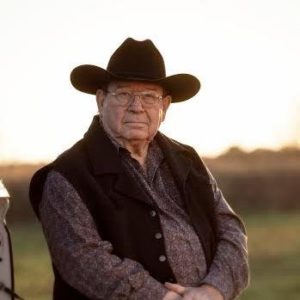
First introduced to Dusty as a newbie author by a mutual friend, I was a bit starstruck. Dusty and Pat were always at events and conferences for writers. Dusty would pick one of the most centrally located tables in the atrium or bar and spread out his books. With a personality as big as the endless western sky and a wide grin under that familiar cowboy hat, you couldn’t help but stop for a chat. In between the stories behind his stories and a good cowboy yarn or two, he’d ask about your work and tell you to keep at it. You’d end up buying a book, or usually the entire series, and he always autographed them with something clever.
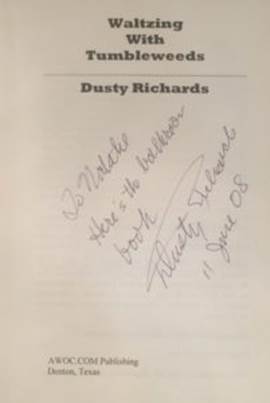
“To Natalie. Here’s the bathroom book.“
At one event I had the pleasure of sitting next to his wife, Pat, at a luncheon. Quiet and unassuming, her wicked sense of humor surprised me. She pulled from her a purse a few treasures she had purchased for grand kids and we giggled and whispered away several hours. “I don’t write a word,” she said. “I just read.”

To Natalie. May the pages fly like a good horse.
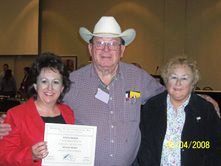
Dusty handed me a 2nd place award for my Middle Grade western novel at the Oklahoma Writers Federation banquet many years ago, and I asked Pat to join us for a picture. That recognition and his encouragement motivated me to keep going, and today that manuscript is Book 1 in my Trouble in Texas Series.
After that award, Dusty relentlessly encouraged me to join Western Writers of America, an organization that he tirelessly promoted. Serving as President and on the Board for many years, Dusty believed in the power of the western novel and in the power of WWA to promote the creatives behind the genre. Finally with enough publishing credits I was approved for membership, and attended the WWA Conference in Lubbock, Texas, several years ago. On the final night, Dusty found me in the crowded banquet hall and handed me one of his books, which has become one of my treasured possessions.

“To a real Ranch wife at her 1st WWA conference. Lubbock TX June 2015 Dusty Richards”
Dusty inspired so many writers. I want to have a deeper understanding of the West like he did, and to have the ability like he does, to fill my stories with a richness and authenticity that assures readers it’s real. I am sad that his mentoring days are done; there are so many questions I have yet to ask him. Legendary Texas author Elmer Kelton said, “Dusty Richards writes … with the flavor of the real West.”
His first novel, NOBLE’S WAY, was published in 1992, and since penning 150 novels and winning numerous awards including two of the prestigious SPUR Awards from the Western Writers of America. Dusty and Pat lived on Beaver Lake in the Ozarks of northwestern Arkansas.
For more about Dusty Richards and his work, go to dustyrichards.com
Happy Trails, Dusty and Pat. See you around the next bend.
POST CARDS FROM THE MUSE
Knock Knock
By Nandy Ekle
Going back through some stories I have written over the years when it happens.
KNOCK KNOCK
Who’s there?
Muse
Muse who? I haven’t heard from Muse in forever. Be more specific.
Muse with words for you.
You’re kidding! You’ve been gone for so long. I thought you were dead.
Nope. I’m here right now. Let me in.
On one condition. Never leave me again.
Done!
*Opening the door* Look at you! You’re loaded down with stories! Come in and unload!
Congratulations. You have just received a post card from the muse.
Outtakes 333
Hibernation
By Cait Collins
I don’t mind winter. I can handle the cold and the wind. A little snow doesn’t bother me.
But I’m having real problems with wanting to curl up in my blankets and just sleep. I will come home after work and fall asleep on the couch and wake up at midnight. This sure does mess with my writing. It’s difficult to write coherent sentences when you keep nodding off.
Truth is I have to force myself to open my computer and attempt to write. Still I force myself to work to finish my goals. Thank goodness I have a great critique group that helps me make sense of some of my chapters.
A good critique group can be a writer’s best asset. Knowing your fellow writers have your back allows you to make changes and updates without second thoughts. You can trust their suggestions because they won’t lead you astray. Their input is designed to make your work better. That doesn’t mean you make every change suggested. It’s still your story and you have the creative control, but don’t dismiss everything they say. They may have a great fix for that ho-hum chapter.
POST CARDS FROM THE MUSE
Consider the Onion
By Nandy Ekle
This is not a cooking lesson, or a nutrition lesson, even though I am a pretty good cook, and know enough about nutrition that I raised three kids to health adulthood. But I want to consider the onion as a metaphor. And this is nothing new. Onions have made famous metaphors for time out of mind. I just feel like it’s my turn to consider the onion.
A lot of people don’t like onions in their food because they’re so strong, maybe a little hot on the tongue, they make you cry when you cut them up, they smell bad, and some people claim to get headaches when they eat onions (maybe because of the smell). But these are exactly the reasons onions are needed in our diet.
And so, as writers, we will examine the onion as an ingredient for our stories. First of all, they have layers. Some onions have what seem to be thousands of layers. And our stories should also have layers. The more layers we have in our stories, the better. We want thick, strong purple layer on the outside to get the reader’s attention, but we also want the thicker, juicier layers the deeper we go. This is the flavor of the story. And we want the very center, the core, to be so soft and sweet, so heart gripping, that our readers weep with every cut they make closer to the center.
We also treasure that smell. Now, it is true that an onion’s odor is not really a perfume we want to go to the store to buy. In fact, it has the reputation of being one of the worst smells in the world. But really and truly, isn’t that how we identify that it’s an onion? But then, we add heat to it, and guess what happens. The smell and the flavor change to something so mouth watering we can’t wait to eat.
So there you go. Add heat to your story. You can add a slow, all-day heat and watch the story turn different colors before your eyes. Then when your reader eats it, it will melt in their mouths and they won’t be able to stop reading. Or you can apply high fast heat, which will bring out the sweetness quickly, causing your readers to beg for more, more, more.
And then there’s the tears when you cut the onion. And when your readers cut to the middle of your story, what could be better than a good cry?
Congratulations. You have just received a post card from the muse.
 Wordsmith Six