Historical Fiction


Historical Fiction
Natalie Bright
 
Historical details haunt me. Am I getting this right? Accuracy in the stories I’m writing cause me much concern and angst; I never feel I’ve done enough homework or that I have a full grasp of the time period. Take for example a letter to the editor of the Western Writers of America’s magazine. He wrote to complain about the use of the word “sheriff” in western novels. City councils hired a “marshall”, not a sheriff. For my middle-grade series set in the Wild West, I did research Marshall, who was appointed by the U.S. President at the time. I got that right. The thought to question and research the term ‘Sheriff’ never once crossed my mind. Will the incorrect information aggravate some readers, and since it’s a children’s book, should writers have an even bigger obligation to make certain the historical information is accurate?
 
I’m experiencing the same doubts when working on the WordsmithSix’s Route 66 anthology. The history is fascinating, and it’s difficult to stop the research and just write. My story is set in the 1930s, and when I read first-hand accounts of the time period, I want to include all of the details that I find enthralling, but the readers may find cumbersome. I guess the best thing to do, is just let the characters decide.
 

Here’s the blurb for our upcoming anthology, which will be a collection of stories from different time periods but with one common Route 66 location. I think readers will love this collection of stories, and the research has been fun. My story is actually based on the true circumstances of my husband’s great-grandmother and is set in 1930’s Texas.

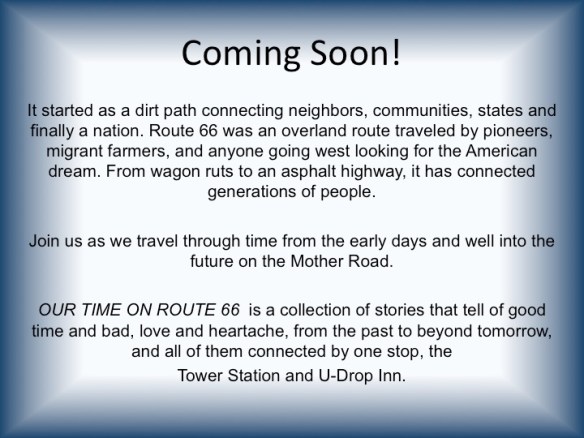
It started as a dirt path connecting neighbors, communities, states and finally a nation. Route 66 was an overland route traveled by pioneers, migrant farmers, and anyone going west looking for the American dream. From wagon ruts to an asphalt highway, it has connected generations of people.

Join us as we travel through time from the early days and well into the future on the Mother Road.

OUR TIME ON ROUTE 66 is a collection of stories that tell of good times and bad, love and heartache, from the past to beyond tomorrow, and all of them are connected by one stop, the Tower Station, and U-Drop Inn. 


Coming Soon!

Image


The Great Reward


POST CARDS FROM THE MUSE

The Great Reward

By Nandy Ekle

Your favorite author has a new book on the shelf. You read all the books he/she ever wrote. You’ve waited for a long time for this new book and you spend the whole evening at the bookstore waiting for the midnight release. You grab the book, run to the check out counter and the clerk has to pry it from your fingers to ring it up and take your money.

You immediately begin turning pages and devouring words, but suddenly realize this will not be your favorite of his/her books. The story starts slow, the drama is over the top, and the inner dialogue makes you want to simply curl up and dream of something else. But you’re so committed to this author that you can’t just quit the book. You have faith that they will eventually pull out all the stops and become the same wonderful writer you’ve always loved.

Pressing on. You’re now half way through the book and a little interest has been sparked. If nothing else, you have an idea of the path the story is taking, or even a couple of different paths. And you’ve begun to wonder which way it will go in the end.

But the main reason you keep reading that book is your belief that this author can do no wrong. True, this has not been the best beginning he/she ever wrote, but you’re a die hard constant reader fan, and you will die before you quit reading the book.

Three-fourths of the way through the book, you can tell the crescendo to the climax has begun. While it’s still a little predictable, and you feel a big flat anti-climax coming up, you are committed. At the point you reason with yourself that you have invested too much time and too much faith in the author to stop now. By this point, you have to finish it on principal alone.

And there it is. The great reward. The twist at the end. It may not have been a complete total surprise, but it was satisfying enough that you’re glad you finished the book. After all, you are no quitter. And one dud book does not make a normally amazing author into a dud.

And that is the lesson you learn from reading this book, because there’s a lesson in every book you ever read.

Congratulations. You have just received a post card from the muse.

“The Nanny” Film Review


“The Nanny” Film Review

by Adam Huddleston


The next film up for review is “The Nanny”. Released in 1965 and starring Bette Davis in the titular roll, “The Nanny” is a class in suspense. Unlike many movies that try to create a “slow burn”, this picture begins raising questions very early and spends its 91-minute run time answering them.

The dialogue is perfect and many of the screen shots are very well done. One in particular is an extreme close-up of a character as she crawls along the floor. The effect really draws the viewer into the scene. The acting is superb, not just by Ms. Davis (which is suspected), but also by the two main child actors (William Dix and Pamela Franklin).

“The Nanny” is a perfect example of “hag-horror” and I highly recommend it to any horror or suspense fan.

Happy watching!

Seasons


Outtakes 322

Seasons

By Cait Collins


I love the changing seasons. Spring gives the promise of birth and renewal. Blossoming flowers and budding trees give us hope for a brighter, warmer time. Summer’s brightness and warmth bring families and friends together to celebrate by the lake or the pool. Picnics and bike rides are popular activities. Crops planted in the spring grow to maturity.

Fall is my favorite season. The turning leaves paint the world with unspeakable beauty. The golden colors of the aspen and birch trees against white trunks reaching up to a cold blue sky take my breath away. Red, gold, and brown maple leaves fall gently to the ground. Every turn of the road reveals more beauty. The air is cooler and crisp fall scents of the harvest perfume the air.

Winter snows blanket the ground and we slip and slide on icy streets and sidewalks. Frigid air chases us indoors and we gather around the fire popping popcorn and telling stories while the world sleeps preparing for rebirth in the spring.

Writing a book or story follows the pattern of the seasons. Spring is the spark or beginning of the work. The author opens his mind to possibilities. He embraces this new-born idea and nurtures it.

As spring becomes summer, the work grows under the watchful eye of the creator. Characters mature and actions lead to reactions that are both good and bad. The climax is on the cooling horizon.

The work is completed and sold. The author settles in anticipating the harvest of sales. And then the resting time comes. It is a time to restore the mind and allow the body to recharge and while the seed of a new idea takes hold. A new flower blooms.

Little More Work


Little More Work

Rory Keel


Dialogue’s realistic,

the story moves along.

The characters are believable,

But the point of view is wrong.

The ending makes more sense,

The conflict gets resolved,

With proper punctuation

And the use of perfect tense.

Promote You: Hit the Road, Find Inspiration, & Post a Picture


Promote You: Hit the Road, Find Inspiration, & Post a Picture

By Natalie Bright

Spent a Saturday morning with my Thursday night critique group researching historic Route 66, which runs through our area of the Texas Panhandle. We are working on an anthology of stories set on this iconic road.

I’ve been involved in this discussion before with a previous group of writers, and even have a 25,000 word story that never materialized into anything tangible. Sometimes you have to give a story everything you have, and then know when to move on. Maybe I can revive that someday, but in the meantime the topic of doing a group project came up again. We’ve talke about this before, and finally, we are actually to the DOING because Mr. Keel hit on a common theme that inspired us all:

Old Route 66

To set fire to our inspiration and story sparks, we planned a field trip to visit one of the most well known landmarks on Old Route 66 in our area. The U-Drop Inn is located just up the road in Shamrock. It was a great day and very inspiring. My character and her journey is definitely more clearer in my head. At some point in the story, she will make her way along Old Route 66 and stop at the U-Drop Inn diner.

Here’s the cool part; the spark from the my story came from my husband’s great-grandmother who was given to a man 31 years older then her when she was 21. Some of the family believe it was to pay off her own father’s gambling debt, others can’t say for certain. I’ve thought alot about this lady and how she must have felt. She was an interesting lady. She acquired a divorce in Washington D.C. and married a young man her own age, my husband’s great-grandfather. I have no idea if she ever traveled on Route 66 during her lifetime, but that’s where the character becomes fictional. Don’t dismiss those wonderful family stories as sparks.

Our characters  and their adventures are beginning to take shape. I am so excited about this anthology. The six stories in our new book will be in various genres and time periods, but they will all have at least one scene at the U Drop Inn. I’ll also be offering my novella as a stand alone title.

Promote You

Have you been on a research trip? Post pictures on your social media and create a little buzz about your upcoming story.

Are you looking for inspiration? Nothing like a road trip. Clear your head and just look, listen, smell, and touch. Don’t forget your pen and notebook.

More about Old Route 66

Built in 1936 at a cost of $23,000, the Tower Conoco and U-Drop Inn were featured in the 2006 Disney Pixar movie CARS.

Although the cafe does not serve food today, it is immaculately preserved. At the grand opening in April, 1936, it was considered “the swankiest of the swank eating places.” When Route 66 came through Shamrock in 1937, it was the only eating place for a hundred miles along the new roadway. Elvis ate in one of the corner booths. As an excellent example of Art Deco, the building features two flared towers with green glazed ceramic tile walls and neon light accents.

Route 66 was decommissioned in 1984 and Shamrock became one of the many towns bypassed by highway Interstate-40. Through several owners, name changes, and layers of paint, a son of one of the original owners purchased the dilapidated building in the 1980s and restored it back to the original colors and name.

Today, the U Drop Inn is owned by the city of Shamrock and houses the local tourist information center.

The Day Job


POST CARDS FROM THE MUSE

The Day Job

By Nandy Ekle

Today at my day job we moved to our third building this year. Two of those three moves were somewhat traumatic.

First They moved us downtown to an older building our company wants to sell instead of renovate. No problem. The reason they did this was because they wanted to renovate the building we had been in. Great. The renovations promised to be absolutely wonderful, so we were happy to move to allow the to happen.

I was on vacation when the move actually happened, but when I got to my desk, things seemed great. However, we soon discovered the reason the downtown building was to be sold instead of renovated. The internet was overworked. This was a big problem because 100% of the work I do depends on the internet.

So they moved us back to the other campus, different building from where we started, but same campus. This went very smoothly. The internet worked much better and the work went well. But the grand scheme was that our permanent home was to be a different building in the same campus which was in the process of being renovated. So I only unpacked enough to be able to do my job, knowing that we would be moving again soon.

Today was that day. Today, the day I happened to have a doctor’s appointment. When I got to the office, I opened the email telling me it was time to move. So I packed up all the things I had had at my desk, including my computer, and moved from one building to the the other. Then I unpacked and reconnected my computer. But internet did not work. At all. So they had me pack my laptop and my rolling chair to a different building in the same campus in a training room where I set up as if I were working from home.

I did get a little work done, but then I clocked out and went to my doctors appointment.

So I will go to work in the morning wondering where I will be sitting for the day. But I am determined to get the letters written for our customers, who I really want to help.

And with my doctor’s help, I will get my muse back.

Frightening


Outtakes 321


Frightening

By Cait Collins


Blood and gore. Slasher movies. Halloween One to whatever. Some find these movies frightening. But think back to the shower scene in PSYCHO. A black and white movie instead of Technicolor. The music. A knife stabbing down. The heroine cringing in the shower. The scene was so artfully filmed the mind took over and the viewer imagined he saw the knife strike a woman’s body.

The mind is far more powerful than blatant scenes. Alfred Hitchcock had the creative talent to scare the life out of me without the blood and gore. To this day, the movie THE BIRDS still terrifies me. The swarming birds hid the damage to the humans. The teacher died from being pecked to death, but we never saw the sightless eyes and ripped face.

The point is a well-crafted paragraph that builds a villain has more impact than the blow-by-blow vision of a killer’s actions. Give me a masterful book or a brilliant movie and I can imagine so much more than what I read or see.

Putting a Slant on things


Putting a Slant on things

Rory C. Keel

When words are slanted to the right, they are in Italic. In writing, this can indicate several things to the reader.

Italic word are used to accent words with emphasis or importance. They can also indicate book, magazine or play titles, even words from a foreign language.

Standard practice when writing of typing a manuscript is to underline the words to be Italicized.