Characters have Secrets


Characters have Secrets

Natalie Bright


Grey’s Anatomy has me captivated again. Since first premiering on ABC in 2005, I’ve got thirteen yeas of writing experience and I’m watching the show in a whole new frame of mind. A writer’s mind. And thanks to Netflix or Hulu, I don’t have to be patient for another season to begin. Binge watching is extremely inspiring for a creative soul.

The characterization in this medical drama television series is brilliant and addictive. This show is the perfect example of developing depth in fictional characters. One of the ways you can make your characters leap off the page is to give them secrets. Real people have secrets. We have things buried deep within us that we’ll never tell. What we say out loud is not always reflective of what we may be hiding inside.

You’ve probably heard the story craft tool of throwing everything at your character. Conflict keeps the plot moving and holds the readers’ interest. As authors, we are all border line sadistic when it comes to the things we put our characters through.

Let’s look at the characters and their secrets in the show Grey’s Anatomy:

Meredith Grey: central protagonist, is hiding her mother’s illness, who was a brilliant surgeon herself, and is sleeping with her boss while trying to succeed under her mother’s shadow.

Izzie: feels unworthy of her smarts and success because she grew up very poor in a trailer park.

Christina: sleeping with her boss and she has an almost unhealthy obsession with cutting people open.

Dr. Burke: begins a romantic relationship with an intern.

George: is secretly in love with Meredith and is extremely smart,  and not the goof-ball that the world sometimes sees.

Alex: cares deeply about his career and relates to patients on a deeper level, as opposed to the A-hole, shallow attitude he sometimes displays.

Dr. Webber: Surgery chief hides a medical issue with his eyes and had an affair with Meredith’s mom when they were in medical school.

Dr. Shepherd is married and does not tell his girlfriend Meredith, who is an intern.

That barely scratches the surface as the show develops, but you get the idea. The fun part is that we know their secrets as an audience, and we can’t help but watch to see if, and when, they will reveal all to each other. It’s very entertaining and can be applied to the characters in your books.

In season 2, Izzie prepares a Thanksgiving meal for everybody. She explains to Dr. Burk that she wants just one day where they can be normal and act like everybody else. Dr. Burke mumbles, “A day without surgery.” That one line says so much about him as a character and about the entire theme of the show. You have to watch carefully and pay attention to those one-liners. When I first watched the show every week thirteen years ago, I was caught up in the medical issues of the patients. Now I’m focusing my attention entirely on the characters.

As an added bonus, Shonda Rhimes explains her writing process and development of the series at MasterClass.com.

Happy writing, and thanks for following WordSmith Six!
 

ELEMENTS OF A MIDDLE GRADE NOVEL


ELEMENTS OF A MIDDLE GRADE NOVEL

Natalie Bright

The following list of elements for middle grade novels was a handout from a writing conference. The name or origin of the information is not on the handout, so apologies that I cannot give credit. It’s a helpful list as you are crafting your story for middle grades, defined as a core audience of 8 to 12 year olds or 3rd through 6th grades.


  1. Drama!
  2. Imagination.
  3. Use humor.
  4. Write to the age level.
  5. Make place a character.
  6. Make each word resonate.
  7. Bring history alive.
  8. Mix genres.
  9. Craft prose carefully.
  10. Let joy spill out!

Scenes Defined


Scenes Defined

Natalie Bright

Does your scene in your book play like a movie in your head while you write? It takes some concentration and the ability to block out the world around you, but I love it when this happens. I try to focus on every detail, no matter how minute, as I focus on the “moving picture”.

The scene is the unit of story, and in a book usually starts with a character arriving and ends when something has changed. A scene propels the story forward.

  1. Scenes in a book are anchored in a certain place and certain time.
  2. A narrative summary can describe the specifics of your scene.
  3. Scenes usually contain some type of visible action, not just internal thinking from the character.
  4. Do not use italics for internal dialogue, or what your character is “thinking”. Once the standard norm, the point of digging deep is writing inside your character’s head. This one is hard to break. We’ve discussed this several times in our critique meetings. Next time you read a recent release, notice that italics are a thing of the past.
  5. Keep the scene and action moving. No backstory in the first chapter (maybe two). Hook the reader and save the backstory for later.
  6. Skillfully weave your backstory into the story, these can be tension filled scenes into itself.
  7. End scenes (chapters) with a hook—a punchy, pithy statement.


Book Review


Book Review

Natalie Bright
HOW TO MARKET A BOOK, Third Edition by Joanna Penn, is a comprehensive step-by-step guide to launching your book.
Every author has to devote some effort into marketing. We have to tell people about our book and hopefully make it appealing enough that they will want to read it. Finding people to read your book sounds simple enough, but as we all know this is a marathon and can take as much time as our writing.
As Ms. Penn suggests in her book, “If you re-frame marketing as creative and fun, you will find yourself enjoying it more.” Her book definitely provides you with a place to start as she covers many options.

Best Quotes from WWA


Best Quotes from WWA

Natalie Bright

The Western Writers of America meeting was held in Billings this year, and I had the chance to attend, as you might have noted from previous blog posts. Here are the best quotes from that four-day meeting.


“Write about your passion. Consider it lucky to follow that passion your whole life. Research is the key to everything.” Rob Word, TV writer, producer, host of the YouTube celebrity talk shows A WORD ON ENTERTAINMENT and A WORD ON WESTERNS

“You have to get out from behind your desk.” Toby Thompson, author & creative writing instructor at Penn State University.

“Thank you for coming to Crow country. The land you are standing on is mixed with Crow blood.”Alden BigMan Jr.

“Western writers have a strong sense that place is special.” Linda Jacobs, geologist & award-wining author.

“Just because you know beef, you don’t know buffalo.” M. Michael Gear, archeologist & award-winning author.

“Bison are not worked physically. It’s more like a chess game.” Kathleen O’Neal Gear, archeologist, historian, and author.

“So many different ways to connect with readers. Be findable.” Kirsta Rolfzen Soukup, owner Blue Cottage Agency.

“Be prepared to get on social media and promote the hell out of yourself.” Cherry Weiner, Cherry Weiner Literary Agency.

“Take a moment to consider the breadth of subject matter our organization represents. We have a great group of finalists and winners.” Kirk Ellis, WWA President & television producer.

“I had to remind myself this is not a documentary. It’s art.” Marcus Red Thunder, technical adviser on Longmire.

When your book becomes a television show…”It’s like ranching. You get the very best people you can to work with and leave them alone.” Craig Johnson, WWA board member & best-selling author of the Walt Longmire mystery series.

“I tell kids, get into the books. They are a hell of a lot better than that TV show.” Marcus Red Thunder referring to the Walt Longmire mystery series by Craig Johnson.

“Write good books; the one thing writers have control over. Never underestimate those characters.”Craig Johnson


Spending time with other writers reminds me of why I can’t ignore the stories and characters in my head, and why I don’t want to stop no matter what life throws in my path. Listening to someone else tell you about their work and hanging around others who are passionate about stories is very inspiring.

If you are a fan of history, the western genre, or stories set in the American West, you might be interested in these organizations for writers.

Women Writing the West is a group of writers and professionals who promote the contributions made by women to the history, culture, and growth of the American West. For more information, visit http://www.womenwritingthewest.org The 2018 meeting will be held October 25-28 in Walla Walla, Washington, or join us in 2019 in San Antonio, Texas.

Western Writers of America boasts historians, nonfiction authors, young adult, romance writers, songwriters, poets, and screenwriters for film and television within its 650 members. We all have one thing in common—our work in every medium is set in the ever-changing American West. For more information go here  http://westernwriters.org Join us in Tucson, Arizona in June 19-22, 2019.

Natalie Bright is an author, blogger and speaker. The two newest books in her RESCUE ANIMAL SERIES features a Tennessee Walker named Flash and a registered Hackney named Taz. Click on the books tab above for more information, and check the events calendar. For a funny, Wild West adventure, the TROUBLE IN TEXAS series is perfect for middle grades and family read-a-longs. Coming soon for young adults, WOLF’S WAR is a dark adventure set in the Texas frontier about a muleskinner and Comanche brave who reluctantly join forces to fight a ruthless gang of outlaws. Also in the works from NKB Books LLC, tales from an Arkansas Vet and a book for novice cow punchers about the unwritten rules of the cowboy code.


INDIE AUTHOR MINDSET


INDIE AUTHOR MINDSET

Natalie Bright

Several weeks ago, at a Western Writers of American conference, I pitched an idea for a book featuring pictures of a cattle ranch, an explanation of the work Texas cowboys do, and original recipes from a ranch house cook. The editor told me that bookstores will never know where to shelve it, and she is absolutely right. She raised several good points that I had never thought about. My idea doesn’t fit with cookbooks because it has picture of cowboys, not that much food. Maybe ranching related, but it’s not a coffee table book because I’m not a professional photographer and my name wouldn’t be the draw. What about regional or local history, but it has recipes.

If you publish traditionally you must have an iron clad genre, theme and target market. That question will be asked of you in the pitch appointment. By the way, my roommate and I had practiced our pitches several times. Yes, she shot down my book, but I wasn’t nervous or offended, and I really appreciated an editor’s insight on my project. Business is business.

The mindset for Independent Authors is slightly different than taking the traditionally published route. I understand retail selling and bookstore shelving labels, but on the other hand as an Indie I can turn my idea into a book anyway. My target market is the local ranching community, a group I am very familiar with. I would sell it at library and book events in my area. Will it be worth my time and expense to have a book in hand? I’ll have to do the math and give it some serious consideration.

In the Indie world of publishing, I see myself as a writer with a gazillion ideas that cross all genres and numerous markets. I want to monetize my work in every way that I can. Parts of fiction books become short stories in anthologies. The theme for my nonfiction book can be rewritten for the magazine market or as a children’s book. Related topics would make great blog posts. If you’re bound by a literary agreement, you are limited in turning those characters, themes, or ideas into something new.

The mindset of a traditionally published author is slightly different which involves a literary agent and publishing house editor. You may have heard traditionally published authors advise, “pick a lane“. It’s valid advice. I am a fan of numerous best-selling authors who write only one genre and do it extremely well, resulting in very successful careers. Write, write, write, and keep writing what you’re good at. It’s a gamble for those who stray. What if your regency romance readers hate your new young adult fantasy? Will it cause your fans to stop buying your books all together?

A good story is a good story. That will never change for readers. Today’s readers don’t care if you’re traditional or self-published, and probably don’t really understand the difference. They just want to be entertained.

Indie Authors are free spirits in many ways. We don’t write to any pre-set list of rules. Indie Authors can define our own story elements such as word counts, settings, characters, and plot lines regardless of publishing trends set by acquiring publishers. We acknowledge the characters that wake us up at night. We set our stories in the places that call to us. We write the stories of our heart, and that can make for a very satisfying work day.

www.nataliebright.com

Traditional vs. Indie: What Should You Do?


Traditional vs. Indie: What Should You Do?

Natalie Bright

The topic always comes up at our meetings. Reach for the stars and snag a literary agent who will negotiate a deal with a Big House publishing company? Or go it alone and join the throng of independent authors who self-publish? What should you do? I know, it’s a lot of information to absorb. Here are a few main points to consider as you move closer to publication in 2018.

Option 1:

If you have a high concept book theme or genre, the urgency of publication is not an issue, and you are willing to relinquish the rights to said work, then Traditional Publishing is your best option. This will require you to sign with a literary agent who will “shop” your manuscript to the five publishing houses which are closed to un-agented submissions. This process takes years. Dollars are well spent in attending conferences to network with agents and editors. Practice your pitch.

Option 2:

If you have a polished manuscript ready to go, a clear idea of your genre and target market, and a Type A personality that likes the control, then becoming an Indie Author and self-publishing your work is the perfect fit. In this option, you can do as much or as little of the process that you want. Dollars are well spent in hiring the professionals to do the work that you don’t want to learn. Become proficient on social media.

Choices

The point is, don’t get discouraged and don’t stress. Take one step at a time. Honestly, both options will sometimes move at a snail’s pace.

My body of work languished with a NYC literary agent who I met at a conference in Oklahoma City. The hardest part was not knowing the status. I got a report as to which houses had my book, but had any editor like it? How could I make it better? Maybe I should revamp my website? I should send an email to my agent, or maybe just call him? My husband finally told me, “Leave the man alone and let him do his job.”

The entire process stretched over six years and then I decided to make a change and become an Indie Author. I like knowing the exact status of my manuscripts. Although it is hard work and long hours, I am able to juggle writing and marketing around the day job. Prioritizing is key. Formatting for wide distribution in Mobi, ePub and PDF blows my mind, so a reasonably priced professional does that job. I also pay for a professional editor who checks grammar, but not plot or structure which costs more.

The point is that writers have so many choices and options for running their business these days. Either option requires a lot of patience and perseverance. It is a great time to be a creator of new and original content.

Below are links to two podcasts that have provided a wealth of information for me in my understanding of the publishing environment of today. There are several years of back logs covering a variety of topics.

The Creative Penn https://www.thecreativepenn.com/podcasts/ with Joanna Penn

Self-Publishing Formula https://selfpublishingformula.com/category/podcast/

Mark Dawson has done it all himself and is now negotiating a movie deal.

Save the Date: July 21 in Amarillo

Wordsmith Six blogger Rory C. Keel and I will be on a panel with other Indies in July to talk about Indie Authors, small presses, and self-publishing. Hosted by the Texas High Plains Writers group, we’ll be meeting in downtown Amarillo at the Amarillo Tower on the 9th Floor.

I’ll be asking the panel questions which will cover the entire process from spark to book-in-hand. We’ll find out why they went Indie, what’s so great about having control, and what they hate about their decision.

No RSVP required, nonmembers are welcome. Our meetings are open to the public and guests may attend for a small $10 fee. It all starts at 10:00 AM and you’re invited! Hope to see you in July in Amarillo.  www.texashighplainswriters.com

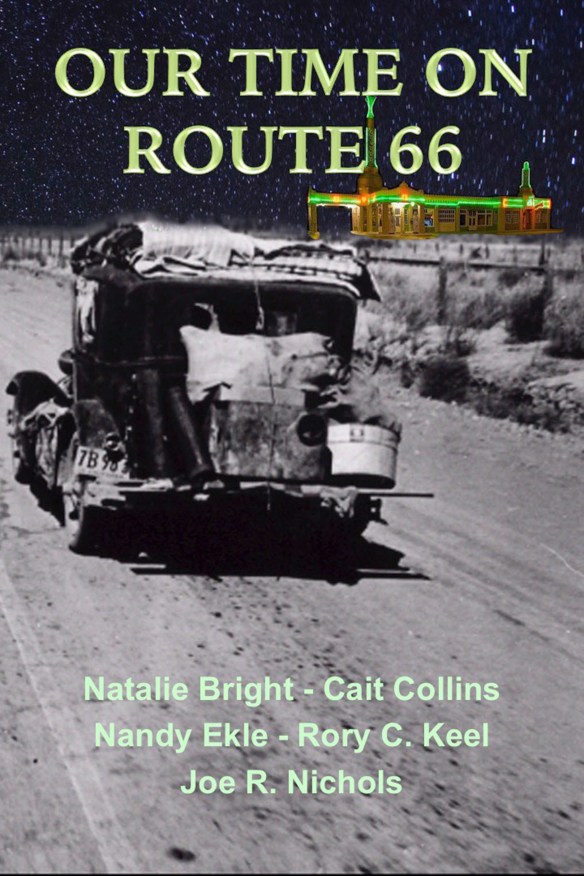
OUR TIME ON ROUTE 66


OUR TIME ON ROUTE 66

Five unique short stories and novellas set on historic Route 66 in Texas:

  • A gripping story of family betrayal, deep despair, and a young girl’s courageous triumph. MAGGIE’S BETRAYAL by Natalie Bright
  • A young soldier leaves his new bride for war sharing their life through letters in this heartfelt story. WAITING by Rory C. Keel
  • A down-on-his luck cowboy sees opportunity in a young widow’s neglected ranch in 1944 Texas. SUDDEN TURNS by Joe Nichols
  • A Cherokee Chief predicts Mora O’Hara’s future as she travels The Mother Road seeking closure after a career related tragedy. SHOWDOWN AT U-DROP INN by Cait Collins
  • Raylen Dickey learns the difference between her friends, lovers, and enemies. FEAR OF HEIGHTS by Nandy Ekle


Five authors tell five different stories, through five different time periods, and all crossing the same place—the Tower Station and U-drop Inn.

Read it now!

Amazon       Apple iBooks        Barnes and Noble

Carpe Diem Publishers

Writing Life Struggles Part 2


Writing Life Struggles Part 2

Natalie Bright


I adjusted my flight schedules.

In a previous blog, link below, I talked about me needing to be at one place, but I’d decided to choose my writing instead. I mentioned that the whole universe seemingly joins forces to prevent writers from writing. This only happens once you’ve acknowledged the stories in your head and more than once, told someone “I am a writer”. The cosmos goes nuts at this point and so does your family.

This time I took a stand. I chose a writer’s conference over needing to be somewhere else, but then I gave in  and compromised. I changed my flight schedules and will only be missing one day of meetings. If the weather holds and the good Lord willing, I will make the other event too. Unfortunately, three different airlines are needed to get me where I need to be, but I’m giving it my best shot during that week.

Everybody’s happy, right?

I’ve been busy writing blogs, but have done nothing on the work in progress.  Actually, more than one project has been put on hold and it’s waking me up nights. So why don’t I just get up and work?

What do you do when life gets in the way and you are itching to get back to your fictional world.

Do you get up an hour early?

Should I stay up past midnight to get those words in and drag through the day job?

Let us know how you push back at life and make time for your writing.  Thanks for following WordsmithSix!

https://wordsmithsix.com/2018/05/28/writing-life-struggles/