Techniques to help develop a plot


Techniques to help develop a plot

Rory C. Keel

1. Write a synopsis of your story

2. Outline your story by Chapters

3. Use index cards

4. SOTP – Seat Of The Pants writing where you draw the map as you travel

Remember, Plot is the map of the story and not the story. It is the overarching outline that you fill with all the story details.

Find the method that helps you write your story.

Let’s Talk about Endings.


Let’s Talk about Endings.

Natalie Bright

Do you have an idea the ending before you start writing?

Are you a total pantser, allowing the characters to take you on their journey and realize the ending when you get there?

My brain does not work in pantser mode, I’ve discovered, after a workshop with Kathleen Baldwin, who explained the difference. I work with numbers and deadlines at the day job, and for the time I have at the keyboard writing, I like structure. My characters are well defined and I have a general idea of the ending; then I can begin writing.

The final scene is the big yellow ribbon on  your plot. It ties up the story in a satisfactory way for your readers and answers all of their questions. Make it big, make it bold, play that last climactic scene for all its worth.  This is your ultimate test, proof that the main character is worth their time and worth saving.

In bad fiction the ending may seem forced. The plot and characters have been manipulated. As a reader it is unsatisfying, maybe a bit annoying. In good fiction, plot and characters meld together and the climactic ending seem inevitable.

Happy writing!

Pantser or Plotter?


Pantser or Plotter?

By Adam Huddleston

Here’s a repost of a blog from 2015

So the questions come up when new writers look to begin their first work: How do you write a story?  Do you begin at the first and then just plug away?  Do you organize all of your scenes first and then write it?  What’s the best way?

Guess what folks.  It really depends on the writer and their preferences.  I will say that there are pros and cons to each. Let’s examine the two prevailing methods.

  1. The “pantser” writes by the seat of his/her pants.  They start from word one and let it fly. The plot unfolds as they write.  This can be a very exciting and creative method, but it can also lead to quite a bit of editing later on. 
  2. The “plotter” plans out each scene and plot twist before they begin to write anything.  This allows the process to be more streamlined and decreases editing. 

Most writers probably use a little of both and what works best for you is simply that; what works best for you.  I prefer to write and edit the “major” scenes that I know I want in the story then piece them together with “minor” scenes. 

Try out both methods and see which you prefer.  Happy writing!

Let Down


Outtakes 377

Let Down

By Cait Collins

Have you ever started reading a story and when you reached the end, it was a real let down?  Good plots lead to a satisfying ending.  No one wants to read a romance only to find the hero and heroine separate at the end. Rule number one of a romance is to have a happy ending. But when Prince Charming leaves Cinderella with a peck on the cheek and a “see you later”, we’re not satisfied.  And chances are we will not purchase another book by that author.

A good story catches the reader within the first few pages. It maintains a rhythm that builds to a climax and then begs for a resolution. It’s spiced with twists and turns that challenge the characters. The obstacles force the hero to grow and become stronger. And in the end the questions are answered and the hero is able to build a life beyond the troubles and trials of his past.

Sometimes the writer’s journey is really difficult. A promising story falls apart. I write my characters into corners and can’t find a way to get them out without the story seeming contrived. Good writing requires patience and an open mind. It doesn’t happen overnight. I am currently reading an early Nora Roberts release. It’s fun and I am enjoying it.  But the real thrill is seeing how she has continued to hone her talent and find new stories to tempt the reader.

Story Plot chart


Story Plot chart

Rory C. Keel

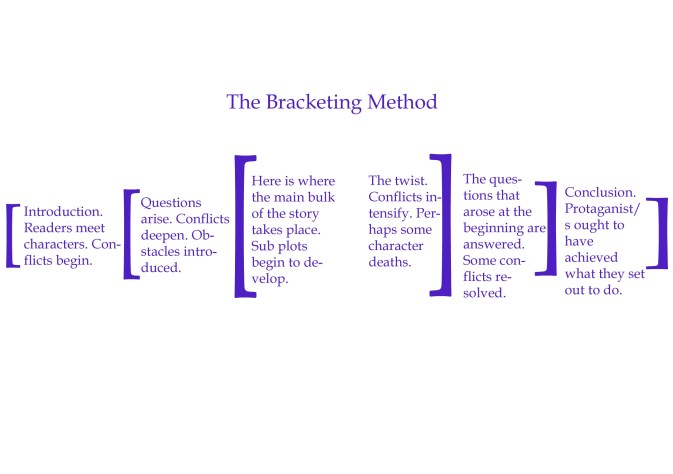
We’ve all heard of the Story arc or Plot Mountain, here is another way to look at the “plot” in your story.

Credit: https://writingcooperative.com

SCENE AND SEQUEL


SCENE AND SEQUEL

Nattalie Bright

At a writer’s conference held on the campus of WTA&M University in Canyon, Texas, award-winning author Dusty Richards talked to us about scene and sequel when plotting. This is the method that he used to write his popular Byrnes Family Ranch series.

Scene structure = goal, conflict, disaster

Every scene starts with:

  1. character
  2. the viewpoint character
  3. what does he want to accomplish in the confrontation that about to happen
  4. a stepping stone to the big-picture story goal

The story goal in the scene can be stated through dialogue beforehand, internal dialogue through character thought, or stated in the opening line of the scene.

What happens next is the sequel. The pattern of sequel is:

  1. emotion
  2. quandary
  3. decision
  4. action

More on scene and sequel next week.

Follow us all month long as we blog about Story Plot. Happy writing!


ODE TO OUTLINING


Lynnette Jalufka


Most plots have some type of structure. But when I start a story, structure is the last thing I consider. I don’t think about what plot type it is. That takes some of the magic out of writing. I just start with an idea or premise, which I jot down. Then I meditate on it until I have a good idea how the story is going to play out. I make general notes about the characters. Now I can write the story. 

I’m somewhere in between being an outliner and a “seat of your pants” author. But, as I discovered in revising my novel, the more detailed outlining I do before I write, the easier the editing will be, especially in a novel. This way, I can see the big picture I have in my head on paper and catch plot holes before I write the entire book. I will know where the turning points are and if they need to be changed. I am trying this on my next novel. Hopefully, editing it will go smoother.

Non-linear Plot


Non-linear Plot

by Adam Huddleston

Infuriating to some, fascinating to others, a non-linear plot in writing or film can be very thought provoking.  I, for one, am a fan of non-linear narrative.  

What does it mean for a work to be non-linear?  A simple definition is that it is a plot that does not follow a chronological path.  This can be obtained by using multiple plot lines, character flashbacks, or internal narrative.  

Literary examples include: “Wuthering Heights”, “Slaughterhouse-Five”, and “Cloud Atlas”.  Examples in film include several Quentin Tarantino pieces such as “Pulp Fiction”, “Reservoir Dogs”, and “The Hateful Eight”.  One movie told almost completely in reverse is “Memento”.  

While some readers or movie viewers are put off by the fact that they have to work to make sense of the narrative, I enjoy piecing the plot together.  It makes for a fun trip through the story and gives a feeling of accomplishment by the tale’s end.  I highly recommend giving some of these books and movies a try and see what you think.   

Plan Ahead


Outtakes 376

Plan Ahead

By Cait Collins

While I admit to not being an in depth plotter, I do admire those who do spend time plotting out their story.  I’ve known writers who know to the minute when the hero will propose to the heroine.  They have detailed character sketches; know whether the hero will bring roses or gardenias. Will they vacation at the beach or in the mountains? Will the heroine wear Michael Kors or Levi’s?

Timelines stretch across one wall of the office. Sticky notes are moved from one point to the next.  Every move, every word, every decision is meticulously planned. There is no deviation from the first word to “the end”. The story or novel is almost perfect from beginning to end. I do envy those writers.  They know where they are going. They make it work.

On the other hand, I enjoy the times my characters throw a monkey wrench into the plan. So he doesn’t fall madly in love with the heroine.  What’s wrong with them being best friends? That’s a rewrite. But it works for me.

The amount of research and planning that goes into writing a short story may change the amount of time and detail that goes into the preparation. Genre may also change the game plan. The point is each one of us must embrace the method that propels us forward in our writing adventures. It may mean we experiment from time to time. Or try to fly in a different direction to get the job done. The method is not as important as completing the work and being happy with the result.


PLOT TYPES


PLOT TYPES

Rory C. Keel

Christopher Booker, in his book The Seven Basic Plots: Why We Tell Stories, outlines seven types of story plots.

Overcoming the Monster

The protagonist sets out to defeat something that threatens him/her or a group they belong to.

Rags to Riches

A protagonist is in some way misfortune, usually financially. Throughout the story, he/she acquires things such as power, wealth or a love interest.

The Quest

The protagonist sets out to acquire an object or get to a location, facing many obstacles and temptations along the way.

Voyage and Return

The protagonist goes to a strange land and, after overcoming the threats it poses to him or her, returns with experience.

Comedy

A humorous character faces a conflict that becomes more and more confusing but is at last made plain in a single clarifying event.

Tragedy

The protagonist is a hero who makes a mistake that brings about his/her downfall, evoking sympathy.

Rebirth

An important event forces the main character to change his/her ways, often making him/her a better person.