BANNED


BANNED

by Sharon Stevens

While going through some boxes at the bookstore I came across an old Uncle Remus book published in 1903. Never in my life for whatever reason have I read any of these stories and I found such treasures within. Books have never been banned in our house. My parents, especially my mom let us read whatever we chose within reason. They never discriminated or guided us in our reading habits, so it is foreign to me to think that there could be a culture that would destroy any kind of creative thinking.

Getting into the book I didn’t think I would be able to muddle through only because the writing was so fragmented with the talk of the times and diction of the south. But I found once I got into the rhythm of the words, like Shakespeare, the life of the story came together. Brer’ Rabbitt, Mr. Cricket, Wiley Wolf, and Brother Fox shared through the pages parables that are centuries old.

There is a chapter in the first part where Uncle Remus is sitting at the dinner table encouraging the young master to eat per the grandmother’s order. The grandmother was concerned that the mother was only serving the child simple fair, and that he needed ham, potatoes, biscuits and gravy to grow big and strong. Uncle Remus said the grandmother had written a message of love on the dishes and the little boy exclaimed that he couldn’t see any words there. Remus replied.

….“But I weren’t callin’ out no letters; I wuz callin’ out de words what yo’ granmammy writ wid de dishes.’

Uncle Remus wanted to share that the grandmother held her grandchild close to her heart and showed so much love that she would risk the displeasure and outright anger of her son and daughter-in-law and be brave enough to enlist the help of the wise, and elderly, old plantation slave to do it.

Uncle Remus, the story, and therefore the character have been banned for years along with such tales as “Huckleberry Finn”, and “Treasure Island”. But on this the 30th anniversary of banned books includes, “Harry Potter” by J.K. Rowling, the “Hunger Games” by Suzanne Collins”, “Roll of Thunder, Hear My Cry” by Mildred D. Taylor, “The Outsiders” by S.E. Hinton, “A Light In the Attic” by Shel Silverstein and “Bridge To Terabithia” by Katherine Paterson.

Most are challenged or censored because of demonstrating racism, insensitivity, offensive language, violence, occult and satanic themes, but these are also pulled off the library shelves because families don’t feel comfortable with the message they are sending their children. And don’t forget this also affects the school and public libraries as well as the bookstores such as Hastings or Barnes and Nobles and the publishing houses as well.

One of the books banned this year and in years past is “To Kill A Mockingbird” by Harper Lee for racism and offensive language. This year the Social Justice department at WTAMU will be hosting the woman who played, “Scout” in the movie. The professors and students will be discussing discrimination and how it pertains to our area and the here and now. They are working with the Varsity Theatre here in Canyon about showing the film.

I will never second guess a parent and their wisdom in raising their own children. I am just proud that I was given the chance to read anything and everything at an early age. Hopefully my husband and I have passed that on to our children and they will pass this on as well.

As writers we never know when someone will find our words offensive, insensitive, or political. At any given moment our thoughts might be seen as anti-ethnic and anti-family no matter how color blind or family oriented it may seem. On the other hand we can’t censor our own story or characters frightened that we may offend across the board. This causes us to lose the spirit, heart and passion ingrained deep in the soul of the letters formed together to make words. Jodi Thomas and DeWanna Pace taught me in writing class to be always true to what we believe and to trust the story we are writing. And just think, even though it was written for adult market, “Fifty Shades of Grey” by E.L. James would have never seen the light of day if censors had challenged the book in the very beginning.

So on this anniversary of the week of Banned Books look through the list and cherish the Freedom we have to celebrate the joy of reading, and the Freedom to choose on our own.

I leave you with this beautiful passage from the book of Uncle Remus:

TOLD BY UNCLE REMUS

New stories of the Old Plantation

by Joel Chandler Harris 1903

“The little boy was sitting on Uncle Remus’s knee, and he turned suddenly and looked into the weather-beaten face that had harbored so many smiles. The child seemed to be searching for something in that venerable countenance, and he must have found it, for he allowed his head to fall against the old shoulder and held it there. The movement was as familiar to Uncle Remus as the walls of his cabin, for among all the children he had known well, not one had failed to lay his head where that of the little boy now rested.”

Sharon Stevens

Figment


Outtakes 60

Figment

One of my favorite jobs was my five year stint with the Disney Store in Amarillo, Texas. I hired on as one of the original cast members in 1995. Disney training and environment is top notch. Cast members are given every tool to provide the guests with the ultimate shopping experience. Rewards and recognition is a staple. I own a number of awards and prizes for guest service and sales.

With all the training efforts, I was surprised when a guest asked if we carried Figment. She saw them when she visited EPCOT Center, but ran out of time and didn’t have a chance to go back and buy one. I hated telling her we did not carry EPCOT characters. I did give her the website and phone number so she could order Figment. As she prepared to leave, I asked, “Who or what is Figment?” She smiled, “Haven’t you ever heard of a Figment of your imagination?”

Webster’s New Collegiate Dictionary defines Figment as something made, fabricated or contrived. With all due respect to Mr. Webster, I prefer to think of a Figment as something that sparks the imagination. What does Figment look like? Is it cloth, stone, or metal? Short or tall? Does Figment have eyes, ears, a nose, and a mouth? The truth is Figments come in all shapes and sizes. It’s the drop of dew on a rose petal. Or snow blanketing the trees and the lawn. Or it’s a baby’s smile when he hears mama’s voice.

Look around your home or office and you will be surprised at all the Figments living there. For me, it my Charlie Brown doll, my Captain Hook watch autographed by the character’s animators. What about my pewter frog wearing a prince’s crown that reminds me you sometimes have to kiss a few frogs before finding the prince. My jewelry box is full of Figments from the jewelry I inherited from my mother, gifts from friends and family to my Celtic cross made from silver recovered from the Atocha. Even my stuffed Puff the Magic Dragon evokes thoughts of being the eternal child.

As you find Figments, consider how they will work into your writing.  Puff could be the guy that refuses to grow up. Instead he forever plays childish games. The silver rattle given to your baby could be the identifying factor for a character in a mystery novel. My white, dew-kissed rose is a gift from a groom to his bride symbolizing true love. And it works all because they are Figments of our imaginations.

Cait Collins

GREATEST STORY IDEA—LOST!


GREATEST STORY IDEA—LOST!

It’s the middle of the night. Pitch black. The cricket’s chirping fiddle serenade has ceased and the man on the moon has shut his eyes in sleep. After what feels like the deepest sleep you have ever experienced, you sit straight up in the bed with the greatest story idea—ever. Frantically you try to remember the smallest details. Your mind races back to the beginning of the dream to piece together the plot line. Sleep fights the adrenaline as your eyes begin to close. In a haze you convince yourself that you will remember it in the morning.

As the alarm startles you awake and your eyes open and begin to focus, horror sets in because you can’t recall the greatest story idea—ever!

You didn’t write it down.

Keep a notebook or writing pad by your bedside and make notes when the thoughts happen or they will be lost forever.

Brainstorm for Critique Groups


Middle Grade Mondays

Brainstorm for Critique Groups

By Natalie Bright

Are you stuck in the middle of your story and can’t decide where to go next? Unsure about your character’s motivation? Maybe you need some spin off ideas from your finished novel to move on to your next WIP.

Organize a brainstorming session at your next writers critique group.

This is a tool often used by business managers. When I worked as a human resources director, part of my job was to plan employee events. I’d invite a few people from each department and we’d brainstorm ideas for the coming year. Everyone could speak out and make suggestions based on the first thing that came to mind and I’d take notes. In no time I had a list of ideas for places, events, and possible dates. Writers can utilize this tool as well.

A list of edits from my super agent included the need for one more episode before the climatic scene near the end. I had a solid story arc, but it needed work and I needed one more intense scene for the main character. My writers group was very familiar with the story and characters, which by the way, is reason to find compatible critique partners and stay with them. Their input is so much more intuitive when they’re familiar with your complete body of work.

I prepared a chapter grid for my group as follows, which I’ve listed headings and one example.

Chapter # and  Locations  Day # and time of day Main event or scene(s)
Chapter 1, Main StreetHotel lobby June 20, 1887 / high noon TrialVerdict is guilty

With a red dry erase marker in hand, I listed the two ideas from my agent first. This gets the creative juices flowing in the group. I asked for ideas of a scene before the climatic scene, and told them to speak out no matter how crazy. The thing about brainstorming is that creativity begets creativity. One person’s idea will trigger an idea for you, and so on. In a short time, I had a white board full of possibilities which seemed amazing since I’d spent an entire week worrying and pondering over what to do.

When I started writing, I discovered several of their ideas combined into one scene. I had to add a few elements early on in the story to tie it all together. The whole process turned out to be fairly painless.

My current work in progress is set in 1887 Texas featuring a wonderfully spirited eleven year old named Silver Belle. I’m so excited to think that she might be on the bookstore shelves one day.

And thank you awesome wordsmithsix partners. Lucky me for being a part of such a creative and inspirational group!

http://www.nataliebright.com

Postcards From the Muse


Postcards From the Muse

The old house sits on its own little acre of land.  It’s beautiful in its dilapidation, sunburned gray siding, broken windows, roof falling in.  You can’t stop looking at it and wondering about its story.

How many old buildings have you seen as you drive down the road, ancient places full of history and drama?  Do you notice shapes moving around inside?  Do you think that if you listen closely you will hear whispering?  Eerie music?  Phantom laughter?

Congratulations.  You have received a postcard from your muse.

Nandy Ekle

FOIBLES


FOIBLES

by Sharon Stevens

I was reading a young adult novel this week.

Let me rephrase that. I attempted to read a young adult novel until I reached chapter four, and I just couldn’t bear to read another word. I had to put the book down.

It wasn’t that it was evil or dirty. The cover was beautiful. The writing was bright, and the characters engaging. The author brought each person to life, gave them a past, and you just knew the story would share a future until the very last word amid the final period or exclamation point.

So why did I set aside a perfectly good book and weep? Only for the simple fact that the author wasn’t true to the characters stored within the soul of the memories.

It was so hard for me to lay down these pages. I wanted to know the ending and how the main character achieved her goals, but I just couldn’t bear witness as the heroine lost her way. I truly felt whoever wrote the book that she or he betrayed the heart just to write the story, not caring if their beliefs mattered or the time period matched.

My passion in life is to read, and I will read anything and everything within reason…cereal boxes, Reader’s Digest, marketing blurbs, I love it all. BUT I will not sacrifice or betray a book just to read a tale.

Our critique group, Wordsmith Six, works so hard to get it right. We try time and again to share our musings, but we are totally honest and true to our craft. Each speaks up when we hear an echo, or we lose our focus, or our characters stray off the beaten path. Every individual in our group helps us to get back on track before we stray too far afield.

Not only that, the speakers that present at our Panhandle Professional Writers meetings, and the presenters at our Frontiers in Writing Conferences, say in so many words time and again to remain true to the characters we believe in, that we write about.

As writers, we not only have the ability and the commitment to build a life and make it come alive, but we also have to honor the most basic concept of writing 101.

We can give our characters a twist or thicken the plot, but we must strive to always be dedicated to those we write into our stories. Instill in them a spirit and passion, trials and tribulations. Never forget that each person connects together at some point, and we have to stand steadfast for each and every one. And please note I would have had this same opinion as a reader way before I became a writer.

My Webster’s Dictionary gives the description of the word “foible” as a weakness. I have nothing against the author of this book, otherwise it was beautifully written. Someday I may return to its pages. To me this was a weakness that would have come across if there had been a strong critique group to catch the glaring errors. He or she has probably sold a million copies. I think it’s that good. And I can imagine that people of all ages have fallen in love with this book. I just can’t be one of them.

My loyalty lies with the characters. They deserve at least that much.

It’s as simple as this, and comes right down to this fact. Bees love flowers, bears treasure honey, and a leopard can never, ever change its spots.

End of story.

Caution


Outtakes 59

Caution

Does the indemnity clause, “The characters in this book are fictitous. Any resemblance to persons living or dead is purely coincidental.” really protect a writer from libel suits. The short answer is maybe. It really depends on the circumstances and how the author handles the writing.

I am not an attorney and I cannot offer any legal advice, but there are some scenarios that suggest an author proceed with caution.

1.  You answer the phone. “Hi. I’m Joe Smith. My friend Kathy Jones told me you are a writer and I have a story that should be told. Thing is, I have no idea how to write the book. Can you help me?”

“Tell me about the story.”

“Well, it goes back about three generations. Seems my great-grandmother met this farmer. They wanted to get married. He was a good man, but her daddy didn’t approve of his children marrying beneath their stations. He told her if she married the man, he’d cut her out of his will. The farmer wanted to give Granny time to think about the consequences of marrying, so he suggested they wait until after the harvest for the wedding. Granny’s cousin wrote saying Gramps changed his mind and the marriage was a go. They got married, Granny was disinherited and the cousin got all the money. It broke up the family. We haven’t spoken to the cousin’s family in years.”

“Okay, do you have any papers, letters, or journals to prove the story?”

“No. This is my Granny’s story. She told my grandmother, who passed the story to my mother.”

2.  A big scandal is reported in the local newspaper. Councilman A embezzled a couple of million from the city’s economic development budget. Great plot for a fictionalized account of the events.

3.  A historical event catches the author’s interest. However, it is recent news and key figures and their families are still living.

I wouldn’t touch the ghost writing request for a million bucks. Unsubstantiated stories are an invitation to a law suit. Without documentation to prove the events, an author would be unwise to write this book.

I listened to a writer speak about the scandal story. Of course the names would be changed, the location disguised, and some changes would be made to the actual events. But anyone who was around at the time would recognize the story. There was a gleeful gleam in the author’s eyes as the details were revealed. The conference speaker was not amused. “Be careful,” he warned, “you could be sued. You might win, but your reputation will be damaged, and you might have problems getting an agent or publisher. Let’s face it,” he continued, “your agent and publisher will not appreciate being drawn into a legal battle.”

The third situation is a non-fiction publication that hits the book shelves every week with great success. The caution here is verifying the facts. Research. Research. Research. Adhere to the oath a witness takes to tell the truth, the whole truth, and nothing but the truth. In other words, present the facts; all of the fact; and leave out the spin.

While a writer should feel free to write his story, he should also exercise common sense in selecting assignments. The writing community is not that large. News travels and people will remember. Don’t risk your reputation and financial security for a burst of fame.

Cait Collins

Make a fortune by doing nothing!


Make a fortune by doing nothing! 

If you’ve been around the block once, you’ve heard them, the get rich quick schemes. “Work part time for thousands of dollars a week!” “Get rich with minimal or no effort!”

Get Rich

Let’s get real. Most people run from this kind of hyped up claims—or do we?

Somehow the idea that a new writer can write a book, publish it and sit back to rake in the money without any work is alive and well today.

You may have an agent and a publishing house contract, and yes, you may have a good book, but the world doesn’t know it. You must promote it.

Promote 

By every means possible you must promote your work: word of mouth, business cards and fliers, libraries, writing conferences and book signings. Use electronic promotions such as a website or a blog. Social media outlets like Twitter, Facebook, Myspace, and Pinterest also create large platforms for your writing.

Sell

The truth is if you are going to be successful, you not only have to write a good book, but you must work hard and sell it too.

Rory C. Keel

Libraries and Librarians


Libraries and Librarians

By Natalie Bright

The local library in my small hometown will always be a special place for me. Located on the same block, and just around the corner from the laundry mat, I spent most Saturdays there. While my mother did our weekly wash, I hung out with crazy characters and visited places I’ll never forget.

Just inside the door and to the left were several comfy chairs and a low coffee table. It was in this spot I studied the cover of the newest Highlights for Children magazine, always the first order of business. I loved the detailed, busy covers of the colorful artwork. Then I read a new story each week until the next month.

The librarian usually had a stack of books ready and waiting for me. Even though I was very young, our hometown librarian never limited me to a certain section. I could check out anything I wanted. With a simple smile and a cheerful “Good morning. I think you’ll enjoy this.” she handed me something new. The feel, the smell of the pages, filled me with anticipation, and I couldn’t wait until I could hide into the new story.

One of the happiest days for my mother, when she got a new washer and dryer, was one of the saddest for me. I realized we wouldn’t be going to laundry mat on Saturday.

www.nataliebright.com

Natalie Bright

A Writer’s Vacation


POST CARDS FROM THE MUSE

A Writer’s Vacation

We took a trip out of town just to get away for a couple of days. Now two days is not very long and there’s no reason to drive far, so we ended up in a small town four hours north of our house. The town doesn’t have very many activities, but I’ve always told people that a creative person is never bored. And I think we proved this again.

Forty miles from our hotel was a museum dedicated to a well-known outlaw gang. This was a small museum, but full of character.  The tour started in a barn that had been renovated and made into a gift shop. The loft had been converted to a museum full of items depicting life in the days of the outlaws and history of the county. Back down on the first floor of the barn, one wall opened up to an underground tunnel leading to the main house on the property. The property had been owned by the sister of the brothers in the marauding gang and they were known to visit her when they needed to “cool their heels.”

As I stepped into the tunnel, a sense of adventure in a different time crept up my spine. Tunnels and secret passages have always fascinated me, and this one delivered that scrumptious snack for my imagination. I could almost hear the voices of the bad guys as they flew through the underground space to the house up the hill from the barn. I pretended to hear them shush each other and climb the stairs into the kitchen of the little house.

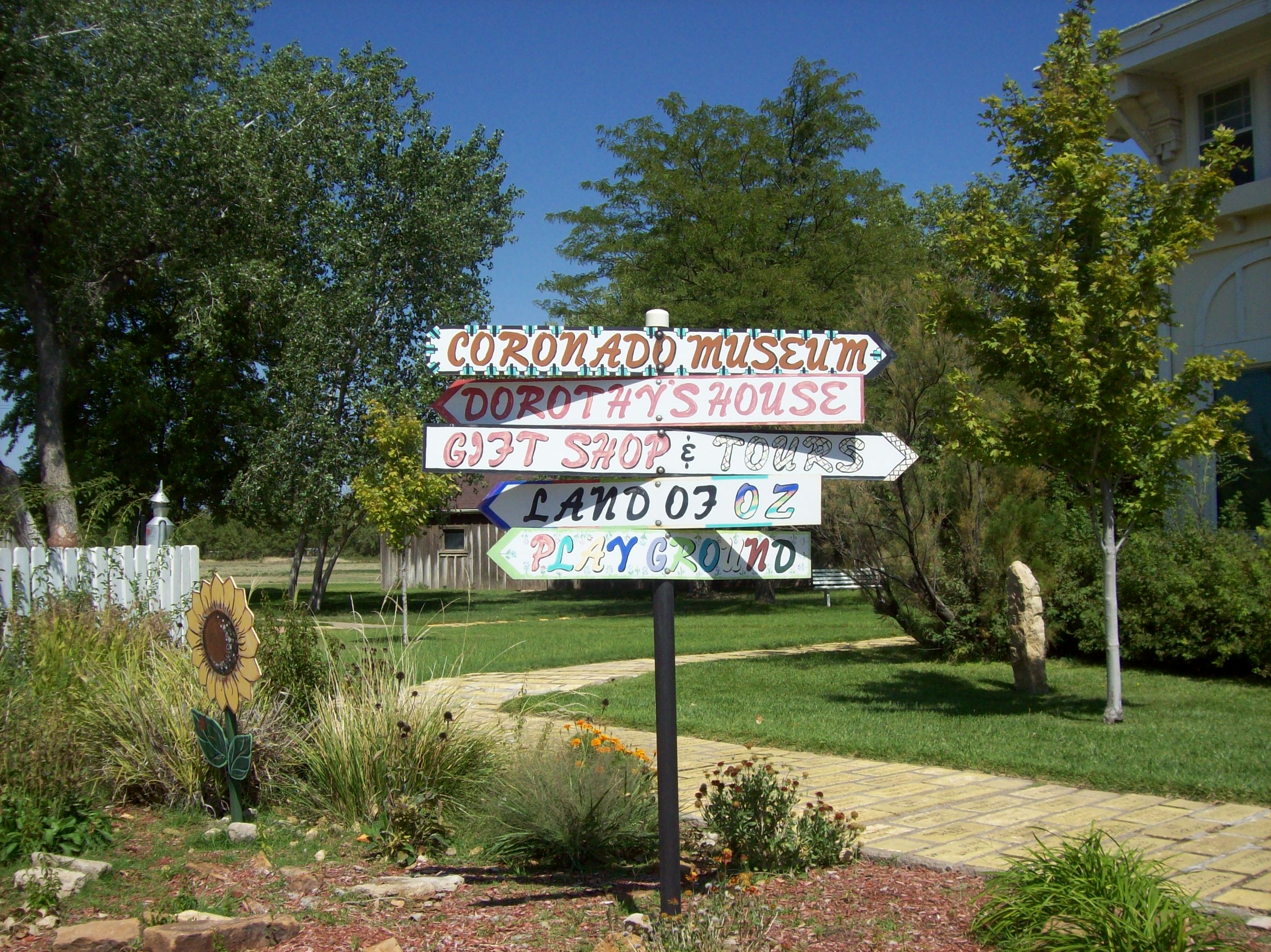
The next attraction on our itinerary was the Wizard of Oz museum. As a child, my life revolved around this movie, and even now as an adult who recognizes and loves good writing and good plots, this was my holy grail.

Our tour guide was a young actress dressed as Dorothy and she led us through the little white house that the museum society had erected to represent Dorothy’s House, which was full of period items to illustrate what life was like at the turn of the century. After going through every room of the house we headed to “the Land of Oz” where movie scenes had been built to re-enact the movie.  My heart beat a million beats a minute and I had to fight tears of excitement, just as if I was a little girl again. And, just like in the outlaw hideout tunnel, my imagination took over. A story concept popped into my head and heightened my experience even more.

When you feel writer’s block coming on, try taking a sight-seeing road trip. Even a small, unknown place will have a story hiding behind a door or in a barn, under a rock or just out in a field. It’s up to you to find them.

Congratulations. You have just received a post card from the muse.

Nandy Ekle