PODCASTS: LEARNING WHILE YOU WORK AT WRITING


PODCASTS: LEARNING WHILE YOU WORK AT WRITING

Natalie Bright

Perhaps I’m way behind the times, but I’ve never been into podcasts. My youngest son has always been a fan, but it never made sense to me that he spent time watching someone else play a video game. I realized he’s watching a lot about science though, when he began spouting off facts about the universe.

This past weekend I discovered podcasts are for writers too!

Thecreativepenn.com is a treasure trove of information for writers including 250 podcast interviews by self-published author Joanna Penn. She is officially my first podcast subscription.

Here’s what I did last week while listening to Joanna Penn talk about writing:

  • Folded two loads of clothes.
  • Re-arranged my make-up drawer.
  • Ironed shirts for my husband and son.
  • Unloaded and loaded the dishwasher several times.
  • Cooked tacos for dinner.
  • Logged five miles on the treadmill.

Which brings me to the point of this blog post:

Here’s what I learned from thecreativepenn.com podcasts and how I applied that information to my own self-published eBook:

  • Discovered my eBook on Smashwords had 225 sample downloads, but only eight sales.
  • My price of $4.99 is double the cost for about half the page length as compared to books on the same topic which are priced at $1.99 and $2.99.
  • GONE NEVER FORGOTTEN is a heartfelt memoir about loss and the grief of losing our oldest baby boy. The book title is also the same as a porno video that used to be available on Amazon, which is why I stopped promoting it. I should have researched and put more thought into title ideas before I self-published.
  • The title page, dedication, table of contents makes up most of the downloadable sample. No one is seeing any significant example of my writing or what the book is about. When formatting your eBooks, begin with the text of the story. Put everything else at the end.
  • Social media is amazing, and it’s mind-blowing as to what self-published authors are able to accomplish these days.
  • Guest blogging, Twitter, Facebook promos and whatever else, are all things I can do to let readers know about this book. The measurable results of what works best for me is completely different for what might have worked for others. Every author must decide upon their own journey.
  • The most profitable combination is to have at least four books written, polished and published before you begin a concentrated social media blitz.
  • Start building my fan base now by actively participating on twitter, facebook, pinterest, and other social media sites.
  • A newsletter is the best way to build an email data base of possible buyers for your books.
  • The number of people reading on their iPhone devices has exploded (estimated at three times other devices), which makes the iBook app worth considering both as a reader and as a writer.
  • I’ve decided to retire my eBook on Smashwords and rebrand the project.
  • Do I want to spend time and money on a cover redesign, new formatting, and find an illustrator?
  • Should I write a book proposal and research possible submissions to a small press?
  • I must develop a social media marketing plan.
  • I must learn to balance the creative side with the business side, if I want to be a successful author and sell books.
  • Be open minded and consider all of the possibilities for my books in today’s publishing environment.

I’ll keep you posted as this project develops. Thanks for following WordsmithSix!
 

Love Is A Rose


POST CARDS FROM THE MUSE

Love Is A Rose

By Nandy Ekle


My favorite writing tool is the metaphor. This is the comparative device that shows, not tells. So here are some metaphors I’ve used, and I would love to hear about some you may have used, or seen someone else use.

Liquid mercury. Remember the old-fashioned thermometers you had to hold under your tongue, or in your armpit, or . . . somewhere else? Those little tubes contained a silvery ball of mercury that would rise when heated by your body to a line on a graph that showed what your temperature was. If one of those little glass tubes broke, the mercury fell on the floor like liquid beads, except you couldn’t pick it up. If you tried, it would change shape and roll away. This always reminds me of something that might be hard to grasp, sort of like an idea . . .

Love of books. Reading books is as much a need for me as breathing air. I need that quiet time to myself to let my imagination out to play. As a kid, my imagination ran full speed all the time and I had to learn to put it in a box during the times I was expected to pay attention to the real world. But as a writer, my imagination is a very important thing. However, it tends to shrivel up if it’s not used. And that’s what books do for me. So to illustrate this, I thought about a character from a book that falls in love with his reader. Not only does this show how much I need books in my life, it also shows that books need readers.

Spiders. I am proud to admit that I am a confirmed arachnophobe. To me, spiders are the absolute worst nightmare that ever crept on the face of the earth. While this irrational fear can be paralyzing in some situations (depending on the size of the monster), it has also given me some excellent stories. After all, who can write about that kind of fear better than someone who experiences it? So it’s in this vein I use it as a metaphor to illustrate things that are paralyzingly scary, such as a character who has an arrogant attitude and must learn to put his ego aside to save his family from a devious creature that has invaded his home to terrorize his children. The spider actually represents his fear of inability to protect the home.

So, go ahead and tell me about some of your favorite metaphors. Just post a comment down below, and don’t worry about being long-winded or short winded. I love to hear from my readers.

Congratulations. You have just received a post card from the muse.


Writing in “On Her Majesty’s Secret Service”


Writing in “On Her Majesty’s Secret Service”

by Adam Huddleston

The sixth film in the James Bond franchise, “On Her Majesty’s Secret Service”, is the first and only to star George Lazenby. Due to the fact that Sean Connery had played Bond in all of the previous installments, and had done a wonderful job, Lazenby had big shoes to fill. In my opinion, he did quite well.

The plot, still centered on S.P.E.C.T.R.E leader Blofeld, involves Bond’s infiltration of the antagonist’s base in the Swiss Alps. This film, while still containing several action sequences, has a bit slower pace. At 2 hours and 22 minutes, it is the longest installment up to that point and much of the movie involves Bond falling in love and getting married.

As far as dialogue goes, I actually had a difficult time understanding some of it. Many of the British actors mumbled their lines and I found myself having to rewind the film to hear them correctly. The length of the film and the dialogue lead to a less than enjoyable experience.

Characters and Careers


Outtakes 232

Characters and Careers

by Cait Collins

Characters don’t just sit around all day shooting the breeze. They have jobs, careers, and education. But where do you start in researching careers? If you know someone in the profession, make an appointment to discuss the job description, education, salary, perks, lingo, attire and so forth. But if you don’t have access to an expert in the field, there are other sources to help you out.

When I first began writing fiction, I knew I would need handy resources. Writer’s Digest released Careers for Your Characters by Raymond Obstfeld and Franz Neumann a number of years ago. It’s one of the first books I purchased for my library. The volume covers 101 professions providing good information on common careers and some not so common ones. It’s has helped me better define some of my characters. Unfortunately, it doesn’t provide information on jewelry design and gemology. So it’s time to punt.

I started with pulling information from my college geology classes and labs. What equipment did I need for my hero? What would he have in his kit? Would he do some prospecting on his own? What is the process for filing a claim? And as the writer, what did I need to learn to create this character?

My local Barnes and Noble Booksellers provided a number of books for my research. Tom Jackson’s What’s that ROCK or MINERAL? guided me in rock and mineral identification. Smithsonian Nature Guide Rocks and Minerals by Ronald Louis Bonewitz provided information on gem properties and locations. Gemstone Settings by Anastasia Young gave me insight on the types of settings and lingo. I began comparing some of my personal jewelry with the designs in the book so that I could describe the various pieces in my hero’s line.

I then hit the internet to learn what gems one could find in Colorado. I also found fee sights where I could go to pan for gold and sluice for gems and minerals. I may need to make a trip to the state to put my book knowledge to work so that I can accurately describe the panning process.

What do I hope to gain from this research? I will be able to create more dynamic characters, settings and description. And in turn I will hopefully give the reader a really great story.


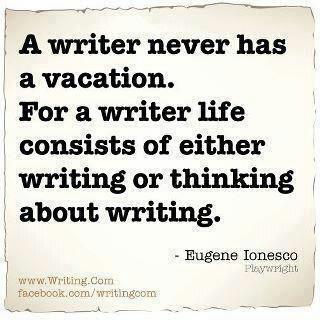
NO VACATION!

Image


writers-quotes-story-writing-34823004-320-320

Story in a Sentence


Story in a Sentence

Natalie Bright

There’s no better way to discover the “heart” of your book then to summarize the plot into as few of words as possible.

One sentence can explain the main characters, the plot line, and the theme. Now that’s a challenge!

Stripe your story down to the bare bones. Hooks are attention getters to lure readers into your story. You want to generate interest with a promise of adventure. Ensnare the reader. Pull her away from reality.

If writing one sentence is too difficult, perhaps you have more than one story line. Maybe you have multiple plot lines, and need to decide upon the main story and theme.

*Toy Story is about the ‘secret life of toys’ when people are not around.

*Princess Anna, a hopeless optimist, sets off on an epic journey – teaming up with rugged mountain man Kristoff, his loyal reindeer Sven and a talking snowman named Olaf – to find her beautiful sister Elsa, whose icy powers have trapped their kingdom in eternal winter.

*After a painful divorce, the author sets out to devote one year to pleasure, prayer and love. (EAT, PRAY, LOVE by Elizabeth Gilbert.)

Please share the story in a sentence of your current work in progress.

The Blank Wall and Paper


POST CARDS FROM THE MUSE

The Blank Wall and Paper

By Nandy Ekle

I have a friend who is an artist. She paints everything from glass jars to cardboard boxes. When we moved into our house with the extremely white walls, she was so excited.

“I love your new house,” she said.

“Thank you,” I said. “The walls are so white it makes the whole house gleam.”

She looked around the room and I could see the proverbial light bulb going on above her head. “I look at those walls and see canvases just waiting for paint.”

I smiled and just went on with my unpacking.

Now, quite a few years later, I remember her telling me that, and I think about the blankest thing that inspires me. When I was a kid in school, my favorite time of year was right before school started. My mom would cut the school supply list out of the paper and drive us to the five and dime store. There we would load up on crayons, pencils, paste, and paper. Lots and lots of paper. Back at our house the supplies were doled out and I spent the last few days of summer arranging and rearranging my school supplies.

I had to touch every brand new crayon, sharpen all my pencils and smell the paste. But my very favorite school supply was all that blank paper with the blue lines, just waiting for words to be inscribed.

To this day, well past my school days, blank paper still makes my heart smile, kind of like the blank wall my friend was excited to see.

Congratulations. You have just received a post card from the muse.


Writing in “Live and Let Die”


Writing in “Live and Let Die”

by Adam Huddleston


Roger Moore’s debut at 007 occurs in the eighth film in the series, “Live and Let Die.” The plot centers on James Bond investigating the deaths of three agents. He discovers that a Caribbean dictator, Dr. Kananga is involved and is growing a massive crop of poppy plants to produce heroin. Kananga is using the fear of tarot cards and the occult to keep the locals away from his headquarters. Although he is captured by Kananga’s henchmen, Bond ultimately kills Kananga, destroys the poppy fields, and escapes.

The plot was not horrible, but the editing left a lot to be desired. One particular boat chase scene near the end drug on for an insanely long amount of time. Several of the characters were beyond stereotypical and the Blaxploitation seen in many movies of that era was a little sickening. Moore’s portrayal as 007 was a breath of fresh air and I am looking forward to seeing more of his Bond films.

Valentine’s Day


Outtakes 233

Valentine’s Day

by Cait Collins


I write romantic suspense and women’s fiction, so I assumed I could write a great love story. Guess again. Writing a love story is not easy. It’s difficult to find the balance between cheesy and trashy. In some ways, I prefer the old days when romance didn’t mean falling into bed on the first date. Love is more than sex. It’s the development of a relationship from the first, sometimes awkward, meeting to the first date. Falling into like and then choosing to love someone. It’s committing to the love and allowing it to grow until the needs and dreams of one become a part of the partner’s needs and dreams. It’s walking into life’s sunset hand in hand and holding on until, as the vows say, death do us part.

But love lives on and the surviving partner opens the heart to new horizons and to new possibilities knowing the comforts and blessings of commitment. So, how does the writer approach writing a real love story? With respect and caution. One cannot be jaded or cynical. The writer has to look at the good and the bad in a relationship and honestly interweave them into the tale. The high points of the relationship must be celebrated and the lows must be faced and resolved. The telling must be truthful and explore the human side of the relationship.

So, I will never write a real love story. Not because I feel incapable of the task, but because I’m a romantic. I believe in romance. I like the idea of being cherished and appreciated. I believe in creating a haven for the one I love. He deserves a shelter from the pressures of life. Yes, I believe in happily ever after. And I know my view, my dream is not realistic.

I wonder how they used to do it?


I wonder how they used to do it?

Rory C. Keel

I thought I would write a few observations. We are surrounded by such a diverse assortment of super technology. For example, we have smart phones that are so powerful they can interrupt a personal, face-to-face conversation with an individual, and allow us to talk, text and send pictures simultaneously around the globe to multiple unseen individuals.

Computers are now a way of life. They check our spelling and grammar and make learning the many beautiful loops of cursive penmanship once taught in schools obsolete. And what is a pen anyway?

We sit in dark rooms like hermits, wearing our pajamas,  tangled hair and unshaven, and faces with no makeup, and with the push of a button circle the globe. We gather information on places we would love to go, and things we want to do–if we ever got dressed and left our home.

The sun is no longer needed to determine which direction is north, south, east or west. Grown men who stubbornly refuse to listen to their zealous wives give them directions will react, without hesitation, to the soft and sultry female voice of a GPS system, accepting every command without question.

With vehicles that can automatically parallel park, the useful skills needed in backing automobiles are forgotten, and the rearview mirror that automatically adjusts to the lighting, is relegated to review our hair, lipstick, or to check for pimples.

The aeronautics industry is also awe-inspiring. The kid down the block that used to chase the other children, dive-bombing them with his remote control airplane, is still in his backyard chasing the Taliban on the other side of the world with remote war drones.

Speed has not always been a friend to avionics. The world’s fastest commercial passenger jet, the Concord, is now retired. The expense of chasing itself around the world was too high. Crossing the International Date Line, it could arrive at its destination tomorrow, and come back yesterday.

The truly amazing thing about all the technology that we experience today is that it causes us to ask questions. But the most frequent question I hear today is not, “How will we do things in the future?” but, “I wonder how they used to do it?”

As an exercise, write about a few things in your past that have changed.

Roryckeel.com