Cultures Unlike Us


Cultures Unlike Us

We had an interesting discussion about cultures that are so very different from us at a recent critique group meeting.

Bullfighting

The discussion began because one among us is researching the Matador and the history of bull fighting for a story. She shared some of what she had learned. The centuries old tradition can be traced as far back as ancient Rome where man–against-animal events were held. Bullfighting is a blood sport deeply entwined into the cultures of Spain, Portugal, and many South American countries. Matadors enjoy celebrity status and the showmanship is very entertaining. A special breed of cattle are bred especially for the bullfighting ring.

Food in the Eyes of the Hungry

Our discussion turned to cultures different from us and their food. It was pointed out that some cultures think “food” when they see a dog, which is considered a delicacy in many Asian cultures. These dogs are bred specifically for the purpose of feeding people.

A visitor from Belgium told me that grocery stores in Europe have horse meat for sale in their meat market along side beef, pork, and chicken. She rarely buys beef because it’s so expensive in her native country.

As an owner of a cow/calf operation in the Texas Panhandle, the ranch horse and the cow dog are our working partners in the ranching industry. Our business is feeding hungry people with Texas Angus beef raised on native grasslands. The American culture has included beef and pork as a mainstay for centuries. I could never plan a menu around a juicy hunk of horse or dog meat. What about having a character eat something odd or cook something they’d never eat themselves? Interesting premise!

Writers and Their Research

One of the things I love about my WordsmithSix writers critique group is how non-judgemental we are. Our discussions cover a wide range of topics, and it’s great fun to dig deep into the issues that impact our stories. We greet each new subject matter with hyper curiosity. We question everything, and since we’ve been meeting for over five years now, we have very open and informative discussion. Visitors to our group are sometimes shocked at our musings.

To get to the heart of the story and to dig deep into our character’s motivation, can writers greet their research without bias? Does our background and beliefs get in the way?

Writing onward…
Quoting the Masters


POST CARDS FROM THE MUSE

Quoting the Masters

By Nandy Ekle


I like to read quotes by authors who know what they’re talking about. I find a lot of inspiration, instruction, wisdom, truth, and humor.

Here’s a few I’ve picked out from other sites on line to share with you.

  1. “I want to write because I have the urge to excel in one medium of translation and expression of life. I can’t be satisfied with the colossal job of merely living. Oh, no, I must order life in sonnets and sestinas and provide a verbal reflector for my 60-watt lighted head.” — Sylvia Plath
  1. “Writing is my way of expressing – and thereby eliminating – all the various ways we can e wrong-headed.” —Zadie Smith
  1. “When I sit down to write a book, I do not say to myself, ‘I am going to produce a work of art.’ I write it because there is some lie that I want to expose, some fact to which I want to draw attention, and my initial concern is to get a hearing.” — George Orwell
  1. “I don’t know why I started writing. I don’t know why anybody does it. Maybe they’re bored, or failures at something else.” — Cormac McCarthy
  1. “Why does one begin to write? Because she feels misunderstood, I guess. Because it never comes out clearly enough when she tries to speak. Because she wants to rephrase the world, to take it in and give it back again differently, so that everything is used and nothing is lost. Because it’s something to do to pass the time until she is old enough to experience the things she writes about.” — Nicole Krauss
  1. “I write because I don’t know what I think until I read what I say.” — Flannery O’Connor
  1. “I started writing novels while an undergraduate student, in an attempt to make sense of the city of Edinburgh, using a detective as my protagonist. Each book hopefully adds another piece to the jigsaw that is modern Scotland, asking questions about the nation’s politics, economy, psyche and history . . . and perhaps pointing towards its possible future.” — Ian Rankin
  1. “Why am I compelled to write? . . . Because the world I create in the writing compensates for what the real world does not give me. By writing I put order in the world, give it a handle so I can grasp it. I write because life does not appease my appetites and anger . . . To become more intimate with myself and you. To discover myself, to preserve myself, to make myself, to achieve self-autonomy. To dispel the myths that aI am a mad prophet or a poor suffering soul. To convince myself that I am worthy and that what I have to say is not a pile of shit . . . Finally I write because I’m scared of writing, but I’m more scared of not writing.” — Gloria E. Anzuldua

Congratulations. You have just received a post card from the muse.

Static Character


Static Character

by Adam Huddleston

This week’s literary device is the static character. A static character is one that experiences no arc throughout the story. Their motivations and personalities remain the same from beginning to end. This is not to say that a static character is also a “flat” character. Flat characters are one dimensional. A static character can be fleshed out as much as the author wishes.

Some examples of static characters are: Scar in “The Lion King”, Draco Malfoy in the “Harry Potter” series, and Atticus Finch in “To Kill a Mockingbird”. They remain constant throughout their tales and often are employed to aid the protagonist or antagonist in their pursuits.

Hopefully, the use of static characters will help you in your craft. Happy writing!

Life Changes


Outtakes 264

Life Changes

By Cait Collins


Sometimes life throws you a curve. A sudden impact with a sidewalk landed me in the hospital with a broken arm that had to be surgically repaired. Good news is the hospital stay was short and I have no down time. And I’m back at work. I’ll be out of the splint in six to eight weeks.

The point is this experience has taught me valuable lessons that I can use to better myself and as reference for writing. You see, I’m having to learn to adjust to having on hand. I had to buy cloths that don’t need to be buttoned, hooked, or snapped. For the time being, any type of heeled shoe is out. Personal hygiene is a challenge. I’m still fumbling with applying make-up. Frustration has increased. But I will get through this.

When I begin writing a story where a character is struggling, I now have better insight into his struggles, feelings and frustrations. I will create a better character because I have, to a certain extent, walked his path. How can we truly write pain and loss if we’ve never experienced them? Our interpretation of the character’s actions may or may not be correct for the character. But digging into our own experiences, we can add emotion and empathy to the story.

Another plus is the people we meet along the way: a student nurse eager to learn, Dr. Barbie who did not inspire confidence, and three young doctors who truly cared. Add friends and family who made this journey easier and memorable and I have a roomful of inspiration.

I’m sorry this happened. I’m sorry my sisters and I had to cancel our trip. But I’m not sorry for the lessons learned.

Where Do I get my Characters?


Where Do I get my Characters?

Rory C. Keel

When we begin to write a piece of work, we need characters to fill our pages. Beginning with our protagonist, our main character, who will normally be opposed by the antagonist. Supporting characters fill in the gaps and make our stories interesting and full of life.

Characters are all around. Every day you’re surrounded by characters such as a spouse, children or even pets like a cat, dog or a goldfish. Maybe your boss at work or co-workers could add that personality you need for a story. And animals can offer the type of character you need based upon the creature’s instincts and habitat.

As you go through the day, notice who is around you and take notes on how they act and what they say.

Before long you will have the perfect characters for your work.

SOUNDING OFF on Facebook


SOUNDING OFF on Facebook

As the final weeks wind down towards the US Presidential election, emotions are running high. More people, than ever before, are involved in the political process. In today’s world, people are not satisfied with sounding off around the dinner table to family and friends, they have this overwhelming need to blast it on social media as well.

As a writer and AuthorPreneur, are those few statements of venting worth offending current and future readers of your work? Is declaring your opinion worth the detriment to your business and livelihood?

GO BOLD IF YOU’RE GOING

At an Oklahoma Writer’s Federation conference in Oklahoma City, I attended an informative session by C.Hope Clark, blogger and author. She made some interesting comments about this very topic which gave me pause to consider.

Social media reaches a worldwide audience. If you are active on Facebook, Twitter, Blogspot, Google+, or maybe you guest blog on a regular basis, most likely you have followers from all cultural backgrounds. Everyone has a political opinion. Besides political leanings, more than likely, you have readers who are atheists, wiccans, Baptists, Methodists, and Catholics. They probably feel strongly, one way or the other, about any topic you could name.

As a business owner and professional author, trying to sell your book to as many readers as possible, why would you want to offend anyone?

On the other side of this topic (and there’s ALWAYS another side), you may want the attention. You may host a political blog and you want to be deluged with controversial comments and the arguments. If that’s the case, Ms. Clark says to declare your position loudly. If you’re going to say it, say it loud, say it bad, and say it bold, just don’t be offended by the results.

WORDSMITH SIX

When we started the WordsmithSix Blog, we agreed on several ground rules and one of those was to not sound off on anything religious or political or otherwise. You won’t see anything offensive here. Our hope is that this blog inspires and informs writers from all walks of life, wherever you are or whatever your world views.

Back to politics and Facebook, I get likes and comments from extreme liberals directly followed by comments from extreme conservatives, and everyone in between. I like that. It makes for an interesting mix of people I call friends, and I hope ALL of my followers will buy lots and lots of books.

Writing Onward (in a non-offensive way)

My Current Obsession


                                                                                       POST CARDS FROM THE MUSE
                                                                                                   My Current Obsession

                                                                                                             By Nandy Ekle

 After weeks and weeks, months actually, of deep research and culture immersion, here is the first paragraph of my newest obsession.

 The trumpet sounded, signaling the beginning of the paseillo. Iliana sat next to Ricardo in the presidential box and watched the horses trot into the arena followed buy the three toreros and their cuadrillas, their supporting crews. The roses in her lap smelled beautiful as they cooked in the midday sun.

 And so, Nandy fans, get ready for an adventure!

Congratulations. You have just received a post card from the muse.

Dialect


Dialect

by Adam Huddleston


The literary term this week is: dialect. This word is simply defined as the pronunciation, grammar, and spelling of a particular people. Dialect is one facet that separates groups of people from one another. Using dialect effectively increases the level of characterization and leads to more enjoyment by the reader.

Many authors have used regional dialects well. The first author that comes to my mind is Mark Twain. If you’ve ever read Tom Sawyer or Huckleberry Finn, you can almost feel Southern speech dripping off the page. My favorite author, Stephen King, uses speech patterns and phrases often heard in the northern New England states.

One word of advice: if you give a character a specific dialect, be cautious that it is one generally understood by your audience and not what you think it sounds like. For example, some may believe that all Southerners use the term “ain’t” or drop the “g” off of the ending of words. Many do, but don’t fall into the trap of stereotyping.

Hopefully, the proper use of dialect will flesh out your characters. Happy writing!

Little More Work


Little More Work

Dialogue’s realistic,

the story moves along.

The character’s are believable,

But the point of view is wrong.

The ending makes more sense,

The conflict gets resolved,

With proper punctuation

And use of perfect tense.

                 Author: Rory Keel


More Funny Pics About Writing


More Funny Pics About Writing

by Adam Huddleston

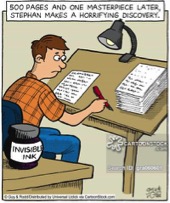
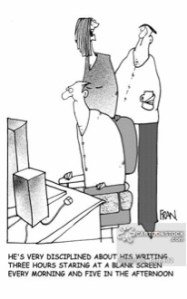
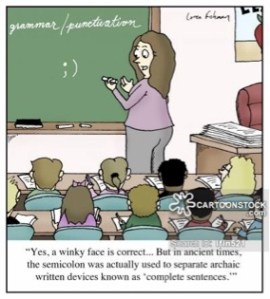
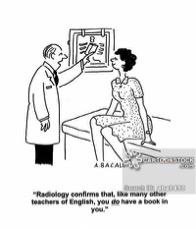
     Here are more humorous pics about writing:

untitled untitled1 untitled3 untitled4 untitled5 untitled6