A Few Tips about School Visits


 A Few Tips about School Visits

Natalie Bright

Like most parents, I have volunteered at the school to help with book fairs, teacher appreciations, band boosters, and fundraisers. I started writing when our sons were in elementary school. I had visions of volunteering at the book fair one day where my book would be sitting on the Scholastic cart. As you can guess, the publishing industry rarely coincides with an author’s big dreams.

The reality is I finally have several children’s books out, but both boys are too old to read them. Our youngest is a high school senior this year, and I continue to volunteer as a parent at the local schools, but work in a slightly different capacity. I’ve changed my focus to writing and reading. This year I’m offering a free power point workshop on writing to the schools in our district. Even more fun, is the added bonus of having the star of one of my books, a rescue horse named Flash and his trainer, participate in some of the events as well.

We’ve got six programs under our belt now. Here are a few things to consider about book promotion on a local level.

  • Reach out.

Clubs, organizations, and schools are desperate for programs by authors. With fees in the $1000 and up range for most nationally known bestselling authors, school budgets can only afford these type speakers every three to five years.

Reach out to everyone you know and find contact addresses online.  Does your local library have events that you can participate in? Send school and public librarians a postcard or flyer and make it easy for them to contact you. Be flexible and work with their schedule. Herding 700 kids in and out of the library takes some skills, but it is doable. I try to make myself available on a one-to-one basis as well. Be friendly and approachable for teachers and kids. At the end of the day, you’ll be exhausted and inspired.

  • Shine and Sparkle

Kick some booty on the very first gig. Wow them and give them more than they expected. Develop a powerful, informative presentation that enhances the school curriculum. Word will spread.

  • Be Open to Criticism.

I have tweaked my program several times based on feedback from librarians, teachers and principals. I always ask the librarians three main questions at every school visit, “What are your kids reading? Did I connect with your kids? How can this be better?”

I learn something from the students as well. In the first part of my program, we go through a series of slides about everything that writers write. According to a very attentive third grader, guess what I had left out; graphic novels. These are hugely popular with kids today. Based on questions, I also added pics of my workspace and of my co-worker, Kitty, our cat.

  • Kids Are Visual

Use lots of pictures of young people in your power point. Kids today are very visual. Everything is photos, movies, video games, YouTube, and pics of their friends on snapchat. Your presentation must have relatable pictures. There is not one image of any adults in my 30-minute presentation.

  • Kids love FREE things

Send a bookmark home which includes your book covers, website, Instagram tag and ordering information. Include the name of your local book store that carries your books. They may not purchase a book on the day of your author visit, but believe me, kids will remember you. They will point you out to a parent at the grocery store. Have books in your car.

What’s popular with the kids in our school district, you might be wondering? Interestingly, every elementary school has been different. Graphic novels, particularly ones about real historical events, wouldn’t stay on the shelf. The school last week loves horror and scary stories, so the GooseBumps series is always checked out. The school this week is reading mostly Big Foot and alien stories, even the girls. Who knew, right? Harry Potter holds  no interest for this upcoming group of elementary aged readers. And girls have turned their backs on typical “girlie” type stories like the Barbie series which used to be very popular.

The interesting point that I have learned is that kids talk about their favorite books, just like adults do, and you’ll see those patterns from the books they check out. Two friends will read a book, and they tell their friends, and they tell others, and so on. BUZZ and word of mouth still works.

Start locally. With a little effort, you can make your book the BUZZ of the schools in your area.

Natalie Bright is the author of the nonfiction Rescue Animal series, easy readers featuring two rescue horses, Flash and Taz. Her Trouble in Texas series is a wild west adventure for middle grades set in the Texas frontier. She also writes women’s fiction. To see pictures of author events, go to Instagram.com @natsgrams Nataliebright.com
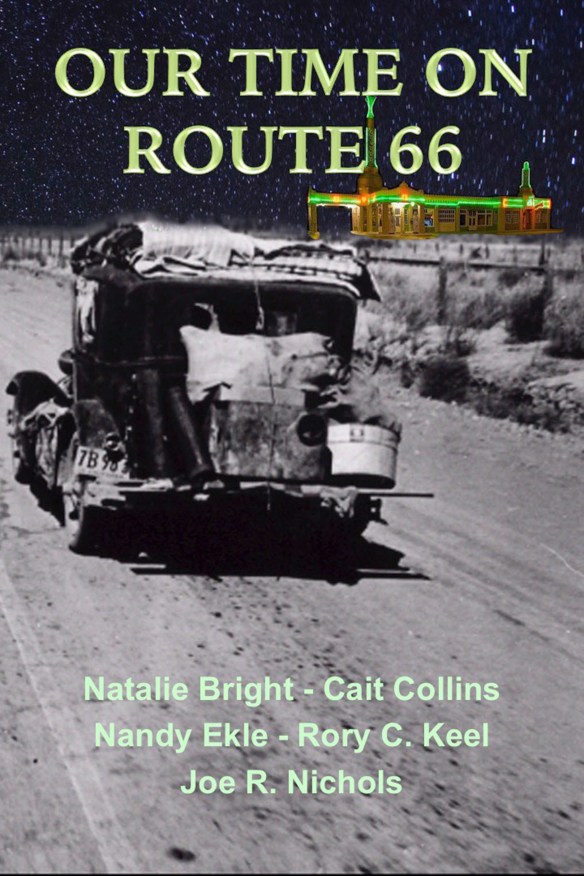
 

OUR TIME ON ROUTE 66


OUR TIME ON ROUTE 66

Five unique short stories and novellas set on historic Route 66 in Texas:

  • A gripping story of family betrayal, deep despair, and a young girl’s courageous triumph. MAGGIE’S BETRAYAL by Natalie Bright
  • A young soldier leaves his new bride for war sharing their life through letters in this heartfelt story. WAITING by Rory C. Keel
  • A down-on-his luck cowboy sees opportunity in a young widow’s neglected ranch in 1944 Texas. SUDDEN TURNS by Joe Nichols
  • A Cherokee Chief predicts Mora O’Hara’s future as she travels The Mother Road seeking closure after a career related tragedy. SHOWDOWN AT U-DROP INN by Cait Collins
  • Raylen Dickey learns the difference between her friends, lovers, and enemies. FEAR OF HEIGHTS by Nandy Ekle


Five authors tell five different stories, through five different time periods, and all crossing the same place—the Tower Station and U-drop Inn.

Read it now!

Amazon       Apple iBooks        Barnes and Noble

Carpe Diem Publishers

OUR TIME ON ROUTE 66


OUR TIME ON ROUTE 66

Five unique short stories and novellas set on historic Route 66 in Texas:

  • A gripping story of family betrayal, deep despair, and a young girl’s courageous triumph. MAGGIE’S BETRAYAL by Natalie Bright
  • A young soldier leaves his new bride for war sharing their life through letters in this heartfelt story. WAITING by Rory C. Keel
  • A down-on-his luck cowboy sees opportunity in a young widow’s neglected ranch in 1944 Texas. SUDDEN TURNS by Joe Nichols
  • A Cherokee Chief predicts Mora O’Hara’s future as she travels The Mother Road seeking closure after a career related tragedy. SHOWDOWN AT U-DROP INN by Cait Collins
  • Raylen Dickey learns the difference between her friends, lovers, and enemies. FEAR OF HEIGHTS by Nandy Ekle


Five authors tell five different stories, through five different time periods, and all crossing the same place—the Tower Station and U-drop Inn.

Read it now!

Amazon       Apple iBooks        Barnes and Noble

Carpe Diem Publishers

Patience


Outtakes 359

Patience

By Cait Collins


Our Director sent an email the other day that really made me think.  It went something like this.  “Patience is not the ability to wait.  It’s the ability to keep a good attitude while you wait.”

I’ll admit patience is not one of my stronger characteristics.  I’m better than I used to be, but I’m still not where I want to be.  As a writer, I’ve tried to develop my patience.  But this can be a frustrating business.  I’d submit a novel or a story and get these really nice rejections.

“We’re sorry, but your story, while interesting, does not meet our needs at this time.”

Or, “You have potential, but may I suggest…”

Don’t get me wrong, I appreciate the constructive ideas, but sometimes I just wanted to know what I was doing right.  And then a friend would get a first publication and I’d wonder why him or her and not me.

I finally found an answer that helps me.  It’s just not my time yet.  So what do I do to keep from shooting my computer?  I’ve thought about papering my walls with rejection letters and pages from rejected manuscripts.  Unfortunately, my apartment complex does not approve of my decorating idea.

I rewrote a novel and realized the second version was a vast improvement over the original.

I killed off a major distraction in a blog.

I edited a finished work.

I read.  Not just romance, but mysteries, and selected non-fiction.

I meet with my critique group.  They can pick me up when I’m down.

I tell myself that I’m a good writer and someday I’ll have that book contract. Someday.

I really try not to be discouraged.  I try not to let the disappointment make me impossible to be around.


Elbow Grease Required


Outtakes 358

Elbow Grease Required

By Cait Collins

My co-worker attached a really great saying to her morning report.

Faith doesn’t make things easy.

It makes them possible.

This statement makes sense to me.  It’s not just in reference to religion or philosophy, but also to our dreams and aspirations.  For example, I believe I have the talent to write.  I’ve made my living writing training manuals, commercials, sales handouts, news, and television programs. I know I can write.  I have faith in my talent.  But that belief will do me no good until I act on it.

Maybe I can write.  Maybe I have the words circling through my head and colliding into each other.  However, if I don’t put the words on paper, if I don’t seek to develop my craft success will not be possible.  Yes success is possible, but not without effort on my part.  I have to provide the elbow grease to achieve my goals.

And just because I believe or have faith in my abilities and I apply myself to enhancing my gifts does not ensure success.  There are often outside forces that throw a monkey-wrench into the plan.  Believing in myself, setting reasonable goals, and working toward them makes success possible. We also have to learn to navigate around the roadblocks.

Catch Up


Outtakes 357

Catch Up

By Cait Collins

Ten days of vacation really put me behind.  I’m behind at work and with my writing. While I was relaxing on the beach, I started my next Route 66 story.  I like the idea, and I’m bringing back Ian Thornton from Showdown at U Drop Inn.  I figured he deserved his own story, but will he get the girl in the end? I really don’t know as he hasn’t told me yet.

Yes, I’m one of those people who have conversations with my characters.  It’s really unnerving to feel “the Presence” looking over my shoulder and saying, “Cait, I wouldn’t do that.  And just so you know, I hate broccoli. “

Ian’s a pain when I’m at work.  I have a list of letters to review before mailing and suddenly this magnificent Irishman starts telling me I need to be researching vintage pottery and china. “And by the way, you need to visit a potter’s workroom.  Your’ description of the process is a little weak.”

I start arguing.  “Really, Ian? When do I have time?  I’m working overtime.  I have commitments.  Give me a break and let me catch-up.”

Good heavens.  I’m arguing with a figment of my imagination!  Maybe I should go back to the beach.

Snowflake Method Step 6 (cont.) -e


Snowflake Method Step 6 (cont.) -e

by Adam Huddleston

This week, I am continuing Step 6 of the Snowflake Method.  See my previous blogs for explanation on the process. Here is the second paragraph of the one-page plot summary:

Before each game, Dwight Lara, the Yellowjackets’ possible savior, performs a ritual of dark magic.  In order for the spell to work, a human life must be sacrificed, resulting in the death of a fan sometime during the game.  The deaths occur in a variety of ways, and while the public begins to view the Yellowjackets as an “unlucky” team to watch in person, no one suspects their new player.

Dwight Lara, all one-hundred seventy pounds of him, slid into the locker room like a cold shadow.  His smile was infectious. He nodded to each of his new teammates in turn, then quietly set about placing his new gear in the small locker assigned to him.  


THESAURUS


THESAURUS

Natalie Bright

One well-known author is quoted saying that if you have to look up words in a thesaurus, then it’s the wrong word. As a writer juggling a day-job and family, as many of you are, I think having word lists handy are a life-saver. Sometimes I know the word, but it’s late at night and the right word just doesn’t come. The only option is to reach for help.

Here are two of my favorite that I’ve found extremely helpful.

THE EMOTION THESAURUS by Angela Ackerman & Becca Pugllisi.

“A Writer’s Guide to Character Expression” is an alphabetical list by emotion. The term is defined by physical signals, internal sensations, mental responses, and signs of acute cases. I kept writing that my character feels nervous, but I wanted to show her nervousness. The list of physical signals is lengthy and can be used throughout the scene. This is a comprehensive tool that writers of every genre would find useful.

CHILDREN’S WRITER’S WORD BOOK by Alijandra Magilner & Tayopa Mogilner

If you write for children, a grade-leveled word thesaurus is particularly handy. This one has word list groups by grade and reading levels for synonyms.

Happy writing!

Snowflake Method (cont.) -D


Snowflake Method (cont.)

by Adam Huddleston

This week continues Step 5 of the snowflake method for writing created by Randy Ingermanson.  For more details, see my previously submitted blogs.


Stephen Craight-

For as long as I can remember, I’ve been in love with the game of baseball.  My father made sure I had a bat (crochet) in my hand as I lay babbling in the crib.  Once I turned three, I was pushed into a toddler’s league where the coach was thrilled just to have one of his players not stagger away with the ball in his mouth.

I played every year, watching as my skills improved to the point where I was eventually offered a scholarship to play at Louisiana State University.  From there I was drafted by the Cleveland Indians and placed in their farm system. Although my time in the majors was short, I made a strong enough impression that the White Sox gave me an assistant coaching job once my playing career was over.

The first time I met Dwight Lara, I was skipping the Amarillo Yellow Jackets, a small but talented semi-pro team in the Texas Panhandle.  I remember him being a tall, lanky kid. From the Bahamas with skin as dark as midnight. Not a bad outfielder and the kid could hit.

We were at the halfway point of the season, the time of year the majors play their all-star game.  The Jax weren’t even sniffing contention. We brought Lara in and our season turned around immediately.  We didn’t win every game, but most of them. Week by week, the boys began creeping up the standings.

Something pretty morbid was starting to happen though; folks were dying at our games.  I mean, actually dying. It was just a handful of fans, but the crazy thing was, they only passed during the games that we won. The police never got involved with the team, because the causes of death were always outside of our influence.  Some had health-related issues, some choked on food, a couple were due to stadium security. It was sad, but…we were winning.

Before a game one night, I remember it was the last part of a homestand, I couldn’t find a clipboard to attach the lineup sheet to.  When I checked the seldom-used room at the back of the locker room, I saw something I later wished I hadn’t. Lara was kneeling on the floor, facing away from me.  In front of him was this…idol, I guess is the closest term.  He was whispering something over and over, kind of a chant.  The kid must have heard me behind him, but when he turned around, he didn’t look startled in the least.  Just calmly nodded at me then turned back to what he was doing.

I put two and two together and figured he was responsible for the deaths somehow.  I felt bad about it, but I let him keep doing his thing.

Winning is addictive.

Well, we made it to the championship series, and one night Lara comes to me and tells me that he’s suddenly grown a conscience.  Says he can’t perform his spells anymore. I told him real quick that unless he wanted me to rain down destruction upon him (and his family), he better keep it up.  He refuses so I contact a man I knew from my days in Chicago. He knows a guy who knows a guy, and such. The next thing I know, this goon is knocking on my front door at home and offers to “take care” of Lara’s son.  It was my final mistake in a history of bad mistakes.

The last game of the series, I get word that this guy has offed Lara’s kid somewhere in the stadium.  We end up winning the game, but before the confetti has even had a chance to set in the outfield grass, Lara finds me and takes me out.  The kid separates my melon from my shoulders.  After that, everything is dark.


Learning Online with MasterClass


Learning Online with MasterClass

Natalie Bright


As I write book #2 of the Trouble in Texas series, I’m watching MasterClass with R. L. Stine during lunch breaks. Stine is the author of the Goosebump Series for kids.

Learning online at MasterClass.com is easy. The first class I took was James Patterson, which is an excellent video series about his writing process. Also included in the price is a workbook which you can print or download. The short videos fit into my already busy day.

Although I do not aspire to be a screenwriter, I paid the additional fee for the All Access Pass to unlock every class. I’ve just finished learning about character development from Shonda Rhimes. Listen to her as she breaks down the inspiration and writing process for her characters in Grey’s Anatomy and Scandal. Go back and watch the pilots for each show. It’s fun to witness genius at work.

Lunch breaks are spent at my desk watching R. L. Stine’s videos, and I print the PDF worksheets from each short segment, jotting notes of the specific changes I’ll need to do to improve my story. I work on edits when I get home.

Interestingly, R. L. Stine does not keep an idea journal. Using character and plot ideas, he formulates a chapter outline. He most always knows the ending before he starts, and then he writes from that outline until it’s done. The key word here is DONE. Finished. The end. I can never get there because I give in to the many ideas swirling in my head. My process is to stop, start this, and then jot notes about that. Those days are over. I’m going to finish final edits on Book #2 of the Trouble in Texas series, THE GREAT TRAIN CAPER, before I start something new.

Mr. Stine has been very inspiring. One class costs $90, and the all access pass is $180 per year. I’ve discovered I didn’t have time to read the writing magazines I used to subscribe to several online magazine, and attending SCBWI conferences is a huge investment. If you want to learn more story craft, consider MasterClass. Next up for me on MasterClass.com: Judy Blume.

Happy writing!