A Literary Analysis of Stephen King’s Writing: Part 1


A Literary Analysis of Stephen King’s Writing: Part 1

by Adam Huddleston


“What? Seriously? We get it Adam, you’re a fan of Stephen King. But he’s a hack! His work isn’t deep or meaningful! He’s a cynical writer with very little to contribute to the overall tome of literature!”

And he’s one of the best-selling authors of all time.    So, say what you will, he must be doing something right.

Over the next few weeks/months, I plan on doing a general overview of what I believe makes Mr. King a successful writer. Notice I didn’t say a superior writer, just a very popular one. These blogs will be swimming with my personal views and opinions. Although I am by no means a professional critic, I feel that I’ve spent enough time in Mr. King’s writing to back up my thoughts with legitimate reasoning. So, let begin.

What does Stephen King do well? What are his writing strengths and (without completely imitating them) what can we draw from his work to improve our craft?

I believe his genius comes out in his character creation. He has the ability to create memorable heroes and villains with just enough backstory to make you care about their struggles without slowing the pace too much. Characters like Pennywise the Clown, Cujo, and Christine are as well known in American culture as Wyatt Earp and George Washington!

Mr. King is also able to throw those full characters into the most imaginative situations. His work, while generally classified as horror, steals a bit from the fantasy, science-fiction, and western genres as well. As you can imagine, when you mix these fields together, a mother-load of strange circumstances can occur. It is these odd occurrences which he throws his protagonists into that keep his “Constant Readers” turning the page.

Next week:

His plotting style and proliferation.

Rookie Mistakes in Writing


Rookie Mistakes in Writing

by Adam Huddleston


As an aspiring writer, I am well acquainted with the myriad of mistakes that a young scribe can make (and truth be told, I still make them all the time). These can range from poor word selection to inappropriate story pacing. For the newbie like me, here are a few pitfalls to avoid:

  1. Don’t over/underuse adverbs and adjectives. Descriptions are wonderful for your writing, they make the scene stand off the page, but using too many will bog the story down and lead to a weak overall reading experience. Instead, opt for a sharper word selection.
  2. Alter sentence length depending on the events in the story. Exposition can afford to be a bit longer but action scenes should contain quick, powerful sentences that drive the narrative forward.
  3. Keep your promises. If you lead the reader to believe something concerning a character or event, make sure you stay true to it or the reader will feel cheated. For example, if you imply that the antagonist is planning something evil and dangerous for the hero, have him do it! Also, if your story has a twist ending, make sure it is still a reasonable one. Avoid the deus ex machina.


Hopefully, you will find these helpful in your writing!

Funny Pics about Writing


Funny Pics about Writing

by Adam Huddleston


This week I thought I’d just share a few humorous gifs about writers and the work they do.

00688-funny-cartoons-writer

flat,800x800,075,t.u3

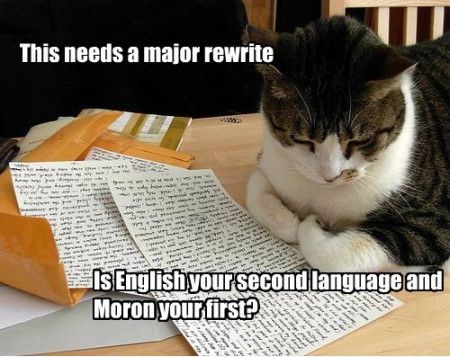
Funniest_Memes_this-needs-a-major-rewrite-is-english-your_9562

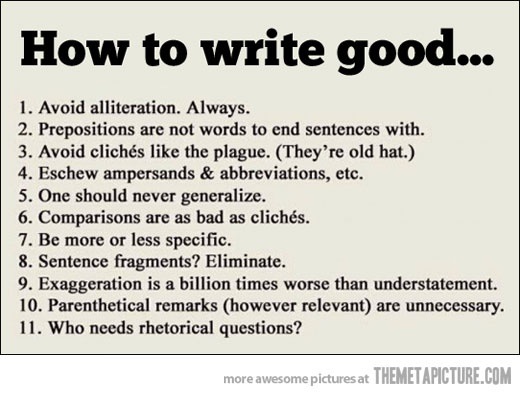
how-to-write-good

Happy writing!

Procrastination


Procrastination

by Adam Huddleston

     Procrastination.

It may not be the hallmark of all great writers, but I’ll bet it pokes its little head around the corner in the minds of most. It’s easy to do, and if done frequently, it can lead to a serious backlog of work. So, what can be done to curtail this bane of efficiency? As it pertains to writing, I believe there are two main weapons:

  1. There are a plethora of tools available to help a writer keep on track. Most smartphone and computer software has scheduling options that will send alerts at specified times. One writer’s software I’ve used in the past and highly recommend is Scrivener. You can set a certain word count and deadline and it will calculate how many words per day are needed. Very helpful!
  2. Fellow writers. It can be quite beneficial to have other writers’ encouragement when you have a project that needs to be finished. They are usually in the same boat and can easily relate.

Hopefully you can use these tools to help meet deadlines easier. Happy writing!

Flash Fiction


Flash Fiction

by Adam Huddleston


Have you ever read a story so short you could finish it while standing in line at Wendy’s? Believe it or not, there is a format of story-telling so quick you could potentially read several of them in that period of time. Of all the existing designs of fiction writing, the one I have the most experience with is flash fiction.

What is flash fiction? In its simplest sense, it is an extremely short work that still contains character and plot. Word count can range from just a few words to around one-thousand (beyond that, you are walking in the land of the short story).

With such space restrictions, each word must be chosen carefully to maximize its impact in the story. There is little to no room for exposition so any backstory or explanations should be inferred or easily deduced by the reader.

The story should possess a discernible plot, even if it leans toward the simple or basic. A hallmark of flash fiction is the twist ending. Having a plot with a surprising climax makes up for the scarcity of words and lends itself to a more enjoyable experience for the reader.

I’ll conclude with a brief and shameless plug. Over the past several years, I have been a frequent contributor to a flash fiction website which I now moderate (www.site.flashfiction5.com). The site hosts a monthly contest where participants may submit a work of flash fiction, one hundred words or less, that must contain a specific list of words which are updated each month. It is completely free to enter and the two winning stories are posted the next month. I look forward to seeing your work!

Happy writing!

Lay vs. Lie


Lay vs. Lie

by Adam Huddleston


Ah yes, the bane of all writers. Well, maybe that’s a bit of an overstatement, but at some point most writers have come across this puzzle. Which form should I use? Does it matter? Actually, it does. Here is a quick refresher for those interested:

Use lay when the subject is setting something down. Ex: I lay the spider in the fireplace.

Use lie when the subject is the one lying. Ex: I lie down in the coffin.

In the past tense, “lay” becomes “laid” (Ex: I laid sod in my yard last week) and “lie” becomes “lay” (Ex: Mary lay in her new bed last night). Confused yet?

One more note, if helping verbs are involved (past participle form), “lie” becomes “lain”. Ex: The dragon had lain on her egg for eternity. However, “laid” is still the past participle form of “lay”. Ex: Susan had laid the gun down on the table.

Poetry


Poetry

by Adam Huddleston

Before I began earnestly attempting to hone my craft through flash fiction, short story, and novel creation, I wrote a fair amount of poetry. Most of it was the sticky, sappy stuff relegated to the realm of love poems to my significant other. A few were decent; not good, but decent. It was the writing of poetry that opened up the creative channels in my brain needed for creating more complex works and I highly recommend all writers trying their hand at it from time to time. Why?

First of all, writing poetry forces us to examine the depth of the world around us. Poems are full of the color, love, hate, and beauty that make up our lives. It is a generous heart, open to criticism and examination that lets the world in to see its feelings.

Another reason to place poetry in your portfolio is that it exercises some of the mental muscles we don’t often use (just try finding a good rhyme for “elbow”). The poet must constantly be working to make sure the flow of the words is lyrical, otherwise it is just prose.

Finally, the process of writing poetry is fun. You can make your poem serious, loving, scary (I’m looking at you, Poe), or funny. It gives a nice change of pace to those of us struggling to churn out a longer work.

Happy writing!

Nocturnal Descriptions


Nocturnal Descriptions

by Adam Huddleston


During a recent bout of insomnia, I lay in bed thinking of ideas for my blog. It finally occurred to me: A lot of writing is focused on describing what the characters see in the world around them, but what if we focused on the other senses that we use at night?

Try this experiment: Lay flat on your back in bed, the later the better. Very few bedrooms are in total darkness. What light is available? Where does it come from? Does it produce any oddly-shaped shadows in the room? Do you feel anything other than the bed-sheets (overhead fan, air-conditioning vent, etc.)? What do you hear (dog barking outside, significant other breathing next to you, refrigerator compressor, etc.)? Any smells (garbage from nearby kitchen trash can, vented air freshener, etc.)?

When your sight is diminished, your other senses can pick-up on lots of things you may not think about. Hopefully these will help you in honing your craft.

Happy writing!


The Writing Space


The Writing Space

by Adam Huddleston


Every writer who ever used pen and paper, a typewriter, or a computer, needed a space to write in. The locations are as varied as the individuals creating the work. This week, I would like to share with you my writing space and why it works for me.

The ideal locale to create in is one with little distraction. Generally speaking, the human mind can only concentrate sharply on one item at a time. I would like to say that my home is the quietest, most peaceful place in my life, but with four lovely, energetic children, it can be anything but. I mean, who can deny a beautiful one-year daughter when she crawls to you and stretches out her arms? Exactly.

So, I have found that the best space for me to write in is my computer station at work. As a pharmacist, I stand in front of a monitor all day. While there are ringing phones and medical questions to distract me (it is my job after all), I still find a few breaks in the action to get some writing work done. Maybe having my brain warmed-up helps with the creative process. I also find that interacting with the general public provides me with a plethora of character ideas.

My advice is to try writing in a few different places and see which locale works best for you.

Happy writing!

The Thrill


The Thrill

by Adam Huddleston


“There is no terror in the bang, only in the anticipation of it.”

                                                        -Alfred Hitchcock


For works in the horror or thriller genres, the high point of the story comes with a bang; the killer is revealed, the hero is murdered by the antagonist, the kidnapped girl is finally discovered. Fans of these types of books and movies are usually drawn more to the build-up of tension rather than the climax. So, if someone were inclined to pen a horror/thriller short story or novel, what methods could they use to increase this anticipation?

  1. Give small bits of information as the story goes on. It stands to reason that the reader does not want the ending spoiled and feels more involved if they can try to answer the puzzle themselves.
  2. Make sure that the reader cares about the character that is in danger. The closer they feel to them, the more “terror” they will fell as the climax approaches.
  3. Set up the “thrill-causing” events of the story in order of increasing dread. By the time the bang arrives, the reader should be flying through the pages.

Hopefully, I’ve given enough advice to help you in crafting your suspenseful story. Happy writing!